About Us · Texas
A repair-first emergency roof crew, working out of Austin, Texas.
Most roofing pages are trophy shelves: founding years, award logos, big promises. This one is different. It tells you how we work, what we will never do, and how to check us before we climb. If water is coming in right now, skip the reading and call (512) 555-0147. A roofer answers, day or night.
Crews working from the towns they live in, not a call centre three states away.
Emergency Roof Repair Texas is a repair-first emergency roofing crew based in Austin, Texas. We stop the water first, show you photos of the part that failed, and fix the smallest thing that truly holds. This page is our method in the open: the promise, the steps, the lines we will not cross, and the questions you should ask us.
Who we are
We are a Texas roofing crew built around one kind of work: the emergency. Not the planned remodel, not the new build. The drip that starts at 2 a.m. The limb that comes through the deck in a storm. The ceiling stain that spreads while you stand there watching it. That is the work this whole site is about, and it is the work we are set up for, with tarping gear on the truck, ladders that reach real roofs, and people who trace leaks for a living.
Repair-first is the short version of us. Most roofing companies earn their money on full replacements, so every visit leans that way. We run the other way. A repair is a real job here, and the smallest fix that truly holds is the right fix. That one choice shapes everything else on this page: the photos, the written scope, the plain talk on the phone.
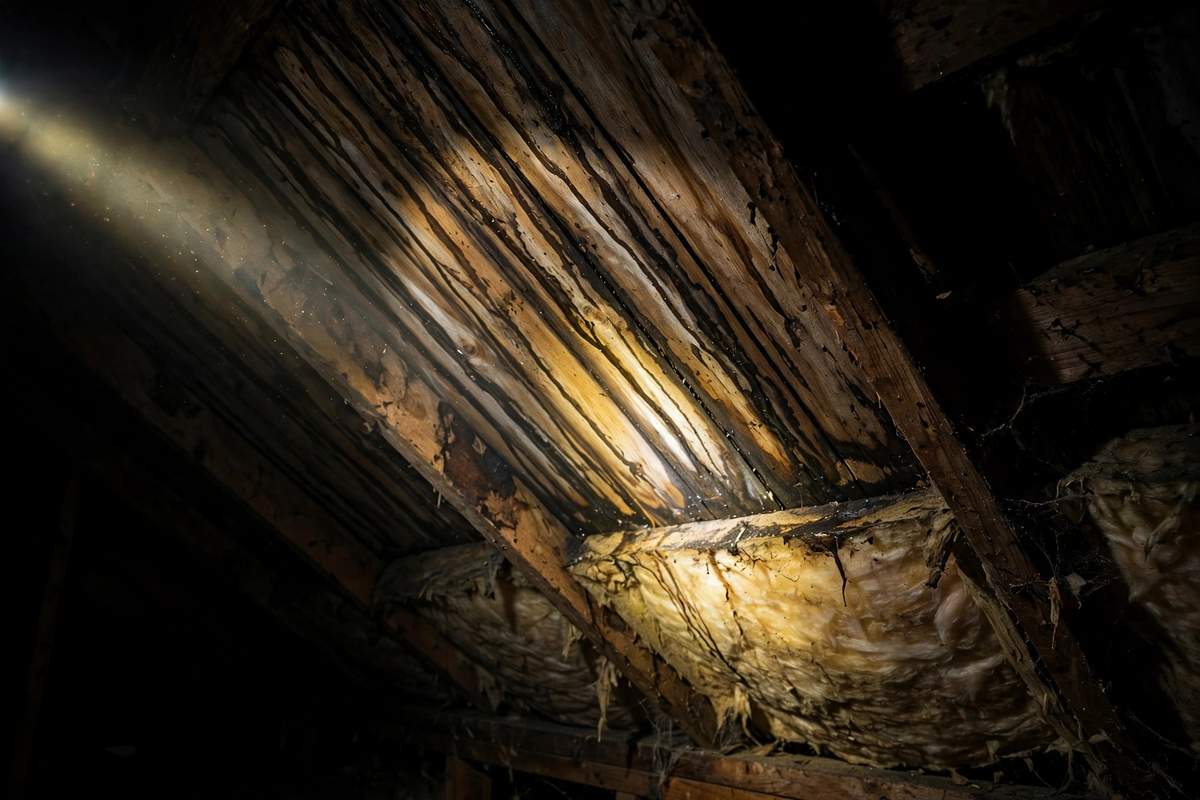
Half of leak work happens indoors. A stain spreading across a ceiling, a soft spot in the drywall, dark streaks on the attic boards: that is where tracing starts, because the wet spot is rarely under the hole. We check the attic side when we can get in, follow the water uphill along the boards, and only then climb. It is slower than guessing from the driveway. It is also why our repairs land on the part that actually failed.
We work out of Austin, and our crews work the towns they live in: Buda, Pilot Point and Plano each have their own page on this site. Local is not a slogan for us. It is a working fact. The crew that covers your roof tonight is a crew you can still reach next month, on the same number, long after storm season has moved on.
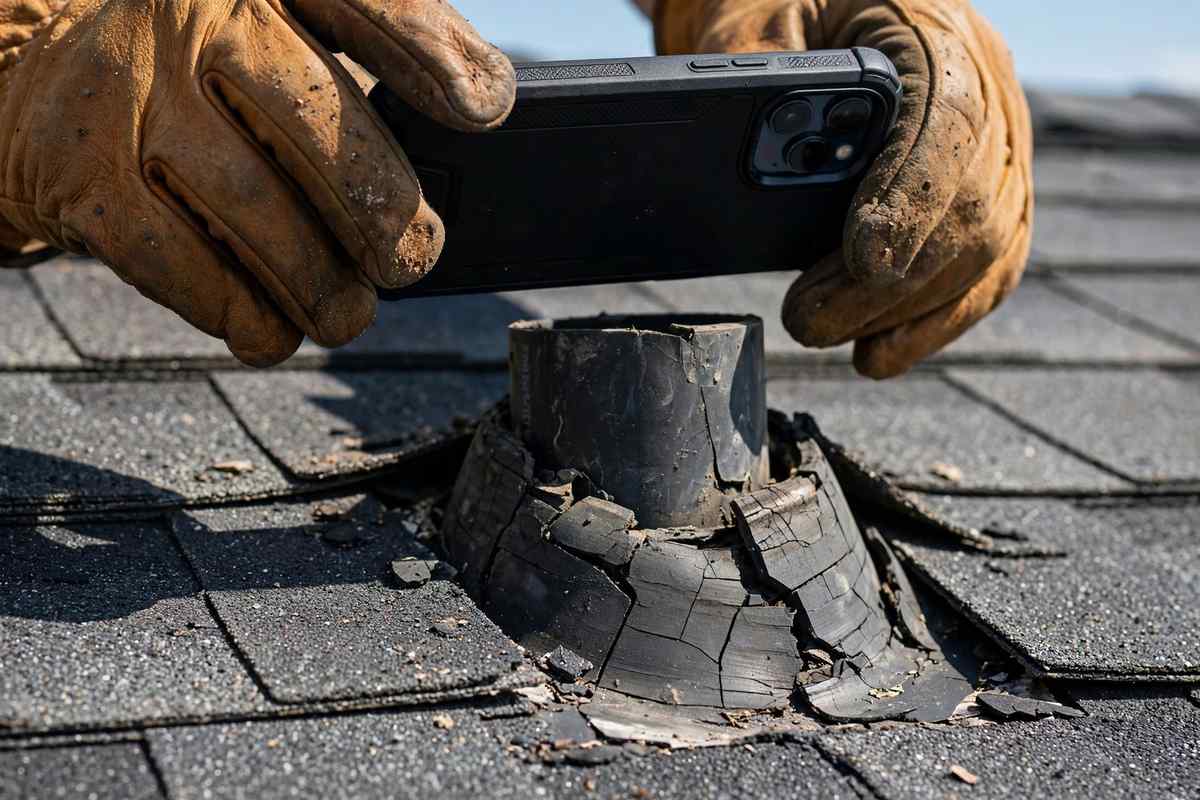
So this page will not hand you a founding year, a trophy shelf or a wall of badges. None of that tells you whether a crew will photograph your cracked pipe boot or invent a whole slope of damage. We would rather spend the page on things you can check: our method, our promises, and the questions you should ask any roofer in Texas, us included, before anyone climbs.
Our promise
The honest ending to most emergency calls is a repair, and we are glad of it. Where a patch and a resealed flashing will do the job, that is the job we will put in front of you, with the photos alongside so the call is yours. We do not dress small damage up as a disaster. And when a roof really has reached the end, the pictures make that plain without any help from us. Nobody here will ever rush you with a ticking clock.
The reason is plain money logic, so here it is in the open. A full replacement pays a roofing company far more than a repair does. A company built on replacements starts to hear every leak as a roof at the end of its life. We built the other way. When one pipe boot has cracked, replacing the whole roof does not fix the boot. It buries it inside a much bigger job.
Repair-first cuts both ways. Some roofs have nothing left worth repairing. When every slope is brittle, a patch holds a month and the leak returns with the next storm. Paying for that patch over and over is not thrift. It is one problem billed three times. If we find a roof like that, we walk you through the photos slope by slope and leave the decision with you, today or next week.
Judge the promise by its paper, not by our tone of voice: photos before and after, a written scope before any permanent work, and the failed part shown to you, in your hand or on your screen. A promise you can check beats a promise you have to take on trust.
Hold us to all of it. Every line on this page is a standard you can read back to us on the phone, at the door, or a month after the job. If we ever miss one, the photos and the written scope will show it. That is exactly why we work this way.
How we work
Every call runs the same four steps, whether it is one torn shingle or half the roof in the yard. The order never changes, and here is why each step sits where it sits.
Rain comes first, repair comes later. Our opening move is to close the roof up: cover the open spot, seal it, and leave the house weather-tight so the damage stops growing. On a dark call that might be a tarp put on properly at night, battens included, or a tight patch over the break. We judge it one way: once we climb down, is any water still getting in? It should not be.
First the roof gets made safe to stand on. Anything loose comes down, and nobody works beneath a damaged section. A hanging limb gets secured, or stays exactly where it is until it can be moved properly. Cracked boards get marked so no boot lands on them. From the yard this can look unhurried. It is what lets the work after it move fast and go well.
Then we show you what we found, while we are at your house. Every failure gets photographed: the split boot, the flashing that has lifted, the hole a limb punched through, and the cover now sitting over it. We talk you through the pictures in plain language. Anything too awkward to photograph comes down the ladder and gets put in front of you instead. In this trade, showing is not a courtesy. It is half the job.
Last comes the lasting repair, and it never starts on a handshake. Once the roof has dried out and been checked over properly, we write the job down as a scope first: which parts, what work, in what order. You read it before anything permanent is done. And if the dry check turns up damage the night visit could not show, that goes in the scope, with photos, before extra work is discussed.
Plenty of crews repair first and explain never, and you end up dry but none the wiser. Others open with a pitch and you stay wet while they talk. Our order runs the other way: water stopped, roof made safe, proof in your hands, then the repair. Book a visit on (512) 555-0147 and that is the sequence you get, every single time.
After the visit, the photos are yours to keep and the scope stays on paper. We will also tell you what to watch for in the next few rains. A stain that stops growing was the leak we fixed. A stain that keeps spreading is a phone call we want to get. All it takes from you is one look at the ceiling after the next rain.
Our lines
Every crew has lines. These are ours, written down so you can hold us to them.
None of this is hard to promise, which is exactly why it is worth writing down. Storm weeks bring out the worst habits in this trade: the knock on the door, the dramatic pause on the ladder, the offer that expires at midnight. If a crew needs your signature before you have seen a single photo, the crew is the problem, not your roof.
If another crew has already been out and the story felt too big, you can still call us for a plain second look. We will photograph what we find and say what we would fix. And if the first crew was right, we will say that too.
Check us properly
Start with the fact most roofing pages slide past: Texas has no state licence for roofers. There is no state board, no licence number to look up, no card that proves a roofer is trained or straight. When a crew hints that a state licence stands behind them, that wording is decoration. It sounds official. It checks nothing.
So how do you vet a roofer in Texas, us included? By evidence. These are the same six questions from our homepage, the ones our crews answer before anyone touches a shingle. Ask them on the phone. Ask them at the door. Judge the answers hard.
Any roofer who gets annoyed by these questions has just answered them. This is the closest thing Texas has to a licence check, and we are glad to be measured by it. It is also why this page carries no badge wall: in a state with no licence, the only credentials worth anything are the ones you can verify yourself, on your own roof, with your own eyes.
Service areas
Our crews work from the towns they live in. Austin is the base. These places have their own pages, with their own local details:
This is where the crews are based. Summers here cook pipe boots until they split early, and the storm season is not gentle. Half the city sits under live oak, so fallen limbs and valleys choked with leaves keep us busy all year.
New streets keep going up here, storms keep coming, and we are only twenty minutes away. Most roofs are young, and young roofs rarely fail out in the open field. They fail at the small parts: a split boot, lifted flashing, the seam where an addition joins the house.
Lake wind, older roofs, and leaks that hide for months. Slow, hidden leaks are the local pattern, so tracing matters more here than speed.
Large houses under tall trees, in a part of Texas hail knows well. Broad slopes and high rooflines add up to extra flashing, extra valleys, and extra weak points for wind-driven rain to find.
Do not see your town here? Call (512) 555-0147 anyway. If your roof is beyond where we can reach in time, you will hear that from us straight away, not after hours of waiting on a maybe. An honest no at the start beats a hopeful maybe at midnight.
The work
Emergency work arrives in four shapes. All four are welcome, and the smallest of them is not too small.
Water stopped tonight, the roof made safe, and the permanent repair scoped once everything is dry and checked. This is the core of what we do, and the homepage walks through it in full. Emergency roof repair in Texas →
Wind, hail and fallen limbs. The full check, ridge to gutters, then the fix. A storm tests every slope at once, so the check has to be just as wide. Storm damage roof repair →
A tarp fitted flat, tight and battened down, so it holds until the repair instead of shredding in the next wind. Fitted well, a tarp buys about 30 to 90 days of cover. Emergency roof tarping →
Tracing first, sealing second, so the same drip does not come back next storm. The stain is rarely under the hole, and finding the real entry point is the whole craft. Roof leak repair →
And the small end of the work matters as much as the big end. One cracked boot. One lifted flashing. One patch of shingles torn off above the porch. Plenty of crews walk past jobs like these on their way to a replacement. We take them gladly, because a small leak fixed early is a ceiling that never bulges, insulation that never soaks, and a call you never have to make at 2 a.m. again.
What we do not take on: new construction, planned remodels, and work outside our ring. That is not modesty. It is how the emergency side stays fast. A crew booked out on planned work for weeks cannot answer a 2 a.m. call, and we would rather be plain about the work we are built for.
Not sure which shape yours is? That is normal, and it is not your job to know. Describe the sound, the stain or the drip on the phone, and we will sort it with you. Our guide to what counts as an emergency walks through the same test, and the contact page is there if you would rather write it down.
Questions about us
The questions people ask about the crew itself, answered the way we answer them on the phone:
Yes. Our crews work from the towns they serve, with Austin as the base, and the number on this page is answered by a roofer, not a call centre. We would rather cover a smaller area well than promise the whole state and keep you waiting.
No. Most emergency calls end with a repair, and that is the outcome we aim for. If a patch and a sealed flashing will hold, that is what we will recommend, with photos so you can judge. If a roof is truly worn out, the evidence will show you.
Small jobs are welcome here. One cracked pipe boot, one lifted flashing, one patch of torn shingles: that is the heart of emergency work, and a repair is a real job to us. Call (512) 555-0147, describe what you see, and we will tell you plainly what it needs.
No. Texas has no state licence for roofers, so no card or truck sign can prove a crew is good. Judge roofers, including us, by evidence instead: photos of the damage, a written scope before work starts, plain answers, and a local number that still answers after storm season.
Photos, before and after, plus a written scope before any permanent repair starts. You will see the exact part that failed, what we did about it, and what we left alone on purpose. If something cannot be photographed, we bring it down and show you in person.
Call the same number and tell us. A repair that starts leaking again at the same spot is our problem to come back to, not yours to pay twice over. We would rather return and fix our own work than leave a drip with our name on it.
Yes, when it is safe to climb. A tarp can go on in the rain, and stopping the water will not wait for a dry forecast. Lightning and high wind are different: no roof is worth a fall, so we secure what we can from inside and climb the moment it clears.