24/7 emergency response · A roofer answers, day or night Serving Austin & nearby Texas towns
Emergency Roof Repair TexasEmergency Roof Repair · Texas

Roof Repair · Texas

Roof Repair in Texas

A leak, a lifted shingle, a cracked boot. Most roofs do not need to be replaced. They need the right repair, done properly, and this page shows what that means.

Roof repair in Texas is its own trade problem. The heat cooks the sealant, the hail bruises the mats, and the wind worries every loose edge, season after season. This page is about roof repair Texas homeowners can plan: what a repair covers, how each repair is done properly, how long it should last, and how to tell a real repair from a smear of cement and a wave goodbye. If water is coming in right now, start with our emergency page instead, then come back here when the roof is dry and the buckets are put away. Call (512) 555-0147 when you are ready to talk through what your roof actually needs.

Crews working from the towns they live in, not a call centre three states away.

  • The failed part shown to you, in photos
  • Repair first, replacement only when the roof itself says so
  • Written scope before any work starts
Tell us what the roof is doingWe call back fast, day or night.
9Repair types covered on this page
12 to 24 inThe deck span most rot repairs need
8 ftHow far water can travel from the entry point
24/7A roofer answers, day or night

Roof repair is the planned work that fixes one failed part of a sound roof: a cracked boot, a lifted shingle, a tired valley, a split seam. The failed part comes out, the layers under it get checked, and sound material goes in, tied into the layers around it, so the repair lasts as long as the roof it sits in. That is the standard every roof repair Texas crew should be held to, and it is the standard this page explains, repair by repair.

The basics

What roof repair means, and what it does not

A roof is not one thing. It is layers working together: decking at the bottom, underlayment over that, then the weather surface on top, shingles, metal, tile or a flat membrane, with flashing and boots sealing every place the roof changes shape or something pokes through it. When people say the roof is leaking, they usually mean one small part of that system has failed. The rest of the roof is often sound. Roof repair is the work that finds the failed part and puts it right, without touching the parts that are still doing their job.

That sounds simple, and it is the part of the trade most often done badly. A repair aimed at the wrong spot does nothing. A repair smeared over the right spot without lifting the layers around it lasts a season, maybe two. A repair done properly, with the failed part out and new material woven into the old in the right order, lasts as long as the roof around it. The difference between those three outcomes is not luck. It is method, and method is what this page is for. Every roof repair Texas homeowners book should be judged by it.

Repair is not maintenance

Maintenance is the upkeep that slows wear down: clearing the valleys where leaves pile up, resealing the odd exposed nail head, trimming the limb that rubs the shingles every time the wind blows, keeping gutters moving so water does not back up under the low edge. Maintenance is cheap in effort and long in payoff, and every roof needs some of it.

Repair is different. Repair starts where something has already failed: the boot has cracked, the flashing has rusted through, the shingle has creased and split. No amount of upkeep fixes a part that has already given up. If a crew sells you a maintenance visit for a failed part, the leak will be back with the next rain, because the hole is still there. And if a crew sells you a repair for a roof that only needed its valleys cleared, you have paid for work the roof never asked for. Knowing which job you are buying is the first skill this page teaches, because roof repair Texas wide gets sold as both, often by the same truck.

Repair is not replacement

Replacement takes the whole system off, down to the decking, and builds it again. It is the right answer for a roof that has worn out everywhere at once. It is the wrong answer for a sound roof with one failed part, and it is the answer too many homeowners get sold in the week after a storm.

The honest test is never the size of the one failure. It is the state of the whole roof. A cracked boot on a ten year roof is a boot swap. The same cracked boot on a roof whose shingles snap when you lift them, whose granules wash off by the handful, is a symptom of a roof at the end of its life, and repairing it is good money spent on a dying surface. This page covers the repair side of that line in full. The page that helps you judge the line itself is our repair or replace guide, and it is linked where it matters below. Most roof repair Texas calls end on the repair side of the line. That is a fact about roofs, not a sales line: roofs fail in parts long before they fail all over.

Repair is planned work, and that is a strength

There is one more split worth making, because it decides when the work happens. When water is pouring through a ceiling tonight, the job is emergency work: stop the water, cover the hole, keep the house safe. That job has its own page on this site, and it matters. Not sure whether yours counts as an emergency at all? Our guide walks the test. But the repair itself, the permanent fix, is planned work, and planned work is better work.

Here is why. Sealant needs a dry surface or it bonds to the damp instead of the roof. A new shingle needs a warm day to seal down flat. Underlayment and flashing sit right when nobody is racing a black cloud. A repair done in the rain is a patch wearing a repair's name, and patches have short lives. So the rhythm of a good roof repair Texas job is: make it safe tonight if tonight needs it, then do the real repair on a dry roof, in daylight, with the method laid out on this page. If a crew wants to do the permanent fix in a downpour, ask them what the sealant is supposed to stick to.

Start here

Before any repair: find the real failure

Every repair on this page starts in the same place, and it is not on the roof. It is at the ceiling stain, because the first job is figuring out where the water is actually getting in, and that is trickier than it sounds.

The stain is rarely under the hole

Water that gets through a roof does not fall straight down. It lands on the underlayment or the decking and runs along it, downhill, sideways along a rafter, sometimes a long way, before it finds a nail hole or a seam and drips onto the ceiling. The travel distance that surprises people is up to 8 feet. The brown ring on your bedroom ceiling can sit 8 feet from the split boot that caused it, on the other side of a ridge.

This is why a repair aimed at the stain fails. A crew that patches the shingles directly above the stain is patching the one patch of roof that may be perfectly sound, while the real entry point keeps leaking two rafters over. It is also why leak work has a method, and the method comes before any material is ordered. A proper roof repair Texas inspection works backwards from the stain, up the slope, looking for the highest point the water could have entered.

Reading the attic

From inside the attic, the water leaves a diary. Dark streaks run down the decking boards from the entry point toward the drip. Nail tips that poke through the decking go rusty in a line that follows the water's path. Insulation that has been wet more than once lies flat and dark instead of fluffy and pale. The highest wet mark is the one that matters, because water does not run uphill. A crew that will not go in the attic is guessing, and a repair built on a guess is a coin toss with your ceiling as the stakes.

The hose test

When the entry point still will not show itself, the trade's answer is the two person hose test. One person stays in the attic with a light and a phone. The other runs a hose on the roof, starting low, wetting one small section at a time, giving each section a few minutes. The moment the drip starts in the attic, the section being wetted is the section that leaks. Low to high, section by section, patient work. It takes time, and it is still the surest way to turn a mystery leak into a named repair. No roof repair Texas leak job should skip it. Our leak page walks the tracing method in full, and it is worth a read if your stain has already beaten one repair attempt.

Photos before anything is touched

One habit separates careful crews from the rest: the failed part gets photographed before it is touched, and you see the photo. Not a photo of a roof, a photo of your cracked boot, your creased shingle, your rusted flashing, close enough to see the failure with your own eyes. If the damage is real, it photographs well. Any roof repair Texas crew that will not show you the failed part before they replace it is asking you to take the whole job on trust, and trust is not a building material. Ask for the photo. A good crew is already holding it out to you.

The repairs

The repairs, one by one

Here is the heart of the page: the repairs themselves. Nine kinds of repair cover nearly every call we take, and each one gets the same treatment below. What fails. How it shows itself. How the repair is done properly, step by step. And how long it should last when it is done right. Read the one that matches your roof, and you will know more about the job than the person trying to sell it to you. That is the point of every roof repair Texas page we would want to read ourselves. Nine repairs, one standard: the failed part out, sound material in, proof in your hand. That is roof repair Texas work as it should be done.

Shingle replacement: the most common repair of all

More repairs are single shingle repairs than everything else combined. A tab torn off by wind. A shingle creased along a line where the wind bent it back once too often. A bruised spot where hail cracked the mat. One shingle, or a small run of them, failed, while the field around them is sound. This is the bread and butter of roof repair Texas wide, and it is also the repair most often done badly, because it looks easy.

What fails, and how it shows. A shingle fails in a few set ways. Wind gets under a tab whose seal has let go, lifts it, and either tears it off or folds it back until the mat creases, and a creased shingle is a cracked shingle waiting for rain. Hail fractures the mat from above, sometimes leaving a mark you can see, sometimes only a soft spot you can feel with a palm. Heat and age curl the edges and burn the granules off until the mat itself faces the sun. However it fails, the result is the same: a gap in the weather surface, and underlayment doing a job it was only ever meant to do for a short while. These are the failures behind most roof repair Texas calls.
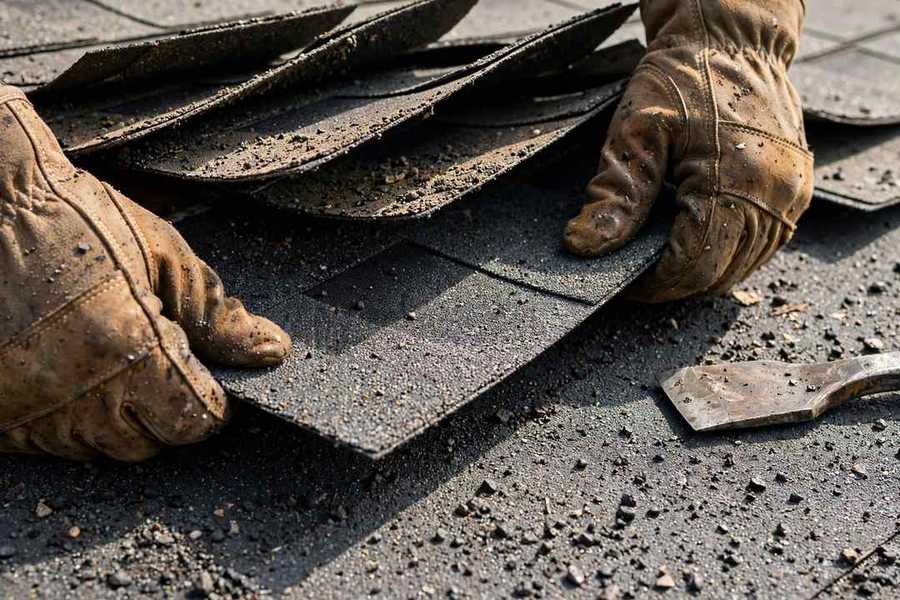
Gloved hands sliding a new shingle under the lifted course

How a proper shingle repair is done. The method matters more than the material here, and it goes like this. First, the damaged shingle and the ones woven around it get lifted gently, with a flat bar, breaking the seals without cracking the neighbours. On a brittle roof this step is the whole job: lift too hard and one repair becomes five. Second, the failed shingle slides out and the decking under it gets checked, because a soft or rotted patch of deck has to be dealt with now, not roofed over. Third, the new shingle slides in, matched for size, colour and weight as closely as the roof allows, and gets nailed in the right line, not high, not low, where the next course will cover the heads. Fourth, the lifted neighbours get resealed by hand with a bead of sealant under each tab, because their factory seals were broken to get in. Fifth, everything gets pressed flat and checked: courses straight, no nail heads showing, no edges lifted.

Skip the resealing step and the repair sheds its neighbours within a season. Nail in the wrong line and the heads show, rust, and leak. This is why a proper shingle repair takes longer than the drive over, and why the quick version is not the same job at a better speed.

How long it should last. Done this way, a shingle repair should last the remaining life of the roof around it. The new shingle is the youngest thing on the slope. Its colour will read slightly darker for a season or two until the sun evens it out, and that is normal, not a fault. If a replaced shingle lifts, curls or lets go within the first year, the fault is in the nailing or the sealing, not in the weather, and the crew should be back on the roof putting it right. Any roof repair Texas homeowner accepts should come with that expectation stated plainly, before the ladder comes down.
The repairs

Flashing rebuilds: where roofs actually leak

If shingles are the field, flashing is the stitching: the metal strips that seal every place the roof changes shape. Along a wall. Around a chimney. Where two slopes meet a dormer. Up the side of every step in the roofline. Flashing fails more quietly than shingles and leaks more faithfully, because it sits exactly where water is channelled and concentrated. A flashing rebuild is the repair behind a large share of the leak calls in this state, and roof repair Texas crews who are honest will tell you the flashing check is the first check on any leak.

What fails, and how it shows. Flashing fails by rust, by movement, and by bad birth. Rust eats the thin metal from the underside where nobody looks, until pinholes become slots. Movement works the joints: a house shifts a fraction with the seasons, metal expands in the Texas heat and shrinks back at night, and a rigid joint cracks its seal a little more every year. Bad birth is the saddest one: flashing installed flat against a wall with a bead of caulk as the only defence, or step flashing replaced by one long strip because it was faster. Caulk is a sealant, not a system, and it ages out in a few summers. The signs inside are stains that run down a wall, stains beside a chimney, and leaks that only show when rain comes with wind from one direction, pushing water into the joint that a straight down rain slides past. Reading those signs early is what keeps a flashing job a small roof repair Texas job instead of a wall and ceiling job.

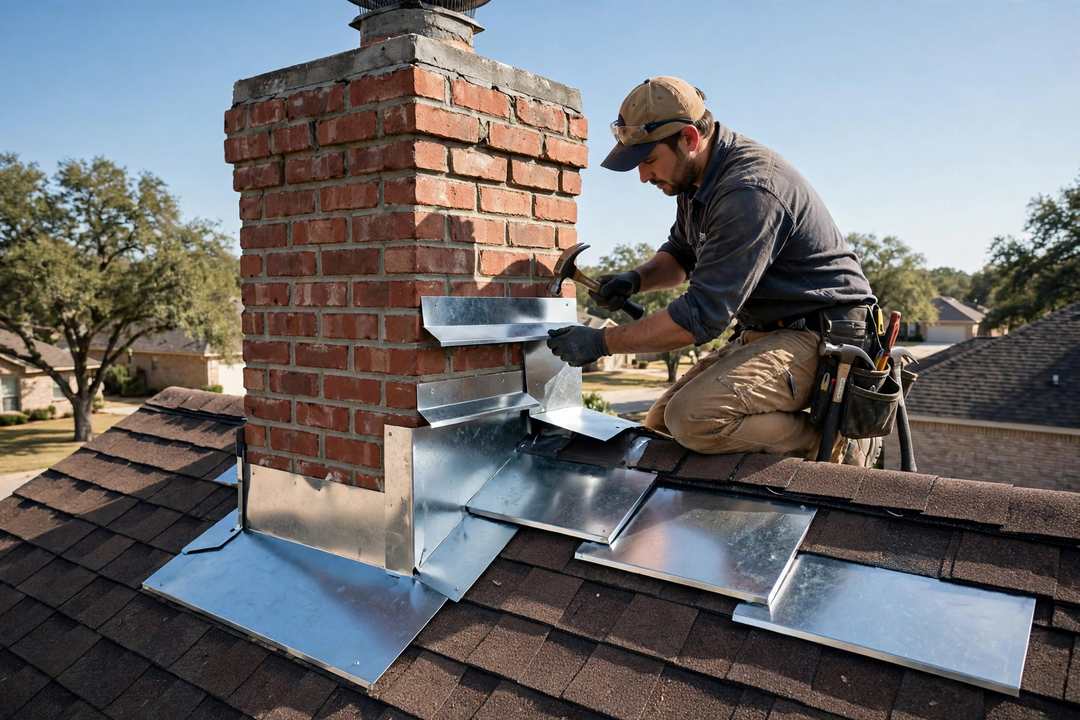
Roofer fitting new metal step flashing around a brick chimney

How a proper flashing rebuild is done. A rebuild means the failed metal comes out, not over. Around a chimney, the old flashing and counter flashing are removed, the mortar joint is cleaned, new base flashing is fitted to the roof slope, step pieces are woven in course by course with the shingles, and counter flashing is set into the mortar joint and sealed, so water running down the chimney face lands on metal, not in a seam. Along a wall, step flashing goes back the way it should have gone in the first time: one piece per shingle course, each one lapped by the next, tucked behind the siding or counter flashed where the wall is brick or stone. The rule a good crew works by is simple to say and slow to do: water should never meet a joint it can enter, because every piece sheds onto the piece below.

What a rebuild is not: it is not a tube of sealant run along the old joint. Sealant over failed flashing buys a season at best, and it makes the eventual rebuild harder, because the new metal has to be fitted over the mess. When a crew offers to seal a flashing joint that has rusted or split, they are offering you next year's leak at this year's visit.

How long it should last. Good flashing, galvanized or better metal, fitted in pieces and lapped right, should outlast the shingles around it. It is common for a proper rebuild to serve twenty years and more, quietly, which is exactly what flashing is supposed to do. If a rebuilt joint leaks in its first hard rain, the lap is wrong somewhere, and it is a workmanship fault to fix, not weather to shrug at. Flashing is where roof repair Texas quality shows most, because nobody can see it from the ground and the crew knows it. Judge a crew by whether they photograph the flashing before the shingles cover it.

The repairs

Pipe boot swaps: the small part behind the big leak

Every house has pipes poking through the roof: plumbing vents, mostly, a few inches wide, sticking up out of the slope. Each one is sealed by a boot, a metal or plastic base with a rubber collar that grips the pipe. That rubber collar lives the hardest life on the roof. It sits in full sun, flexing a little with every heat cycle, and in Texas heat it perishes years before the shingles around it do. The trade's own saying, confirmed on job after job, is that pipe boot failure is the most common roof leak of all. If your stain sits under a bathroom, start the search here.

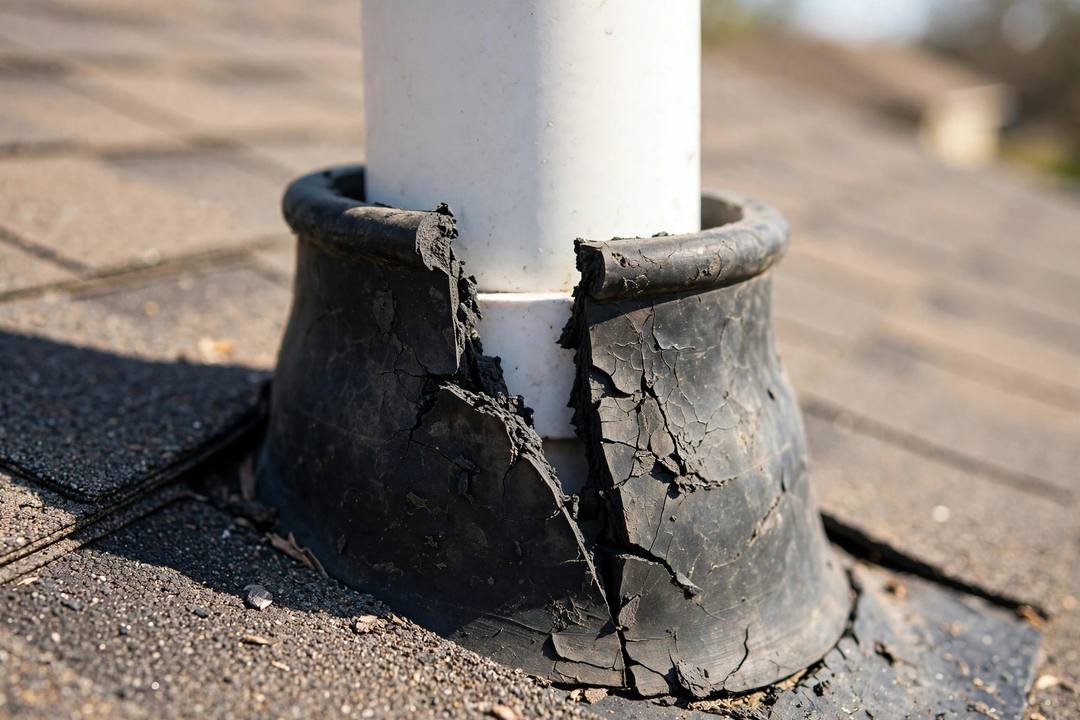
What fails, and how it shows. The collar cracks. First a hairline split at the top of the rubber where it stretches tightest, then a gap that opens a little more each summer. Rain runs down the pipe, meets the crack, and follows the pipe inside, which is why boot leaks drip so neatly into the room below and why the stain often rings a bathroom ceiling like it was drawn there. From the ground, a failing boot shows nothing. From the roof, a practised eye reads the crack at a glance, and a squeeze tells the rest: sound rubber flexes, perished rubber feels like a cracker.

How a proper boot swap is done. The shingles around the boot get lifted, the old base slides out, nails and all, and the deck around the pipe gets checked for the soft ring that says this leak has been running a while. The new boot, sized to the pipe, slides over, its base is woven into the shingle courses so the upper half sits under the shingles above and the lower half sheds over the shingles below, and the lifted courses get resealed by hand. Some crews fit a repair collar over a cracked boot as a stopgap; it has its place on a roof whose shingles are too brittle to lift, and a good crew will tell you plainly that is what it is, a stopgap, not a swap. The full swap is the repair. It takes under an hour on most roofs, and it is the highest value hour in all of roof repair Texas work: the smallest part on the roof, behind the largest share of leaks.

How long it should last. A quality boot, the kind with a collar made to shrug off sun, should last as long as the shingles around it, and the cheaper kind will crack again in five to seven Texas summers. Ask which kind is going on your roof, and ask to see the old one when it comes off. The crack will explain your stain better than any sentence on this page. That one question, which kind, separates careful roof repair Texas crews from quick ones.

Cracked rubber pipe boot split open around a white vent pipe
The usual suspect. A boot collar split wide open by sun and heat, on a roof whose shingles still have years left in them.

The repairs

Valley repairs: the riverbed of the roof

Where two slopes meet, they form a valley, and a valley is a riverbed. Every drop of rain that lands on either slope ends up running down that channel, fast and deep in a hard storm. Valleys move more water per inch than any other part of the roof, and they collect what the water carries: leaves, granules, twigs, the grit of two whole slopes. A valley repair is slow, careful work, and it is one of the repairs where the quick version fails fastest.

What fails, and how it shows. Valleys fail three ways. Debris dams the channel, water backs up behind the dam, and backed up water goes sideways, under the shingles at the valley edge, which is the leak that stains the ceiling at the inside corner of a house. The valley lining itself wears: in a woven or closed valley, the shingles lining the channel take the full force of the flow and shed their granules years before the open field does, until the mat shows through in a dark line down the middle. And in a metal lined valley, the metal can split along the centre fold after years of expanding and shrinking, a crack that hides under the waterline of every storm. Valley leaks are patient leaks. They often run for a long while inside the wall or along the ceiling joint before they announce themselves, which is why the tracing section of this page matters so much on valley calls.

How a proper valley repair is done. The channel gets cleared first, fully, down to the lining, because no honest judgement can be made under a mat of wet leaves. Then the lining is read: shingles worn to the mat, metal split at the fold, or a sound lining that was simply dammed. If the lining has failed, the shingles along both sides of the valley come up in a strip, the old lining comes out, the deck gets checked, and a new valley goes in: a proper underlayment strip first, then either fresh metal with a raised centre rib that keeps the two water flows from crossing, or shingles woven or cut to the method the roof already uses, laced tight and sealed at the edges. The strips on both sides get rebuilt in the right order so each course sheds into the channel, never under it. A valley repair done in this order is a rebuild of the hardest working strip on the roof, and a crew doing roof repair Texas wide will tell you it cannot be hurried: every course that touches the valley has to come up and go back in sequence.

What a valley repair is not: it is not a line of sealant down the centre of the channel, and it is not a fresh strip of metal laid over the old one with the edges glued. Both versions trap the failure under a shiny surface and give the water a hidden path. The stain comes back, angrier, a season later.

How long it should last. A rebuilt valley should last as long as the slopes that feed it, fifteen years and more on a sound roof, because the lining is new and the courses around it were reset properly. A valley that was only dammed needs clearing, not rebuilding, and that is maintenance, honest and simple, and a good crew will say so rather than sell you the bigger job. That kind of honesty is the daily bread of roof repair Texas work.

The repairs

Vent work: turbines, box vents and the holes nobody sees

A roof breathes through its vents, and every vent is a hole in the weather surface with a cover story. Whirlybird turbines spin above a round opening. Box vents sit low and still. Ridge vents run along the peak. Each one can leak, and vent leaks are sneaky, because the vent is doing its job right up until the storm that comes in sideways.

What fails, and how it shows. Turbines fail at the bearing and the base: the head wobbles, the flashing collar under it cracks its seal, and wind driven rain gets spun and thrown where still rain never reaches. Box vents crack: the plastic kind goes brittle in the sun and splits at the corners, sometimes from a hailstone, sometimes from a work boot years ago. The metal kind rusts at the seams. Around all of them, the flashing flange that ties the vent into the shingles can lift when its seal dies, and then every hard rain pushes a little water under the course above. Inside, the sign is a stain that sits oddly high on the ceiling, near an outside wall or under the peak, and a leak that appears in wind and rain together but not in a calm rain. That pattern, rain plus one wind direction, points at a vent or a flashing joint more often than at the open field of shingles.

How proper vent repair is done. A cracked box vent gets replaced, not patched, because brittle plastic does not hold a patch through a Texas summer. The old vent comes out with its flange, the deck opening gets checked, and the new vent goes in with its flange woven into the courses: under the shingles above, over the shingles below, nailed in the covered zone and sealed. A turbine with a dead bearing gets a new head or a full swap the same way. A lifted flange on a sound vent gets lifted courses, fresh seal, and a reseal of the tabs that were disturbed, the same discipline as a shingle repair. The test at the end is a hose, run over the vent from above while someone watches the attic side, because a vent repair you have not water tested is a hope, not a repair.

How long it should last. A new vent fitted properly should serve as long as the roof around it. That is the standard for roof repair Texas vent work: the new part outlasts the visit by years, not by a season. The plastic parts age on the same clock as the boots, faster than the shingles, so on an older roof a vent swap is often paired with the boot swap in one visit: the two shortest lived parts on the slope, renewed together. That kind of pairing is the quiet efficiency of planned roof repair Texas work. One ladder trip, every short lived part on the slope checked while the crew is up there.

The repairs

Ridge and hip repairs: the cap takes the weather first

The ridge is the peak where two slopes meet at the top, and the hips are the angled peaks running down the corners of a hipped roof. Both are capped with special cap shingles that straddle the peak, and the cap is the most exposed material on the house. It takes the wind from every direction, the sun at the steepest angle, and the full force of hail. Cap shingles crack along the bend where they fold over the peak, and when they do, the leak appears at the very top of the house and runs down inside the walls, which makes ridge leaks some of the hardest to trace from the stain.

What fails, and how it shows. Caps fail by cracking at the fold, by losing their seal and lifting in wind until a storm takes a run of them off the peak, and by simple age: the bend is the thinnest stressed point on the roof, and it gives up first. A missing run of cap leaves the ridge board and the underlayment ends exposed, and rain at the peak goes straight into the attic. From the ground, look along the peak line with the light behind you: lifted cap edges catch the light in a broken rhythm, and a missing cap shows as a gap in the line. Inside, ridge leaks stain the highest point of the ceiling or run down an interior wall, and they are often blamed on everything else first.

How a proper ridge repair is done. The damaged caps come off along the failed run, the ridge underneath gets checked for rot at the board and for the state of the underlayment ends, and new cap shingles go on one at a time, each lapped over the last away from the prevailing wind, nailed where the next cap covers the heads, with the end caps sealed by hand. On a roof with a ridge vent, the vent sections get checked as part of the same job, because the cap and the vent live in the same few inches and fail in the same storms. It is fiddly, exposed work, done kneeling on the peak, and it is worth doing slowly: a cap line nailed in the wrong place shows every nail head to the weather, and exposed heads rust and leak in neat rows. Ridge work is roof repair Texas style at its most visible: the whole street can see whether the line runs true.

How long it should last. A renewed cap run should last the life of the roof around it. Caps are sacrificial by design, the first part meant to age, so on an older roof the cap may be renewed once more before the field shingles are done. That is normal roof economics, stated plainly: some parts are wear parts, and replacing them on time is what lets the big parts underneath reach their full life.

The repairs

Metal roofs: seams, screws and movement

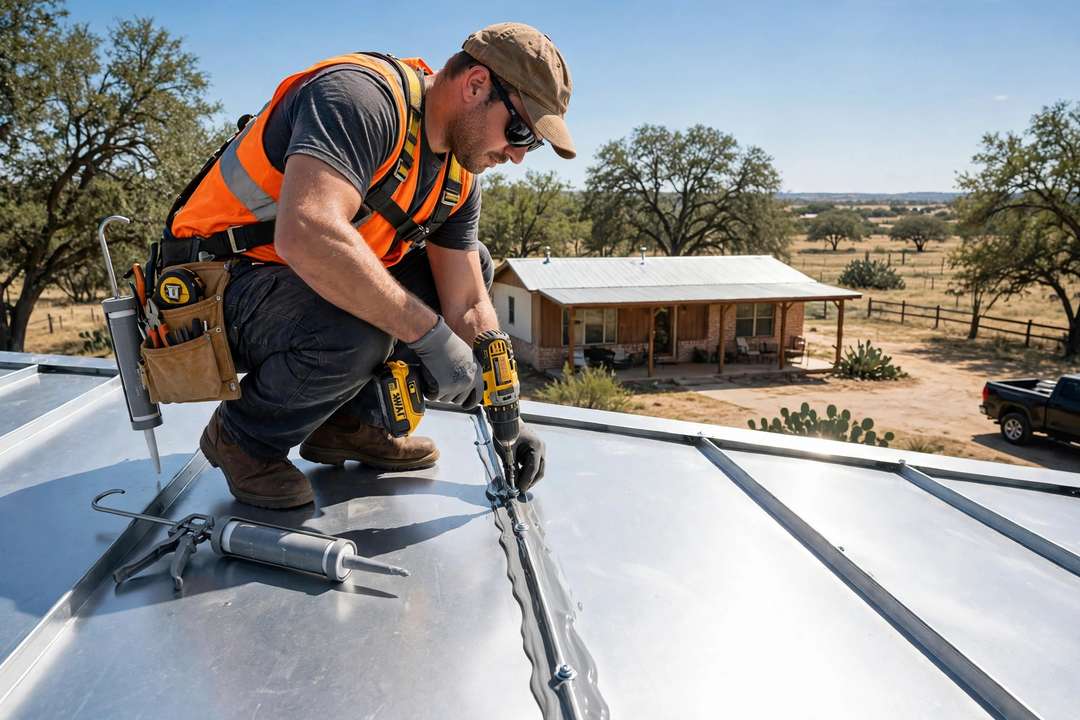
A metal roof is a different animal. The panels themselves can outlast the house's paint, its windows, sometimes its owners. What fails on a metal roof is almost never the panel. It is the joints: the seams where panels meet, the screws that hold exposed fastener panels down, and the trim where the roof ends. Metal moves. A long panel grows in the afternoon heat and shrinks back at night, every day of its life, and that daily movement works on every fixing like a slow hand worrying a loose tooth. Metal roof repair Texas style is mostly the craft of managing that movement.

What fails, and how it shows. On exposed fastener roofs, the screws back out. Each screw is sealed by a small rubber washer, and the washer perishes in the sun on the same clock as a pipe boot, while the daily movement walks the screw a fraction loose. One backed out screw is a pinhole over the deck. A roof of them, after fifteen Texas summers, is a sieve that only leaks in certain rains, which makes metal roof leaks some of the most confusing to trace: the stain appears in one storm and not the next, because the wind has to push the water to the loose screw that matters. On standing seam roofs, the seams themselves are strong, and the failures move to the ends: the trim, the ridge cap, the flashing around penetrations, and the sealant inside joints that were sealed once at birth and never since. Sealant on a metal roof is a wear part with a working life, and when it dies, the joint it served starts drinking.

Roofer resealing fasteners along a standing seam metal roof

How proper metal repair is done. The screw round comes first: every exposed fastener on the slope gets checked, the backed out and perished ones come out, and new fasteners go in, a size up where the hole has worn, each with a fresh sealing washer, driven snug and straight, never crushed, never tilted. A crushed washer splits and fails faster than the one it replaced, so the driving is a feel skill, and a good crew checks its own work screw by screw. Split seams get opened, cleaned, resealed with the sealant made for metal movement, and closed again. Failed trim and flashing get refitted the way the flashing section of this page describes, in pieces, lapped, with room to move. Panels with real damage, a crease from a fallen limb, a rust patch at a low edge, get cut out and replaced in section where the system allows it. What metal repair is not: it is not a coating smeared over the whole roof to hide the joints. Coatings have their place on sound metal as a planned system, but smeared over loose screws and dead seams, a coating entombs the failures and makes the real repair twice the work when the leaks come back, as they do.

How long it should last. A full screw and seam round on a sound metal roof should buy ten to fifteen quiet years, because the panels were never the problem. That is the metal roof bargain: the surface lasts generations, the joints need a service once a decade or so, and the owner who books that service on time never meets the leaks at all. In the world of roof repair Texas crews work in, metal is the roof that rewards planned work most, and punishes neglect slowest, right up until the neglect is in the deck.

The repairs

Tile roofs: the felt underneath does the waterproofing

Here is the fact that surprises every tile roof owner: the tiles are not the waterproofing. Tiles are a beautiful, heavy, sun proof shell that sheds most of the water and takes the weather's beating. The layer that actually keeps the house dry is the felt underlayment underneath them, and felt has a life. In the Texas heat, under tiles that bake like a griddle, the felt dries, cracks and splits years before the tiles show any age at all. So a tile roof starts leaking while it still looks perfect from the street, and the repair is not a tile repair. It is a felt renewal with tile work wrapped around it. Tile is the corner of roof repair Texas work where the visible layer is not the working layer.

What fails, and how it shows. The felt splits along the batten lines and at the laps, and water that blows or creeps under the tiles finds the splits and follows them in. Tiles themselves crack from hail, from a careless foot, from a fallen limb, and a cracked tile lets more water reach the felt, which speeds the felt's end in that spot. The mortar at the ridge and hips crumbles and drops out, opening the peak to driven rain. Inside, tile roof leaks are travellers: water enters at a felt split, runs along the felt or the deck, and stains a ceiling well away from the split, sometimes in a room that is not even under the damaged slope. Tracing matters here more than anywhere, and the attic diary and hose test from earlier on this page earn their keep.

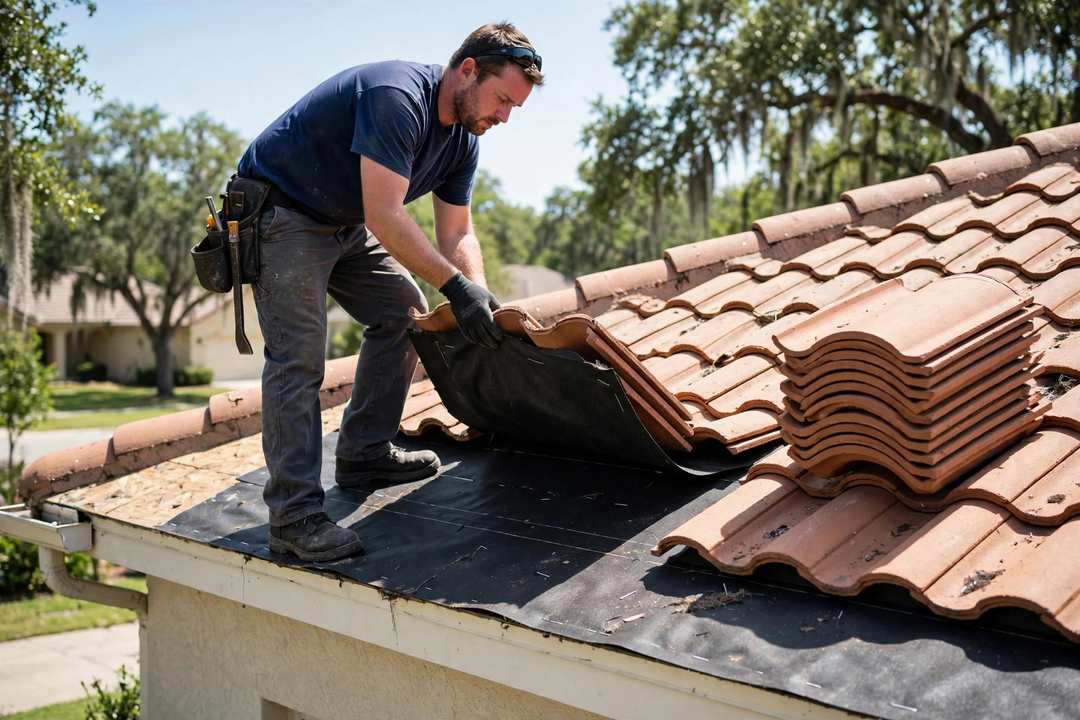
How a proper tile felt renewal is done. The tiles over the failed area come up, carefully, and get stacked in order, because clay and concrete tiles break under careless feet and every broken tile is one more to match. The old felt comes off down to the deck, the deck gets checked, and new underlayment goes on, the heavier modern kind where the roof allows, lapped right and sealed at the edges. Battens get replaced where they have rotted. Then the tiles go back in their order, cracked ones replaced with the closest match, and the ridge mortar or a modern ridge system gets renewed where it had crumbled. The skill is in the handling: a good tile crew breaks almost nothing, and plans the opened area to what one day can close again, because an opened tile roof with felt off is a roof with its skin open to the sky.

How long it should last. A felt renewal under sound tiles should serve twenty years and more, matching the felt's own working life, and the tiles above it will still be there for the next renewal after that. This is the deepest repair on this page, the one closest to replacement in effort, and it is still a repair: the shell, the deck and the shape of the roof all stay. When a crew tells a tile owner the whole roof must go because the felt has failed, they are selling past the problem, and the repair or replace page on this site will help you test that advice.

Roofer lifting clay tiles to check the felt layer underneath
Tiles lifted and stacked in order, with the felt underneath exposed. On a tile roof, that felt is the layer that keeps the house dry.

The repairs

Flat and low slope roofs: patches, seams and drains

Flat roofs, and the low slope sections over porches, additions and garages, play by different rules. Water does not run off them. It strolls. It stands in ponds after a storm and sits on every seam, testing them for hours at a time. A flat roof repair is about seams, patches and drainage, and a flat roof forgives nothing: a pinhole that a steep roof would never notice becomes a slow, steady drip under standing water.

What fails, and how it shows. Seams split where the membrane was joined, because the joint flexes with the heat and the building's small movements until the bond tires. Patches from old repairs lift at the edges for the same reason. The membrane itself blisters where damp got trapped under it at birth, and a blister that breaks is a hole. And above all, drains fail by clogging: a flat roof whose drain or scupper is blocked by leaves and grit holds a pond, and a pond finds every weak point in the field and keeps the pressure on it day and night. The inside sign of a flat roof leak is a stain that grows slowly and drips long after the rain has stopped, because the pond above is still draining through the split, drop by drop.

How a proper flat roof repair is done. Drainage first: the drain and scuppers get cleared and checked, because half of flat roof repair is giving the water somewhere to go. Then the failed seam gets opened, dried, and re-welded or re-bonded with the material the membrane system calls for, TPO, PVC, EPDM and modified bitumen each have their own method, and the wrong patch material on a membrane is a patch that peels by summer. A proper patch extends well past the damage on every side, its edges are rolled and sealed, and the surface around it gets cleaned first so the bond is to the membrane, not to the dirt on it. Blisters that have broken get cut out and patched the same way. Where ponding is caused by a sag, the honest answer may be a tapered repair that rebuilds the fall toward the drain, because no patch outlasts a pond that never leaves. The methods differ by membrane, and roof repair Texas crews who run one membrane type all week will tell you so unprompted.

How long it should last. A welded or bonded patch done with the right material on a clean, dry surface should last the remaining life of the membrane around it. A patch that lifts at the edge within a year was bonded to dirt or damp, and that is workmanship, not weather. Flat sections are where roof repair Texas homeowners most need a crew that works on that membrane type every week, because the methods differ and the shortcuts all look the same on the day they are done.

The honest answer

How long should a roof repair last?

The short answer: a proper repair should last as long as the roof around it. A repair is not a countdown. When the failed part comes out and sound material goes in, tied into the layers in the right order, there is no reason for that spot to fail again before the rest of the roof does. If a crew talks about their repair the way you would talk about a tyre patch, something to get you through the season, they are telling you what kind of repair they plan to do.

The honest version has texture, though, because the parts of a roof age at different speeds, and a repair renews one part inside an older system. The new boot on a fifteen year roof will still be sound when the shingles around it are done; the repair did not fail, the roof finished its life on schedule. The renewed flashing will outlast two sets of shingles. The replaced shingle will be the last one on the slope to curl. This is the pattern roof repair Texas homeowners should expect: the repair spot stops being the weak point, and the roof's next problem, when it comes years later, comes somewhere else.

What shortens a repair's life is almost never the weather. It is the shortcuts catalogued on this page: sealant asked to do a system's job, nails in the wrong line, a patch bonded to dirt, lifted tabs never resealed, a boot collar of the cheap kind chosen quietly. Every one of those is a decision made on the day, by the crew, out of your sight. That is why the checks in the next section exist, and why the photo habit matters so much in roof repair Texas work: the repair you can see being done right is the repair that lasts.

One more honest note. A repair cannot make an old roof young. If the roof around the repair has five good years left, the repair has a five year stage to stand on, and a crew that respects you will say that out loud before the work starts, so you can judge the job for what it is: the right fix, on a roof with a known horizon. Our repair or replace page exists for exactly that judgement call.

Check it yourself

Can you check a repair from the ground?

Yes, more than you would think, and you should. You cannot judge the nailing line or the lap order from the yard, those are for the photos the crew should hand you, but a finished repair tells on itself in ways anyone can read. These are the checks a roof repair Texas homeowner can run with both feet on the grass.

1 Flat and true

The repaired patch sits flat. No lifted edges, no corners standing up to catch the wind, no course running crooked against its neighbours.

2 Nails stay hidden

No nail heads show. A shining row of nail heads across a repair is a leak being built on a schedule, and it is visible from the ground on a bright day.

3 Colour settles in

The colour settles. A new shingle reads darker for a season, that is normal. A patch that reads like a different roof entirely, wrong profile, wrong weight, is a match that was never tried.

4 Yard left clean

The ground below is clean. Old shingles, nails and offcuts left in the yard tell you how the work you cannot see was treated. Careful crews police their drops, because a nail in a tyre is the review nobody wants.

5 Stain stays put

The stain stops growing. Inside, pencil a light line at the edge of the ceiling stain and date it. After the next two good rains, a repaired leak leaves the line untouched. A stain that creeps past the pencil is a call back, not a paint job.

6 Attic dries out

The attic dries. A week after the repair, on a dry day, the attic should smell like warm wood and dust again. A sweet, musty smell that lingers means water is still arriving or still sitting, and either way it is worth a call.

Run those six checks on any roof repair Texas job and you have done what most owners never do: verified the work. A crew that did the job right will be glad you looked. That reaction, glad versus annoyed, is itself one of the checks.

Our word

The repair promise, stated plainly

We keep this simple, because a promise you cannot test is just a slogan. A repair should hold. If a repair we did lets water through at the same spot, we come back and put it right. You will have the photos from the day: the failed part before we touched it, the layers while they were open, and the finished work. You will have the scope in writing, naming the one failure we fixed. If the roof later leaks somewhere new, we will show you the new failure in photos too, and it will be a new conversation, not a shrug. That is the whole promise, and it is the same promise any honest roof repair Texas crew should be willing to make in plain words: the work holds, or we return.

Why state it this way instead of printing a number of years? Because a year count on a repair is only as honest as the roof under it, and any crew can print a big number. What you can actually hold a crew to is behaviour: they showed you the failure, they wrote the scope, they photographed the layers, and they answer the phone when the stain moves. Judge the promise by whether those things happen, starting with the very first visit. Ask for it in those terms from any roof repair Texas crew you call.

The honest limit

When repair is the wrong answer

This page sells repair, so it should be the page that tells you when not to buy it. There are roofs where a repair is money spent on a surface that cannot hold it, and an honest roof repair Texas crew names them without being asked.

The shingles snap instead of bending

To repair one shingle, its neighbours must lift, and on a brittle roof they crack as they lift, so every repair creates the next one. When the lift test fails in three places, the roof is telling you its material life is over, whatever its age in years.

The damage is everywhere at once

One failed part is a repair. The same failure on every slope, boots gone, flashing rusted, caps cracked, field shingles worn thin, is a roof wearing out as a system, and fixing it part by part just repeats the same call, slope after slope.

The deck has gone soft in wide areas

Decking is the foundation the whole system nails to; a repair nailed into rot is a repair already failing. A soft patch gets fixed with the repair. A soft roof is a different conversation.

The roof has been repaired in layers

Some roofs carry two or three generations of patches, coatings over patches, patches over coatings. Each layer hides the one below, tracing becomes guesswork, and the honest move is to stop adding layers.

If your roof matches one of those pictures, the repair or replace page on this site walks the judgement in full, with the questions to ask and the counts to demand, and our replacement page explains what a planned replacement looks like when it really is time. And if it is not time, if your roof fails none of those tests, then be politely deaf to anyone who tells you otherwise at your door. A sound roof with a failed part needs a proper repair, and now you know what roof repair Texas work looks like when it is done right.

Texas conditions

Roof repair in Texas weather: heat, hail and wind

Every state repairs roofs, but roof repair Texas style is shaped by three forces that never take a season off, and a repair that ignores them does not last here even if it would last somewhere gentle.

Heat is the slow one. A Texas roof in August runs hot enough to soften shingles to the touch, and that heat cooks everything on the slope: it perishes rubber boots and washers, bakes sealant until it cracks, and ages the felt under tile like an oven ages anything. It also sets the working rules for repairs. Shingles cut and seal best in warm weather, which Texas has in plenty, but a summer repair has to be timed: early starts, before the surface turns tender and foot traffic starts scarring it. Ask a crew when they plan to start a July repair. The ones who know say dawn.

Hail is the sudden one. This state sits in the country's hail belt, and the record is not a slogan: Austin has seen 59 hail days since 2010, counted within 15 miles of the city centre, Dallas 91, Fort Worth 117, Plano 113. Hail bruises shingle mats in ways that surface months later as soft spots and leaks, and it cracks tile and dents metal trim. The repair lesson is that hail damage is counted, not guessed: a proper hail check marks test squares and counts fractures, slope by slope, the way our storm page explains in full. A roof repair Texas homeowner books after hail should start with that count, not with a conclusion announced from the driveway.

Wind is the testing one. Straight line storm winds and the edges of Gulf hurricanes push rain uphill, sideways, and into joints that calm rain never reaches, and they worry every lifted tab and loose cap until something lets go. Wind is why the reseal step in a shingle repair matters so much here, and why ridge caps and edge metal get checked on every visit: the next wind will find whatever the last one loosened. A roof repair Texas job is not finished when it sheds water downward. It is finished when it sheds water driven at it from the side.

Age changes the job

Repairs by roof age: the same leak, four different jobs

A cracked boot is a cracked boot, but the right repair around it depends on the age of the roof it sits in, and a good crew changes its plan with the roof's years.

A young roof, under eight years

On a young roof, failures live at the details: a boot that was always thin, a flashing joint that was rushed at birth, a shingle damaged by a falling limb. The field is sound and flexible, lifting shingles is safe, and repairs are clean, single part jobs. A young roof that leaks in the field itself, away from any detail, is a roof worth a harder look, because that is not how young roofs fail. On a young roof, roof repair Texas work is detail work, and detail work should be exact.

A mid life roof, eight to fifteen years

On a mid life roof, the wear parts come due together: boots perish, vent plastic brittles, cap shingles start cracking at the fold, sealant joints tire. This is the age where the paired visit pays: one trip that renews every short lived part on the slope while the field still has years in it. Planned roof repair Texas owners book at this age is the cheapest roof they will ever own, because it protects the big surface by renewing the small ones on time.

An older roof, fifteen years and beyond

On an older roof, the lift test rules every decision. If the shingles still bend, repairs proceed, gently, with hand sealing everywhere a seal was broken. If they snap, the conversation changes to the one in the section above: repair becomes a bridge, a way to keep the house dry while a planned replacement is arranged, and it should be sold to you as a bridge, in those words.

A roof at the very end

On a roof at the very end, a repair is still sometimes right: one dry season is a real thing to buy, honestly labelled. What is never right is selling that bridge as a cure. Age is not a verdict by itself, though. A shaded, well vented twenty year roof can be sounder than a baked twelve year one. The material tells the truth, not the birthday, and a crew that tests the material in front of you is a crew doing roof repair Texas homeowners can verify.

How it runs

What a repair visit looks like

1 The call and the photos

You describe what the roof is doing, and if you have photos of the stain or the damage, they help us arrive with the right materials on the truck. A roofer answers, day or night, on (512) 555-0147.

2 The inspection and the written scope

We trace the leak to its entry point, photograph the failed part, and write the scope before any work starts: the one failure, the method, the materials. You see the photo and the scope first.

3 The repair itself

The failed part comes out, the layers under it get checked, and sound material goes in, tied into the roof in the right order. Disturbed seals get resealed by hand, every time.

4 The photos and the walkthrough

You get the after photos, the old part if you want it, and a plain account of what was found and what was done. Then the ground checks on this page are yours to run.

Most single part repairs are finished in one visit, in hours, not days. A valley rebuild or a tile felt renewal takes longer and gets scheduled like the bigger job it is, with the roof left watertight at the end of every working day. Either way, the shape of a roof repair Texas visit does not change: find the real failure, show it to you, fix it in the open, prove it at the end. If a crew's visit has a different shape, more pressure and less photography, you are watching a sales call wearing work boots.

Watch for it

The repair upsell: how a small job gets sold as a whole roof

Close this page where the problem map says the trouble starts: with fear of being played. Repair calls are where the upsell lives, because the homeowner cannot see the work and knows it. It is the shadow side of roof repair Texas work, and it is worth knowing cold. These are the patterns, named plainly, so you can spot them in the wild.

The whole deck story. You are told the decking is rotten everywhere and the whole roof must come off to fix it. Rot is real, but it is local: it grows where water has been entering, and the honest unit of deck repair is usually the bottom 12 to 24 inches at a bad edge or the patch around one leak, not the whole deck. Ask to see the rot, in photos, slope by slope. Whole deck rot that cannot be photographed does not exist.

The damage that appears on the roof. After a storm, some inspectors manufacture the evidence, scuffing shingles with a coin or a hammer edge to make marks that read as hail. Real hail leaves a pattern the whole neighbourhood shares, dents in soft metal, spatter marks, a count that holds up in test squares. If the damage only exists where one inspector's hands have been, it is not damage.

The special that expires tonight. A repair is planned work. It keeps until morning, and the scope keeps until you have read it twice. Any crew whose offer dies at midnight is selling the deadline, not the repair. The midnight test is the easiest one in this whole page: a real roof repair Texas crew will happily come back tomorrow, because their scope will still be true tomorrow.

The vanishing local. The truck has no address you can drive to, the crew is in town for the storm season, and the office is a phone that rings somewhere else. Repairs need a crew that can come back, and coming back requires being here. Ask where they will be in six months, and listen for an address, not a slogan.

None of this needs you to be suspicious of everyone. It needs you to use the tools on this page: the photo of the failed part, the written scope, the lift test, the pencil line on the stain. A good crew passes every one of those tests without being asked twice. That is the crew to book, and it is the crew this site is built to send you.

Service areas

Where we work

The people who answer roof repair Texas calls live and work in the towns below. Roofing habits change from town to town, so each place listed here has its own page, written around the roofs found there:

Austin

home base for our crews. The heat here cooks boots and sealant faster than almost anywhere, and the live oaks drop limbs and leaves into every valley. Austin has counted 59 hail days since 2010, so counted hail checks are a standing part of the year. Most roof repair Texas calls we take start on an Austin slope.

Buda

fast growing, and full of young roofs. Young roofs rarely fail in the field; they fail at the details the builder rushed, the boots, the flashing, the joints where an addition meets the main roof. Buda repairs are detail repairs, and they are satisfying work: a sound young roof made properly watertight, part by part.

Pilot Point

lake wind and older roofs. The wind off the lake worries the edges of every slope, lifting tabs a little more each season, and the leaks here run slow and hidden, travelling far from the entry point before they show. Tracing matters more in Pilot Point than speed does, and patience is a repair tool.

Plano

big roofs, tall trees, and the deepest hail record on this page, 113 hail days since 2010. Wide slopes mean long valleys and a lot of flashing, and spring hail checks are a fixture of the year. Plano repairs often start with the counted inspection, because hail bruising hides under a surface that still looks fine from the street.

Do not see your town above? Ring (512) 555-0147 and ask. When a crew cannot reach you fast enough, you will hear that from us at once, not after hours of waiting by the phone. We would rather lose the job honestly than hold your roof hostage to a maybe. That plain dealing is what any roof repair Texas crew owes you.

Aftercare

After the repair: the first month

Plenty of sites stop once the repair is done. Your house keeps going, though. The weeks after a roof repair Texas job bring small jobs and warning signs of their own, set out below.

Watch the stain, do not paint it yet. A stain that is drying stops growing and turns dusty at the edges. Pencil its outline and date it, the way the ground checks section described. A stain that survives two good rains without moving is a stain you can paint. A stain that creeps is a call back, and catching it in month one, while the photos and the scope are fresh, is the easiest call back there is.

Check the patch after the first hard wind. From the ground, look for the lifted edge, the corner standing up, the cap out of line. Everything that fails on a repair shows itself from the yard first. You never need to climb to run this check, and you should not.

Keep the paper. The photos, the written scope, and the old part if you kept it belong in a folder, not a memory. That folder is the roof's history: what failed, what was done, what was left alone on purpose. It makes the next visit faster and the next decision easier, whoever the next crew turns out to be. It is also, quietly, the best protection a roof repair Texas homeowner owns against the upsell, because a door knocker cannot argue with a folder.

Trust your nose in the attic. About a week after the work, on a dry day, put your head through the hatch and breathe in. A drying attic smells like warm wood and dust. A sweet, musty smell means damp is still sitting somewhere, and that smell is worth a call while the repair is fresh.

And if anything on this list goes wrong, call the same number: (512) 555-0147. A repair that does not hold is our problem to come back to. That is what a roof repair Texas promise should mean.

Questions

Straight answers

No sales talk. The questions every caller asks, answered the way we answer them on the phone:

What does roof repair actually cover?

Roof repair covers the failed parts of a sound roof: shingles, flashing, boots, valleys, vents, ridge caps, metal seams and screws, tile felt, and flat roof patches. The failed part comes out, the layers under it get checked, and sound material goes in. It does not cover a roof that has worn out everywhere at once.

How long should a roof repair last?

As long as the roof around it. A proper repair renews the failed part completely, so that spot stops being the weak point and the roof's next problem comes somewhere else, years later. A repair that fails within a year at the same spot was a workmanship problem, and the crew should return and put it right.

Can a single damaged shingle be replaced on its own?

Yes, and it is the most common repair there is. The shingles woven around it are lifted gently, the failed one slides out, the new one is nailed in the covered line, and every lifted tab is resealed by hand. Done that way, one shingle is a complete repair, not a compromise.

Why do pipe boots fail before the shingles do?

The boot's seal is a rubber collar, and rubber perishes in Texas sun and heat years before asphalt shingles wear out. It cracks first where it stretches tightest over the pipe, and rain running down the pipe finds the crack. That is why boot failure is the most common roof leak of all.

What is the difference between roof repair and roof maintenance?

Maintenance is upkeep that slows wear down: clearing valleys, resealing exposed nail heads, trimming limbs, keeping gutters moving. Repair fixes a part that has already failed, like a cracked boot or rusted flashing. Maintenance cannot fix a failed part, and a repair visit is not a tune up. They are different jobs.

How can I tell if a repair was done properly?

Check from the ground: the patch sits flat, no edges lift, no nail heads show, and the yard below is clean. Inside, pencil the edge of the stain and date it; after two good rains it should not have grown. And ask for the photos: the failed part, the open layers, and the finished work.

What happens if my repair does not hold?

Call the crew back. A repair that lets water through at the same spot is a workmanship problem, not weather, and an honest crew returns and puts it right. This is why the photos and written scope from the first visit matter: they prove what was fixed, where, and how.

Is it worth repairing an older roof?

Often, yes, if the material still has life. The test is the shingles themselves: if they bend when lifted, repairs hold and are worth doing. If they snap, a repair is only a bridge to a planned replacement, and it should be sold to you in those words, honestly.

Can flashing be repaired, or does it have to be rebuilt?

It depends on how it failed. A sound joint whose seal has tired can be resealed as upkeep. Flashing that has rusted through, split, or was installed as one long strip instead of step pieces needs a rebuild: the old metal comes out and new pieces go in, lapped course by course.

How long does a typical repair visit take?

Most single part repairs, a boot swap, a shingle repair, a vent replacement, are finished in one visit of a few hours. A valley rebuild takes most of a day. A tile felt renewal is scheduled work over a day or more, with the roof left watertight at the end of every day.

Do metal and tile roofs get repaired the same way as shingle roofs?

No. The tracing is the same, but the work is different. Metal roofs fail at screws, seams and sealant, and the repair is a fastener and seam round. Tile roofs fail in the felt underneath, and the repair is a felt renewal with the tiles lifted and replaced around it.

When is a repair the wrong answer?

When the roof has worn out as a system: shingles that snap instead of bending, the same failures on every slope, decking soft in wide areas, or layer over layer of old patches. Then a repair spends money on a surface that cannot hold it, and a planned replacement is the honest job.

Why does my ceiling stain sit away from where the leak is?

Because water travels. It gets in at the entry point, runs along the underlayment, the decking and the rafters, sometimes up to 8 feet, and only then drips onto the ceiling. The stain marks where the water landed, not where it entered, which is why tracing comes before any repair.

One failed part does not need a whole new roof.

Call and describe what the roof is doing. We will trace it to the failed part, show it to you in photos, and fix it properly, or tell you plainly if the roof itself says otherwise.

(512) 555-0147
Call (512) 555-0147