24/7 emergency response · A roofer answers, day or night Serving Austin & nearby Texas towns
Emergency Roof Repair TexasEmergency Roof Repair · Texas

Emergency Roof Repair · Plano, Texas

Emergency Roof Repair in Plano, Texas

Water coming in over a Plano living room does not wait for office hours, and neither do we.

A Plano roof is a big roof. Wide slopes, long valleys, tall rooflines and more flashing than a smaller house ever needs, all of it sitting under some of the hardest hail weather in Texas. When a storm tears a section open at midnight, or a valley gives up during a spring downpour, the call that follows is an emergency roof repair Plano Texas call, and it needs a crew that stops the water first and argues about nothing until the house is dry. That is the order we work in. Stop the water. Show you the proof. Fix what is actually broken, at the size the damage actually is. If you are reading this with a bucket on the floor, call (512) 555-0147 now and read the rest later. This page is the full local guide to how that call goes. A roofer answers the line day and night.

Plano, plus Austin, Buda, Pilot Point, Manchaca and Houston.

  • Water stopped first, on the first visit
  • Photo proof of everything we find
  • Repair first, replacement only on proof
  • Plano crews, Texas based, no storm chasers
Send the details, we call you backWe call back fast, day or night.

Water pouring in right now? Skip the form and call (512) 555-0147.

24/7A roofer answers, day and night
113Hail report days near Plano since 2010
8 ftHow far leak water can travel inside a roof
30 to 90 daysThe honest working life of a good tarp

Plano, Texas

Big roofs under the hardest hail sky on our map

Plano is the hail capital of our service map, and that is not a slogan. Records kept from storm reports show 113 days with hail reported within fifteen miles of the city centre since 2010, more than any other town we cover. The city sits in the Dallas Fort Worth metroplex, in the stretch of North Texas roofers call Hail Alley, where spring storms build fast over warm ground and drop stones on the same neighbourhoods year after year. An emergency roof repair Plano Texas crew does not get to be surprised by this. Hail season is the job here, the way hurricane season is the job on the coast.

The roofs themselves raise the stakes. Plano homes carry wide slopes and tall rooflines, two storey entries, dormers, hips and long valley runs where two slopes pour water into one channel. Every valley, every flashing run, every vent and chimney base is a joint, and joints are where roofs fail. A small ranch roof might have a handful of weak points. A big Plano roof can have dozens, spread over a surface you cannot see from the street. That is why emergency roof repair Plano Texas work is so often a tracing job, not a patching job: the damage is up there somewhere, the water shows up somewhere else, and the distance between the two is the puzzle.

The trees finish the picture. Plano is a mature city, and its streets sit under tall oaks and pecans that have been growing for decades. Shade is a gift in a Texas summer. In a storm, those same trees are heavy limbs hanging over wide slopes, and a limb through a roof at two in the morning is the purest form of emergency roof repair Plano Texas call there is. Add wind that gets a run at the suburbs straight off the open ground to the north, rain that falls sideways in April and May, and summer heat that cooks pipe boots and sealant years before their time, and you have the full local list: hail, wind, trees, driven rain and heat. This page walks through all of it, the way we work through it on a real call.

The city also splits in two by age, and the split shows up in the work. East Plano is the older city: mature streets, heavier tree cover, and roofs that have already lived one full life and started a second, with boots, flashing and valley metal that have seen twenty Texas summers. West Plano is the newer city: bigger homes, taller rooflines, more tile and metal, and roofs young enough that their failures are storm failures rather than age failures. That split is why emergency roof repair Plano Texas calls read differently by ZIP. In the east, the call is often age and storm arriving together, a bruised old mat or a boot that finally split. In the west, it is size and force: a long valley overwhelmed, a limb through a tall slope. Same hail sky over both. Different roofs underneath it, and a crew that works Plano has to carry both playbooks in the same truck.

That is also why this page exists: one place where emergency roof repair Plano Texas work is explained the way it is actually done, before the night you need it. If your roof is dry and you are reading ahead of the season, good. This is the page to bookmark. If water is coming in right now, skip to the first hour steps further down, or just call (512) 555-0147 and let a person talk you through it.

The first call

Is this an emergency, or can it wait for morning?

This is the test we run on the phone, word for word. Two lists. If anything on the left is true at your house tonight, it is an emergency roof repair Plano Texas call and you should make it now. If everything true sits on the right, you can sleep, and call first thing.

Call now if

  • Water is pouring or dripping through a ceiling, not just staining it
  • A limb or tree is on the roof, or through it
  • Shingles are torn off and the deck or the sky shows through
  • A ceiling is bulging, sagging or cracking under held water
  • Dripping is landing near lights, switches, wiring or the breaker box
  • A tarp or patch from an earlier fix has ripped loose in wind
  • Hail just came through and water is already finding its way in

It can wait for morning if

  • There is a stain but no active drip, and the rain has stopped
  • A few shingles are missing and the underlayment underneath is intact
  • You heard hail but the house is dry and nothing drips
  • Gutters are bent or a vent cap is dented, with no water inside
  • One slow drip lands in a bucket and the bucket is holding it
  • Shingle edges are lifted but still lying flat after the wind

The grey cases are where people lose the most sleep, so here they are plainly. A stain that grows during rain but never drips: that is water moving inside the roof build, and it earns a call the same day, because a big Plano roof can hide a long, slow path. A drip that only shows up in hard, wind driven rain: that points at an edge, a valley or a flashing joint, and it will be back with the next storm from the same direction, so it counts as urgent even when tonight is dry. Hail with no leak at all: not an emergency tonight, but it is a check within the week, because bruised shingles leak a season later, not a day later. And the bulging ceiling is never a grey case. A wide bulge, or one with cracks at the edges, means the room below it gets emptied and nobody walks under it until it is drained or opened by a crew. Water held in plaster is heavy, and it lets go all at once.

Every emergency roof repair Plano Texas call starts with this same sorting, and honest sorting cuts both ways. A crew that calls everything an emergency is selling. A crew that tells a dry house to sleep and call in the morning is doing the job right. That honesty is the start of every good emergency roof repair Plano Texas job, and we would rather earn the morning call than scare you into a midnight one.

While you wait

The first hour: what to do before the crew arrives

Seven things, in order. None of them involves a ladder. An emergency roof repair Plano Texas visit goes faster and safer when the first hour inside the house is handled well, and most of it is buckets, towels and a phone camera.

1Kill the power near water

If dripping lands near ceiling lights, switches or outlets, turn that circuit off at the breaker box and leave it off. Water and wiring do not get negotiated with. Tell the crew on the phone that you did it, so they know the state of the house when they arrive.

2Move what water can ruin

Furniture, rugs, electronics, books and anything stored under the drip come out of the room or to its dry edges. Water damage inside a Plano home spreads sideways through carpet and padding faster than people expect. Ten minutes of moving saves weeks of drying.

3Catch it and mark the spot

A bucket under the drip, towels around the base. Then note where the ceiling stain sits against the walls, because the crew will measure from that mark in the attic. On a big roof, the stain is a map reference, not the answer, and a clear mark saves real tracing time.

4Read the bulge first

A small bulge that is growing can be drained in a controlled way: one small hole at its lowest point, bucket underneath, water out on your terms. A wide bulge, a sagging ceiling, or cracks around the edges means hands off, room emptied, and the crew handles it. That rule never bends.

5Photograph everything

The stain, the drip, the yard, the roof from the street, any limb on the ground, shingles in the flowerbeds. Photos taken in the first hour show the damage before anyone touches it, and they settle arguments later about what the storm did and what it did not do.

6Keep the room empty

Keep people and pets out of the room. A wet ceiling can drop plaster without warning, and a floor with water on it is a slip waiting for a barefoot trip to the bucket. Close the door if you can. Curiosity is not worth a fall or a falling ceiling panel.

7Do not climb

Do not climb, and do not send anyone else up. A wet Plano slope is steep, tall and slick, often two storeys over concrete. No roof is worth a fall, and no emergency roof repair Plano Texas crew will ever ask you to check something from up there. Your job is the inside. Ours is the roof.

That is the whole first hour. When the emergency roof repair Plano Texas crew arrives, you hand over the photos, the stain mark and a dry floor to work from, and the roof work starts at full speed.

Hail Alley

Plano hail: what 113 storm days actually do to a roof

Start with the number, because it frames everything else. Storm report records show hail reported on 113 days within fifteen miles of the Plano city centre since 2010. Dallas, a short drive south, recorded 91 in the same span. Austin recorded 59. Plano tops our whole map, and it is not close. Spread over those years, it means a Plano roof can expect hail somewhere near it most springs, and a direct hit on its own slopes more often than owners like to think about. Emergency roof repair Plano Texas crews plan their spring around that calendar: March through June, storm after storm, and the phones light up in waves.

What the stones do depends on their size, and the sizes have plain meanings. Pea and marble hail mostly make noise and strip a little grit. Quarter size stones, about an inch across, are where standard shingles start fracturing in real numbers. Golf ball hail breaks tabs, cracks tile and dents metal hard enough to open seams over time. Anything bigger is a wrecking event: decking can crack, skylights star, and the repair stops being a question of patches. Wind drives all of it. A stone falling straight down hits once. A stone driven sideways by a gust hits the slope, the flashing and the soft metals at an angle, and angled hits break mats that straight hits of the same size would only bruise.

The damage itself hides. A hard hit crushes the asphalt and fractures the fiberglass mat inside the shingle, while the surface above it can look almost unchanged from the driveway. That is the bruise: a soft spot where the mat is broken and the stone that did it has bounced away into the gutter. Bruises do not leak on day one. The crushed asphalt holds for a while, then rain washes the loosened granules off the spot, the sun works on the exposed crack, and months later a stain appears on a ceiling below, in a room that may not even sit under the damaged slope. This delay is why hail work is a counting job, not a guessing job, and why emergency roof repair Plano Texas hail calls run on proof instead of opinions.

Hail bruise check on a Plano shingle roof after a spring storm
The bruise hides under a surface that looks fine. The count finds it.

The proof works like this. Soft metals tell the first part of the story from the ground: dents in gutters, downspouts, vent caps, flashing edges and the fins of the outside air unit show the size and force of what fell. Then the roof itself gets counted. A crew chalks a test square, ten feet by ten feet, on each slope, marks every hit inside it, presses each mark for the soft give of a fractured mat, and lifts tabs to photograph the break underneath. Slope by slope, that count is the damage, stated in numbers anyone can recheck. Our full method, stone sizes, roof type by roof type, lives on the hail damage page, and Plano readers should treat that page as the deep version of this section.

Two Plano habits make hail worse here than the count alone suggests. The first is roof size. More slope means more squares, more squares mean more hits, and a storm that bruises four shingles on a small roof can bruise forty on a wide Plano roof with six or eight faces. The second is roof age mixed with heat. Plano summers cook shingles past 150 degrees on the surface, and a mat baked brittle for ten summers fractures under stones that a young, flexible roof would shrug off. Age plus hail is the combination that turns a loud night into an emergency roof repair Plano Texas call, sometimes that night, more often a season later when the bruises open.

What to do after a hailstorm, in order: stay inside until it passes, walk the yard when it is safe and photograph stones next to a coin for size, read the soft metals from the ground, check the attic for daylight or drips if water is involved, and book a counted check within the week. Do not let anyone talk you into signing anything on storm night. The check comes first and the count comes second in any honest emergency roof repair Plano Texas hail job, and every decision after that should trace back to both.
The tree problem

Tall trees, heavy limbs, and the two in the morning call

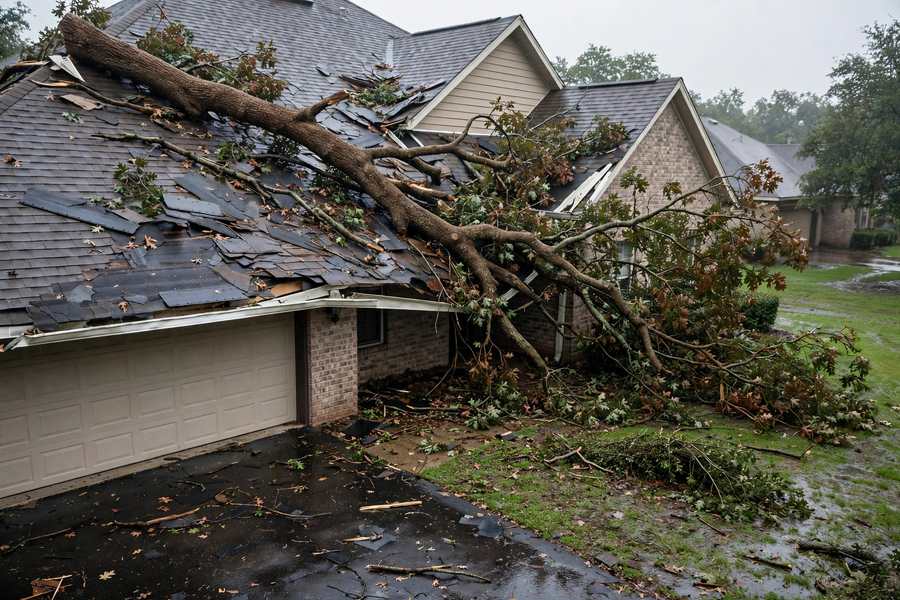
Fallen oak limb resting on a Plano roof after a night storm

Plano grew up under its trees. Neighbourhoods like Willow Bend, Deerfield and Whiffletree sit under mature oaks and pecans, and those canopies are part of why people love the streets. They are also the second most common reason an emergency roof repair Plano Texas crew rolls at night. A storm loaded limb is heavier than it looks: green oak wood, rain soaked, snapping at the trunk and falling twenty or thirty feet onto a slope. The limb does not just break shingles. It can crack decking, bend the edge metal, tear a valley open and drive branches through the roof build into the attic.

The order of work when a tree is on the roof is safety first, and it is not a slogan. If the tree or the fall has touched power lines, or lines are down anywhere near it, nobody goes near it and the power company gets the first call. A load bearing limb, one whose weight the roof is now holding up, does not get cut by a homeowner with a borrowed saw: cutting the wrong piece shifts the load and can drop the rest through the ceiling. The tree work and the roof work get planned together, the weight comes off in pieces, and only then does the opening get covered. That is the moment the job turns from tree work into emergency roof repair Plano Texas work, and it is planned, not improvised.

Once the weight is off, the roof sequence is the same one we run everywhere: photograph everything before it moves, clear the broken material, check the decking and the framing around the hole for cracks that run past the opening, then cover the area so the house is dry before anything else happens. A limb opening is rarely the neat square people picture. It is a star of cracked shingles and split deck boards, and the cover has to span the whole damaged field, not just the visible hole. That cover is tarping work, and it has its own full page on this site, because a bad cover over a tree hole fails in the next rain and doubles the damage inside.

Plano owners can cut the odds before storm season. Dead limbs over the roof should come down in winter, when tree crews can see the structure of the tree. Limbs that rub the shingles in wind wear the granules off a stripe of roof year after year, and that stripe becomes the weak line a later storm opens. And after any storm that drops limbs in the street, walk the roof line from the ground with your eyes: a limb resting on a slope, even a small one, is weight the roof was not built to hold, and it earns a call the same day rather than a wait and see. Trees made these neighbourhoods beautiful. Managed, they stay that way. Ignored over a big roof, they are the most predictable emergency roof repair Plano Texas call on the list.

Where Plano roofs leak

Wide slopes, long valleys, and flashing runs that never end

Ask where a Plano roof leaks and the honest answer is: at the joints. The field of a roof, the wide open slope of shingles, rarely fails first. Water gets in where the roof changes direction, meets a wall, wraps a chimney or collects into a channel. Plano roofs have more of all of that than most, because of how they are built: tall rooflines, dormers punched through slopes, hips and ridges in every direction, and valleys that run long enough to carry the rain of two big slopes at once. Understanding those joints is most of emergency roof repair Plano Texas leak work, so here they are one by one.

Valleys first, because Plano valleys work the hardest. A valley is the inside corner where two slopes meet, and every drop that lands on either slope above it funnels through that one channel. In a hard rain, a long Plano valley carries a river. The water runs fast, it runs deep at the centre line, and wind can push it sideways up under the shingle edges that line the channel. Valleys fail in predictable ways: shingles cut too close or too far at the centre, nails placed where the water runs instead of at the safe edges, debris dams of leaves and oak tassels that hold water back until it backs up under the laps, and metal valley liners that rust or split at the seam after enough summers. A valley leak rarely drips straight down. The water enters at the channel, runs along the decking or a rafter, and shows up in a room that can be well to the side of the valley itself, which is why valley leaks get misread as random stains so often.

Flashing runs are the second big source. Flashing is the metal work that seals the roof where it meets anything: chimney bases, wall lines where a lower roof dies into a two storey wall, vent pipes, skylight frames, dormer cheeks. A small roof has a few feet of it. A big Plano roof can carry long step flashing runs up every dormer and wall, plus counter flashing, plus apron pieces at every roof to wall joint. Each piece is a lap, each lap depends on the one above it, and the whole run fails at its weakest joint. Heat works these joints every single day: metal and shingle expand and contract at different rates, sealant at the joints dries and cracks in the summer sun, and a joint that shed water for ten years opens a hairline in year eleven. Wind driven rain finds hairlines. That is not a figure of speech. Rain pushed at forty miles an hour goes up and sideways, under laps that shrug off straight down rain all day, and Plano storms deliver exactly that kind of rain every spring.

Then the details that age out quietly. Pipe boots, the rubber sealed collars around plumbing vents, crack in Texas heat in as little as five to eight years, and a cracked boot is the single most common leak source on Texas roofs of every size. On a Plano roof there may be six or eight vents, each one a boot, each boot on its own clock. Ridge caps take the wind first and lift at the corners. Shingle edges at the eaves lift after enough gust seasons and start catching driven rain. None of these failures announce themselves. They leak slowly, into insulation and decking, and the ceiling stain that finally appears is the end of a long quiet process, not the start of one. That is why an emergency roof repair Plano Texas crew reads a Plano roof as a system of joints, checks them in order from most to least likely, and never stops at the first fault found: on a roof this size, two faults is a normal count. That is the quiet truth of emergency roof repair Plano Texas leak work: the fault is usually small, and finding it is the skill.

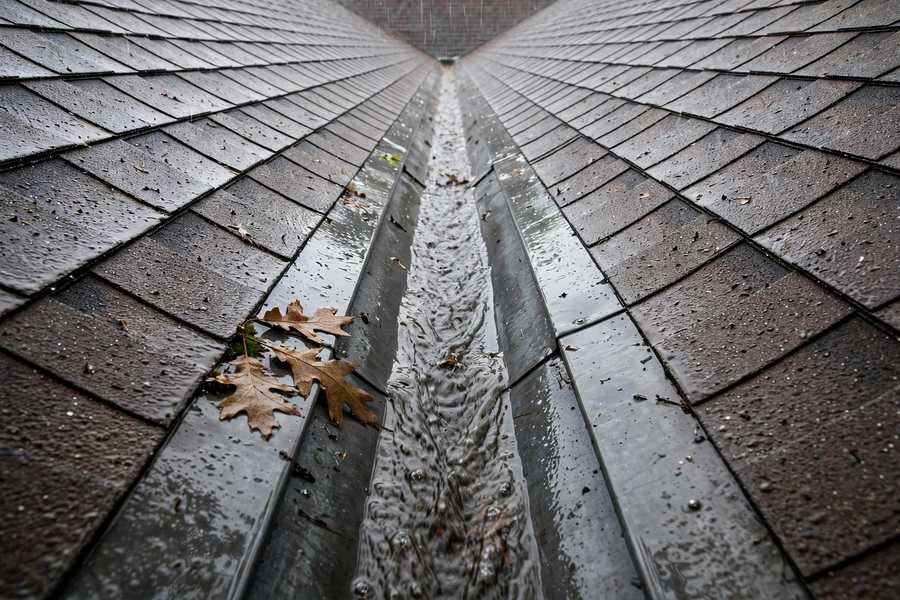
Long roof valley carrying rain between two wide Plano slopes
A Plano valley in the rain carries the water of two slopes at once.

Finding the real hole

Leaking roof repair Plano Texas style: the stain is not the hole

Here is the fact that runs this whole section: on a big roof, the ceiling stain is rarely under the leak. Water that enters at a valley, a flashing joint or a cracked boot lands on the decking or the felt, then follows the slope of the wood, a rafter, a seam in the boards, sometimes a wire run, until it finds a low point and drops. That trip can run up to eight feet from where the water got in. So leaking roof repair Plano Texas work starts with a rule we never break: the stain is the end of the trail, not the start, and patching the roof above the stain is how leaks get fixed three times and leak a fourth.

Tracing starts in the attic, in the dry logic of the build. With the stain measured against the walls below, the crew finds that spot from above, then works upslope from it. The signs are plain once you know them: dark streaks on the underside of the decking where water has run, rusty nail tips pointing along the path, insulation that lies flat and dark where it has been wet again and again, and the highest wet mark of all, which is the closest thing to the entry point. On a Plano roof the attic is often crowded and broken into odd corners, with duct runs, high ceilings cut into the space and slopes that change pitch, so the tracing takes patience and a tape measure, not a guess. That patience is what leaking roof repair Plano Texas homeowners are actually calling for, even when they describe the call as a dripping ceiling.

The pattern of the leak narrows the search before anyone climbs. A leak that only appears in heavy, straight down rain points at the open field or a penetration: a boot, a vent, a valley running full. A leak that only appears when rain comes with wind from one direction points at an edge, a ridge corner or a flashing lap facing that weather. A leak that shows hours after the rain stops is water that travelled, which means a longer trail and an entry point further upslope than anyone expects. A drip with no rain at all is not the roof at all in most cases: it is a plumbing line or an air conditioning drain in the attic, and an honest crew says so and points you at the right trade instead of selling you roof work. Sorting the pattern first is what keeps leaking roof repair Plano Texas work honest and quick at the same time.

When the attic cannot settle it, the hose test does. One person in the attic with a light and a phone, one person on the roof with a hose, and the roof gets wet in sections, lowest first, waiting minutes between sections while the attic watch calls out the moment water appears. The section that produces the drip holds the entry point. It is slow, it is wet, and it is conclusive, which no amount of staring at shingles ever is. This is the part of emergency roof repair Plano Texas work that no shortcut replaces. After the entry point is proven, the repair itself is usually the small part of the job: a boot swapped, a flashing joint rebuilt, a valley section relaid. Leaking roof repair Plano Texas calls end small far more often than they end big, provided the tracing was done before the patching. The full leak method, every entry point in order, lives on the roof leak repair page. This section is the Plano version of it, because on these wide, joint heavy roofs, tracing is not a step in the work. Tracing is the work.

One warning belongs in this section, because Plano owners hear the pitch every spring: sealant smears and spray coatings sold as leak cures are not repairs. A smear over a cracked boot lasts a season at best, traps water under itself at worst, and hides the fault from the next person who looks. Tape products, brush on goo, a can of anything promising to stop a leak from the outside in one coat: they all fail the same way, quietly, in the next hard rain, after the seller is gone. Real leaking roof repair Plano Texas work replaces the failed part or rebuilds the failed joint. If a fix fits in a tube, be suspicious of it.

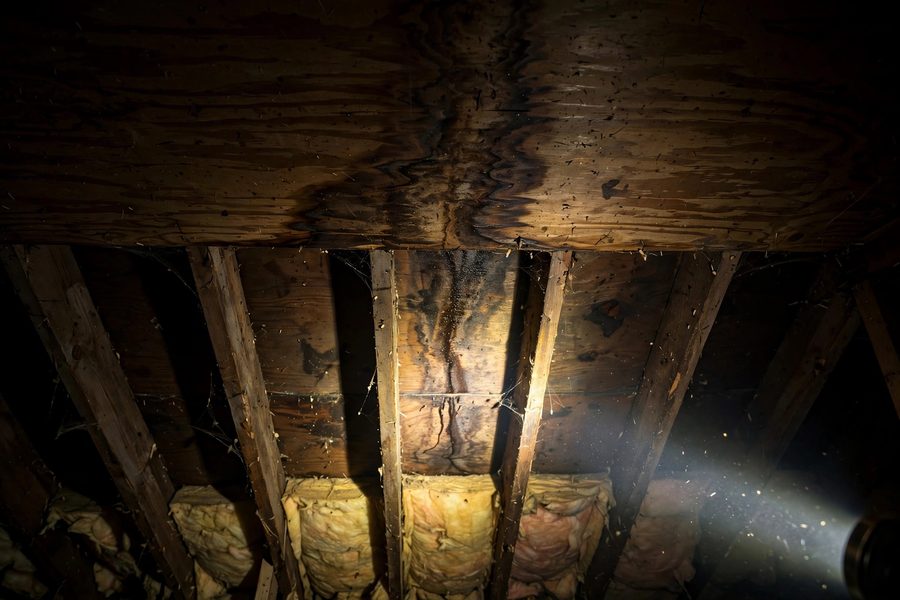
Roofer tracing a leak trail through a Plano attic with a light
The trail in the attic points upslope to the real entry point.

How we work

What an emergency visit to a Plano home looks like

Four steps, the same on a midnight call as a morning one. Every emergency roof repair Plano Texas visit runs in this order, and you can hold us to it.

1You call, a roofer answers

Not a machine, not a call centre reading a script. You describe what is happening: where the water is, when it started, whether a tree is involved. That two minute sort is the most valuable part of the whole emergency roof repair Plano Texas call, because it decides what rolls, and how fast. The roofer sorts it with the emergency test, tells you plainly whether it is a tonight job or a morning job, and talks you through the first hour steps while the crew rolls.

2We stop the water first

On site, the first job is never the full repair. It is making the house dry: a tarp fitted flat and battened over a torn section, a controlled drain for a bulging ceiling, a temporary seal at a proven entry point. A house that is dry is a house that is not getting worse while the real work gets planned.

3Photo proof, before and after

Everything found gets photographed before it is touched: the damage, the bruises, the cracked boot, the valley full of debris, and the same spots after the work. You see what we see. On hail calls that means the chalked test squares and the count, on leak calls it means the attic trail and the entry point. Proof is the whole product of an emergency roof repair Plano Texas visit. A repair you cannot see is a story you have to take on faith, and we do not sell stories.

4A written scope, then the repair

What will be fixed, what will be left alone and why, in writing, before the repair work starts. No signature is ever needed on a doorstep in the rain to get the water stopped: stopping the water is step two and it happens first. The written scope covers the repair, and you decide on it in daylight, at the table, with the photos in front of you.

That order, water, proof, paper, repair, is the difference between an emergency roof repair Plano Texas crew and a sales team with ladders. Keep it in mind when the next section describes the other kind of knock on the door.

What we fix

Emergency roof repair Plano Texas services, one by one

Every service below is a page of its own on this site, because each one is a different job. This is the short version of each, in the order Plano homes usually need them. Each one is emergency roof repair Plano Texas work of a different kind, and the differences matter more than the names.

Storm damage roof repair

When wind tears a slope open or a storm drops a tree through the deck, the storm page covers the full repair path, from the first night cover to the last replaced shingle. Plano storm season makes this the most read page on the site after this one.

Emergency roof tarping

A tarp fitted right, flat, tight, over the peak where it needs to be, battened not nailed through the sheet, buys a house thirty to ninety days of dry. Fitted wrong, it is a sail full of water. The tarping page covers the method, the lifespan and the sizing honesty most crews skip.

Roof leak repair

The tracing service: attic signs, the timing pattern, the two person hose test, and the repair of the proven entry point, whether that is a boot, a valley or a flashing run. On big Plano roofs this is the service that ends the leak that two earlier patches missed.

Hail damage roof repair

The counted check: soft metals read from the ground, chalked test squares on every slope, bruises proven by hand and photographed, then repair at exactly the size the count calls for, no bigger. In the hail capital of our map, this page carries the full method.

Roof repair

Not every Plano job is an emergency. Lifted edges, worn boots, a valley that needs relaying, ridge caps at the end of their run: the roof repair page covers the planned, daylight side of the work, done before any of it turns into a midnight call.

Roof inspection

A full check of a Plano roof, slope by slope and joint by joint, with photos and a written account of what was found, what matters now and what can wait. Owners use it after storms, before selling, and when a roof they inherited needs an honest reading.

Repair or replace advice

The decision page. How to tell a roof that needs a section from a roof that needs replacing, the signs that settle it, and the general code rule many cities use about how much of a slope can be repaired before the slope itself is redone, explained carefully in the section below.

Roof replacement

When a Plano roof truly is at the end, worn on every slope with the proof to show it, the replacement page covers how that job runs and how to judge the crews offering it. We link it last on purpose: on this site, replacement is the end of the road, not the opening offer.

Not sure which one your roof needs? That is normal, and it is exactly what the guide page is for: what counts as an emergency, what the first day should look like, and how to think about the call before you make it. Or skip the reading and call (512) 555-0147: sorting your roof into the right service is the first thing the person on the line does, and it is the same sorting whether you end up booking or not. The full list of everything we do lives on the services page.

After the hail

The knock that comes after every Plano hailstorm

Within a day or two of any real hailstorm, the knock comes. It comes to whole streets at once in Plano, because chasers work a storm map the way roofers work a neighbourhood: every roof in the hail path gets a door knocked. The pitch is polished and it sounds kind. They were working nearby. They noticed damage from the street. They can check the roof right now, today, before it gets worse. Some of what follows is honest work by local crews who also knock doors. Much of it is not, and Plano owners sign things in that week that they regret for years. This section exists so you can tell the difference before anyone climbs.

Know the marks of the bad version. The damage found is always total: never a bruised patch, always a whole roof, and the photos shown are dark, close and impossible to place on your own slopes. The urgency is always artificial: a deal that expires, a crew that is only in the area today, a problem described as dangerous in words that never get specific. The paperwork is always fast: a signature asked for on the doorstep or the hood of a truck, framed as a mere permission slip to look, written as something much larger. And the company is always hard to pin down afterwards: a cell number, a name that changes, an address in another city or another state, a truck with no markings you can remember. When the work leaks, and rushed work leaks, there is nobody to call.

The honest version looks different at every one of those points. The check is counted and photographed in the open, test squares and all, and you get the count slope by slope. The findings come in sizes: this slope is bruised, this one is clean, this valley needs work, and the word total appears only when the count earns it. That is what an emergency roof repair Plano Texas finding is supposed to sound like. The timing is yours: a written scope you can read at the table, compare, and think about overnight without anything expiring. The company has a real local base, a number that answers after the job, and a name that stays the same on the truck, the paper and the phone. And the emergency part never waits on any of it: an emergency roof repair Plano Texas crew stops your water first and does the paperwork in daylight, because the emergency is the water, not the signature.

One more Plano specific habit is worth naming. After the biggest storms, out of town crews flood the metroplex and rent local looking phone numbers by the dozen. A local number proves nothing. What proves something is a crew that can tell you, street by street, what the last storm did in your part of Plano, which slopes it hit hardest and which it missed, because they were standing on those roofs the week it happened. Ask. The answer separates the map followers from the neighbours in about thirty seconds.

Our promise

Repair first. That is the whole promise.

We are a repair first crew, and Plano is exactly the kind of city where that matters, because big roofs attract big recommendations. Most emergency roof repair Plano Texas calls end with a repair. A section replaced, a valley relaid, boots swapped, a slope made whole. When we find damage, we photograph it before we touch it, show you the proof, and fix it at the size the proof calls for. If a roof truly is worn out, you will see the evidence with your own eyes, slope by slope, and the decision will happen in your time, at your table, never on your doorstep in the rain. An emergency roof repair Plano Texas call should end with a dry house and a clear head. Ours do.

Hiring in Texas

Texas has no roofer licence. Here is how Plano owners vet us anyway.

Start with the fact that surprises people: Texas does not licence roofers at the state level. There is no state card to ask for, no licence number to check, and after a storm, anyone with a ladder and a truck can knock on your door and be, legally, a roofer by morning. Cities can require registration or permits for some work, and each city runs that its own way, but the state licence that protects you in other trades does not exist in this one. That gap is exactly why the storm chaser model works in Texas, and why Plano owners need a vetting method of their own. Here is the one we hand out on calls, including to people who end up hiring someone else. Ask these questions of any crew, us included, and grade the answers hard.

  1. Show me the damage before you describe it. Photos first, words second. A crew that leads with conclusions and follows with evidence has the order backwards, and the order is the tell.
  2. Which slopes are damaged, and which are clean? A real check has both answers. Damage on every slope, every time, is not a finding. It is a script.
  3. Can I see the count? After hail, the answer should be test squares, chalk marks and numbers per slope, shown to you on the spot or in photos you can study.
  4. What would you do if this was your roof? Then watch whether the answer changes when you say you are getting a second check. Honest advice survives comparison. Pressure does not.
  5. Where are you based, and who answers if it leaks? A real base, a real name, and a number that gets answered after the job, not just before it.
  6. Will you put the scope in writing before the repair starts? What gets fixed, what gets left alone, and why. If the paper cannot survive daylight, neither can the work.

Run that list on us. It is printed here because we would rather be graded than trusted, because emergency roof repair Plano Texas hiring should run on evidence rather than charm, and because a Plano owner who vets every crew this way makes the whole market better, including the part of it that knocks on doors after hail. The crew that answers all six plainly is the crew you want on a two storey roof over your family. The crew that rushes you past any one of them has answered the only question that matters.

The big decision

Repair it, or replace it? And what the 25 percent rule really says

Every Plano owner with an aging roof eventually faces the fork: keep repairing, or replace. The honest answer is a slope by slope reading, not a birthday. That reading is the heart of honest emergency roof repair Plano Texas advice, and it cannot be done from the street or the driveway. A roof with sound shingles, a tight deck and faults only at the joints is a repair roof, whatever its age. A roof whose mats are brittle across every slope, whose granules wash out by the handful, whose deck feels soft underfoot in places, is telling you the repairs have started chasing each other, and that is when replacement earns its place. Between those poles sits the grey ground where the money arguments happen, and where photo proof matters most, because the difference between a section and a slope is the difference between a repair and a project.

One rule comes up in that grey ground often enough that Plano owners should know it in its careful form. Many cities follow a version of a code rule that roofers call the 25 percent rule: when repairs or damage pass roughly a quarter of a roof area, or of one slope, within a set period, the code can require that area or slope to be redone whole rather than patched further. The details vary from city to city, the rule is written differently in different code editions, and there are exceptions and readings that only the permitting office can settle. So treat this the way we do: the rule is real as a general pattern, it is one more reason a damage count matters, and the final word on how it applies to your roof belongs to your city permit office, not to any roofer's doorstep summary, ours included. Anyone who uses a city rule as a closing argument, in either direction, is using the rule as a lever. Get the count, get the photos, and let the office that enforces the rule say what it means at your address.

The full decision guide, sign by sign, lives on the repair or replace page, and Plano owners weighing the fork should read it before signing anything anywhere. What this section asks you to hold onto is simpler: the decision belongs to the evidence, the evidence belongs to you, and an emergency roof repair Plano Texas crew that respects both will never rush you across that fork in the dark.

Know your roof

Four roof types over Plano, four different emergencies

Plano is not a one roof city. Drive from Legacy West to Los Rios and the rooflines change with the decades: shingle everywhere, standing seam metal on newer builds and porch accents, clay and concrete tile on the bigger west side homes, and low slope sections over patios, additions and modern flat roofed designs. Each material fails its own way, and emergency roof repair Plano Texas work that treats them the same gets the repair wrong. Here is how each one behaves when the storm comes.

Shingle roofs are most of Plano, and their emergencies are the ones this page has mostly described: hail bruises that fracture the mat, wind that lifts tabs and creases them until they snap, valleys and boots that age out in the heat. The shingle emergency has one saving grace: it is the most repairable roof there is. Sections come out and go back in cleanly, single shingles swap, and a well matched repair disappears into the slope. Its weakness is invisibility. A shingle roof can be badly hurt and look untouched from the street, which is why the counted check exists, and why emergency roof repair Plano Texas shingle calls run on hands and chalk rather than eyes.

Metal roofs, mostly standing seam on Plano's newer homes, shrug off the hail that fractures shingles, and owners buy them for exactly that. Their emergencies are different: seams that move and open under years of heat cycling, fasteners on exposed fastener panels that back out a fraction at a time until driven rain finds the holes, dented panels after the biggest stones that look sound but have split the coating, and transitions where a metal porch roof dies into a shingle slope, which leak at the joint long before either field fails. A metal roof emergency is rarely a hole. It is a seam, a joint or a transition, and the repair is a metalworker's repair, sealed and fastened to move with the panel, not against it.

Tile roofs, clay and concrete, sit on some of Plano's largest homes, and they fool people, because the tile is not the roof. The tile is armour. The actual waterproofing is the felt underlayment beneath it, and tile emergencies are felt emergencies wearing a tile disguise. Hail cracks tiles, wind slides them, a falling limb smashes a small field of them, and every break lets water reach felt that may be twenty years old and brittle. Worse, walking a tile roof the wrong way breaks more tiles than the storm did, so the check itself needs a tile crew's feet. When an emergency roof repair Plano Texas call involves tile, the order is: cover the break without crushing the field, then plan the underlayment repair as the real job, because it is.

Low slope and flat sections finish the list: the patio covers, the additions, the modern boxes at the edges of newer developments. These roofs do not shed water, they manage it, slowly, toward drains and scuppers. Their emergencies are ponding water that finds a seam split, drains choked with oak debris until the section becomes a shallow lake, and flashing at the wall line where the flat section meets the house. A low slope leak can run for weeks under the surface before it shows inside, travelling along the deck in any direction, which makes these the hardest traces in the city. The repair order is drainage first, seams second, surface last. Four materials, four failure stories, one rule: emergency roof repair Plano Texas work starts by naming which story your roof is in. Whatever your Plano roof is made of, the crew that shows up should be able to tell you which of these four stories yours follows before they climb. If they cannot, they are guessing with your ceiling as the stakes.

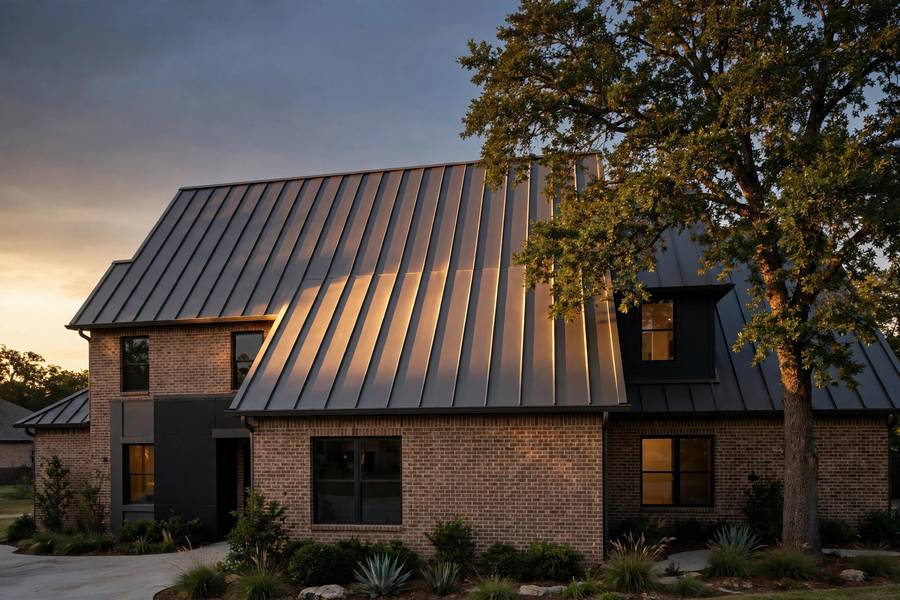
Standing seam metal roof on a newer west Plano home at dusk

The local calendar

Plano's year, season by season, written on its roofs

A Plano roof lives a harder year than most, and the year has a rhythm an owner can learn. Knowing which season does what turns emergency roof repair Plano Texas calls from surprises into appointments you saw coming.

Spring is the main event, March through June. Storms build over the metroplex in the afternoons, and this is when the hail days stack up: the counted checks, the bruised slopes, the valleys torn by driven rain, the limbs down after the worst cells. Spring is also storm chaser season, for the reasons the earlier section covered, and it is the season to have your vetting questions ready before you need them. If a Plano roof is going to have an emergency this year, spring is the odds on favourite, and a roof checked and made tight in February sleeps through most of it.

Summer trades storms for heat, and heat is its own slow emergency. A Plano shingle surface can pass 150 degrees on a July afternoon. That heat cooks the oils out of pipe boot rubber until it cracks, dries sealant at the flashing joints to a brittle line, and bakes aging mats until the autumn hail breaks what spring hail only bruised. Summer also brings the pop up storm: twenty minutes of sideways rain out of a clear evening, which is exactly the rain that finds lifted edges and open laps. The summer job for an owner is simple: after the loudest pop up storms, read the ceilings. A stain caught in July is a boot. The same stain caught in November is a boot, a deck section and a ceiling.

Autumn is the second storm season, shorter and easier to forget. October cells can carry real hail, and they arrive after a summer that has quietly aged every rubber and sealant part on the roof. Autumn is also when the oaks start dropping: leaves, tassels and acorns fill valleys and gutters, building the debris dams that back water up under shingles in the winter rains. A gutter and valley clearing in late autumn is the cheapest emergency prevention in this whole page, and it is the one almost nobody does. Emergency roof repair Plano Texas crews would happily trade a dozen December leak calls for a city that cleared its valleys in November.

Winter is the quiet season, not the safe one. Northers drop temperatures forty degrees in a day, and that swing works every joint on the roof: metal contracts, sealant lines open a hair, and the first rain after a freeze finds gaps the autumn rain never touched. Ice at the eaves is rare this far south but not unknown, and a still, freezing night after a wet day can split a water logged, rotten deck edge that summer would have forgiven. Winter leaks are usually old faults unmasked by the cold rather than new damage, which makes winter emergency roof repair Plano Texas work a tracing job first and a repair job second, and tracing, as the leak section said, is most of the work on a Plano roof in any season.

Read the year that way and the pattern is plain: check before spring, watch through summer, clear in autumn, trace in winter. A Plano roof kept on that rhythm rarely makes the midnight call at all, and when it does, it makes it with a folder of photos and counts that turn the emergency back into a job of known size.

Aftercare

After the repair: the next 30 days in Plano

Most roof pages end at the repair. The house does not. The weeks after an emergency roof repair Plano Texas visit have their own small jobs, and Plano's calendar makes some of them local.

Get the rooms dry once the leak is shut off. The race after a Plano leak is indoors, not on the roof. Carpet, padding, insulation and plaster hold water, and mould starts growing in hidden places if they stay wet past a day or two. Point fans at the soaked patch, crack windows when the air outside is dry, and raise furniture legs out of damp carpet. One wet night is a small job. Left alone, it turns into a second repair nobody wanted.

Watch the stain, and do not paint it yet. A stain that is drying stops growing and turns dusty at the edges. A stain that grows, darkens or returns with the next rain means water is still finding a way, and that is a call back, not a paint job. Plano supplies the test weather on its own: spring will send another storm within the month. Let two or three good rains pass over a dry stain before paint touches it.

Check the cover after every storm. If a tarp is up while the full repair waits, read it from the ground after hard wind: edges lifted, corners loose, a sag holding water. A moved tarp needs a visit before the next rain, not after it. That ninety second ground check is part of emergency roof repair Plano Texas aftercare, and it catches the failures while they are still small. Everything that fails on a tarp shows itself from the yard. You never need to climb to check it, and on a tall Plano roofline, that ground view is the only view you should ever take.

Walk the yard after hail, even when the house stayed dry. Stones next to a coin in a photo, granules washed to the downspout ends in dark piles, fresh dents in the soft metals: these are the early record of what the storm did, and they are worth having before the counted check, not instead of it. Keep them with the visit photos and the written scope, in one folder. A roof's paper history makes every later decision faster and every later argument shorter.

If something on that list lets you down later, ring (512) 555-0147 again and we will come back out. A fix that fails is on us, not on you. And a crew that refuses to revisit its own work has already given you its honest review.

Service areas

Where we work in Plano, and the towns around it

Our emergency roof repair Plano Texas crews cover the whole city: ZIPs 75023, 75024, 75025, 75074, 75075 and 75093, from Willow Bend, Deerfield and Kings Ridge in the west, through Legacy and Legacy West and the Tollway corridor, to Downtown Plano, Whiffletree, Los Rios and Timber Brook in the east, and the neighbourhoods along US-75. Plano is mostly Collin County, with a small part reaching into Denton County, and the crews run the same routes either way. West Plano roofs run big and newer, with long valley systems on tall rooflines. East Plano roofs run older, under heavier tree cover, with more age on the boots and flashing. The emergency roof repair Plano Texas work differs by side of the city, and the crews load for both. Your part of Plano not named here? Call (512) 555-0147 anyway. If we cannot get to you in time, we will tell you plainly rather than leave you waiting on a promise.

Austin

our home base and the biggest book of work. Hard storms, hot summers, pipe boots that crack early in the heat, and live oak limbs over wide slopes.

Buda

growing fast and right in the storm path, twenty minutes from our tools. The roofs are young, and young roofs leak at the small parts: boots, flashing, and where additions join the main roof.

Pilot Point

Plano's neighbour to the north, and the drive between the two is one our crews know well. Lake wind, older roofs, and leaks that hide for months: up there, tracing matters even more than speed. If your people are split between the two towns, both pages are worth your time.

Manchaca

south Austin country, big sky and fast storms, where the calls run to wind lifted edges and boots baked by the heat.

Houston

the toughest weather on our map, where the emergency work runs to driven rain, humidity that never lets a roof rest, and storm surge season planning.

Plano itself is the page you are on. For the company behind the emergency roof repair Plano Texas crews, the about page tells the story straight, and the contact page is the fastest route to a person.

Questions

Straight answers for Plano homeowners

No sales talk. The questions Plano callers ask, answered the way we answer them on the phone:

What counts as a roof emergency in Plano?

Water coming through right now is what makes it an emergency: a punctured or torn-open section, missing shingles with bare decking showing, a branch through the roof, or a ceiling that drips or sags. A stain that stays dry is serious, but it can normally wait until morning.

Should I call a roofer tonight, or wait until morning?

Call tonight if water is pouring in, a tree is on the roof, dripping is near lights or wiring, or a ceiling bulges. If the leak is slow, the rain has stopped and a bucket is holding the drips, sleep, and call first thing. Honest sorting is part of every emergency roof repair Plano Texas job.

How much hail does Plano really get?

More than anywhere else we work. Storm report records show hail on 113 days within fifteen miles of the city centre since 2010, ahead of Dallas at 91 and Austin at 59. That is why Plano roofs get counted checks after spring storms instead of guesses from the driveway on emergency roof repair Plano Texas hail calls.

Hail hit my street but nothing leaks. Do I still need a check?

Yes, within the week. Hail fractures the mat inside the shingle while the surface looks fine, and bruises leak a season later, not a day later. A counted check with chalked test squares settles what the storm did while the marks are fresh and the evidence is still on the roof.

A tree limb is on my roof. What should I do first?

Stay clear of it, and check for downed lines before anything else: if the tree touched power lines, the power company gets the first call. Do not cut a limb the roof is holding up, because shifting that load can drop the rest through the ceiling. Call us, and keep everyone out of the room below.

Why does my Plano roof leak in the valley?

Because a valley carries the rain of two slopes through one channel, and Plano valleys run long. Debris dams, nails placed in the water path, shingles cut wrong at the centre line and worn metal liners all open the same door. The fix is a relaid valley section, not a smear of sealant.

The stain is in a corner, but the roofer checked the middle of the roof. Why?

Because water travels. It enters at a joint or a crack, runs along decking and rafters, and drops up to eight feet from where it got in. On a big Plano roof the stain is the end of the trail. Tracing works upslope from the highest wet mark until the entry point is proven.

Is tarping a permanent fix for a Plano roof?

No, a tarp only buys time. It sheds rain while the proper repair waits its turn. Pulled flat, stretched tight and held with battens, a sound tarp guards a house for thirty to ninety days. Leave one baking under the Texas sun for months and it splits, curls at the edges and lets water back in.

Will I be pushed into a whole new roof?

No. Most emergency calls end with a repair: a section, a valley, boots, a slope at most. Our crew photographs everything before and after and fixes at the size the proof calls for. If a roof truly is worn out, you see the evidence yourself and decide in your own time.

How do I know a Plano roofer is safe to hire?

Texas has no state licence for roofers, so a card and a truck prove nothing after a storm. Ask for photos before conclusions, a count after hail, a written scope before repairs, and a real local base with a number that answers after the job. Grade the answers, not the pitch.

What is the 25 percent rule I keep hearing about?

It is a general code pattern many cities follow: when damage or repairs pass about a quarter of a roof or one slope, that area may have to be redone whole instead of patched. The details vary by city, and your permit office is the final word, not any roofer.

Do you cover all of Plano?

Yes, the whole city: ZIPs 75023, 75024, 75025, 75074, 75075 and 75093, from Willow Bend and Deerfield in the west to Downtown Plano, Los Rios and Timber Brook in the east. If you sit just outside the line, call anyway. We will tell you plainly whether we can reach you in time.

Water does not wait, and neither should you.

This is the emergency roof repair Plano Texas line: one number a Plano home can call at any hour, answered by a roofer.

(512) 555-0147
Call (512) 555-0147