Emergency Roof Repair · Buda, Texas
A young town, a young roof, and water coming through the ceiling anyway. Here is what to do, in the right order.
If your roof is letting water in tonight, you are in the right place. This is the emergency roof repair Buda Texas page of Emergency Roof Repair Texas, a repair-first crew working out of the Austin area, twenty minutes down I-35 from most Buda rooftops. Buda homes are young, and young homes fool people: a five year old roof is not supposed to leak, so the stain gets watched for a month instead of fixed in a day. Do not watch it. A leak in a young roof is almost always one small part that failed early, and small parts are quick to put right when they are caught early. Call (512) 555-0147 and you will talk to a roofer, not a machine.
From Sunfield to Garlic Creek, we work the rooftops of Buda and the Hays County roads around it.
Emergency roof repair is the same-day work that stops water getting into a house: the open spot covered, the leak traced to its real entry and sealed, the roof made weather-tight until the lasting fix can be done on a dry day. In Buda, that work has a flavour of its own. Most Buda roofs are young, many under fifteen years old, and young roofs do not wear out. They leak at the small parts that were fitted fast when the street was built: the rubber boot around a vent pipe, the flashing where a wall meets a slope, the joint where a porch roof ties into the main roof. An emergency roof repair Buda Texas visit here is less about age and more about detective work on details that should have lasted decades and gave up in five years.
Buda, Texas
Buda sits on I-35 in Hays County, just south of Austin, and for years now it has been one of the fastest growing small towns in Texas. Drive any of its newer streets, Sunfield, Garlic Creek, Whispering Hollow, Shadow Creek, Elm Grove, Ruby Ranch, Elliott Ranch, and you will see the pattern: street after street of houses built within the same few years, roofed within the same few months, all aging on the same clock. That matters for emergency roof repair Buda Texas work, because a whole subdivision tends to meet the same problems in the same seasons. When the pipe boots on one young roof start to crack in the Texas heat, the boots on the next forty roofs on that street are cracking too.
A young roof changes what an emergency means. On an old roof, a leak can be the first sign of a whole field wearing out. On a Buda roof, a leak is almost never that. The shingles themselves usually have years of life left. What fails is a detail: a boot, a flashing joint, a valley laid a touch wrong, a row of nails driven a touch deep. Those are repairable things, and they are exactly what an emergency roof repair Buda Texas crew should be looking for first. The trap is the opposite one: a homeowner with a five year old roof assumes a leak must be minor and ignores it, or assumes the whole roof must be faulty and panics. Both guesses skip the step that matters, which is tracing the water to the one part that let it in.
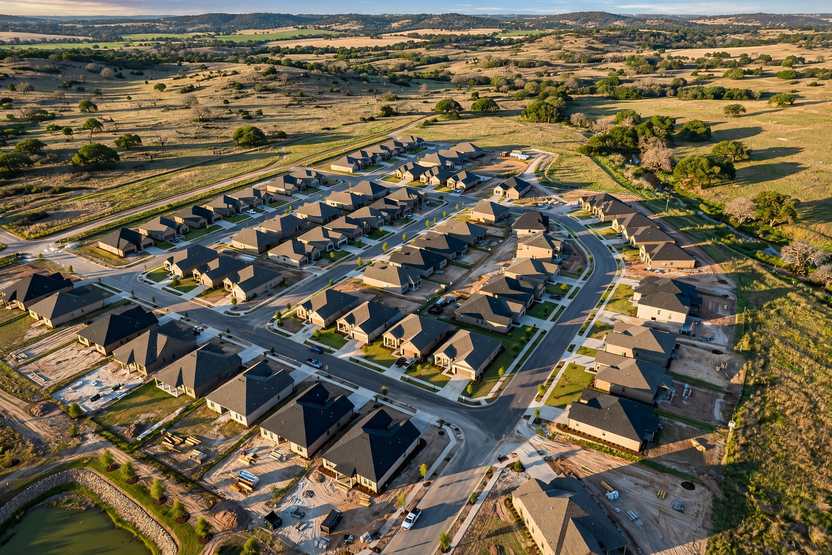
There is a second trap, and it is built into new streets. When a subdivision goes up fast, the roofing crews who covered those houses were working to a builder's pace, not a homeowner's pace. Most of the work is fine. Some of it is rushed in ways that only show up years later, when heat, wind and driven rain have tested every joint a few hundred times. A nail pattern that was a little loose, a course of shingles that never quite sealed, a vent left a little short of what the attic needed: none of it leaks on day one. All of it can leak by year five. That is the honest picture of emergency roof repair Buda Texas work. The roof is young. The failure is specific. The fix, once the failure is found, is usually small.
None of this is a reason to feel bad about a Buda house. A young roof with one failed detail is a good roof with one problem, and one problem is the best kind of roofing news there is. It just has to be found properly, and found soon, because water does not respect a roof's age. It rots the same boards in a five year old house as in a fifty year old one, on the same schedule, and it feeds the same mould in the same attic. Young house, old rules: stop the water first, trace it second, fix the real point third.
The 2 a.m. test
Every call starts with the same question: is this an emergency, or not? Here is the test our emergency roof repair Buda Texas crews run through on the phone. Water coming in right now makes it an emergency: a drip through the ceiling, a trickle down a wall, any water near light fittings or wiring. A stain you have just spotted, dry, with nothing dripping and no rain on the way, can wait for a call in the morning. Buda adds one twist. If you have only just moved in and cannot tell a new stain from an old one, treat any stain that is growing as active until someone has been up in the attic.
Still not sure? Call (512) 555-0147 and describe what you see. Talking it through settles it faster than staring at the ceiling does.
Try the test the way a crew chief runs it. Make one slow lap of the house, eyes on the ceilings, not the carpets. Water announces itself overhead and high on the walls long before it reaches the floor. In a two-storey Buda home, give the upstairs rooms the closest look, especially under the low edges of the roof and anywhere the roofline bends or joins, since valleys and tie-in joints on a new-build roof open up years before the wide flat stretches do. Dry ceilings everywhere, and no drip showing at the attic hatch, means you can sleep on it. One wet patch that is spreading means the question is settled, and your next call is an emergency roof repair Buda Texas call, no matter what the clock says.
Grey cases
It can, and on a young street it often is. A stain in a nearly new Buda home usually means a detail failed early: a boot split in the heat, a flashing joint that was never seated right. The young age of the roof is good news for the repair, not a reason to doubt the stain. Book an emergency roof repair Buda Texas trace, and soon.
Call now. A tree limb lying on a roof is heavy, and the boards under it may already be split. One more gust can move it and tear the hole wider. Keep the family out of the room below, and leave the limb where it is. A branch under pressure jumps when the saw bites, and that jump injures people.
Plenty of owners get caught out by this one. When a leak only appears in heavy rain, wind is usually pushing water under a lifted edge, a course that never sealed or a worn flashing, and it is a genuine leak even if it hides for weeks. If a bucket handles it and the ceiling feels firm, morning is fine. Still book a trace before long: every hard rain soaks the boards again.
This one can wait until morning. Hail knocks the grit loose and bruises a shingle from underneath, and the harm only shows itself weeks or months down the road as worn patches, never as a leak the same night. Book a daylight check instead. And sign nothing at the door tonight, while the storm is still doing the talking.
A dry morning is soon enough for this one, most times. The felt under the shingles acts like a backup layer and will turn water on its own for a while. That buys time, nothing more. Texas sun eats felt quickly, so a patch left bare through a season turns into the next leak, and trading a small fix now for a bigger one later makes no sense on a young roof.
Call now, but turn that circuit off at the breaker before anything else. In this one case the wiring comes first and the roof second. Water running into live fittings can shock someone or start a fire, and a ceiling is never worth that gamble.
The water does not care which room it is in. It is rotting the same boards and feeding the same mould. The only thing that changes is how much you have to move. In Buda's newer homes the garage ceiling often sits under a porch tie-in or a valley, which makes a garage drip a useful clue, not a lesser one. Treat the leak the same, and use the extra calm to take good photos.
First-hour manual
Our crew is rolling down I-35 toward you. The wait is not dead time. What you do in this hour decides how much of the damage stays small, because on most emergency roof repair Buda Texas jobs the worst harm happens indoors while the roof waits. Seven things, in order:
Keep water and electrics apart. When drips come through a ceiling light, find the breaker box and switch that circuit off before you do anything else. Never stand in a puddle to reach it. If getting to the box means crossing a wet floor, skip it: leave the power as it is and keep the whole family out of that room until help arrives.
Catch the drip in a bucket, towels spread around it for the splash, furniture and rugs dragged well clear. Drop a folded towel into the bucket too: it muffles the plinking that keeps everyone awake on a long night.
A ceiling that bulges downward is holding water on top of the plaster. When the bulge is small and still swelling, you can let that water out yourself in a controlled way: bucket beneath the lowest point, one small screwdriver hole, and a thin stream running where you chose. A wide bulge is a different story. If the ceiling sags or cracks are crawling outward, hands off. Get people and pets out of the room and leave it empty. A ceiling on its way down needs nobody underneath it, and one careful choice here is the whole difference between a drained ceiling and a room full of plaster.
Stay off the roof tonight. Rain makes shingles treacherous, storm-loosened boards can give way without warning, and even a dry tarp slides underfoot. The useful work in this first hour is all indoors. The roof will still be there at daylight, and so will you, if you let it wait.
The stain, the drip, the fallen limb, the shingles in the yard, from the ground and from indoors. Get the ceiling bulge before you drain it, and the bucket where it stood. On a young Buda home, photos do double duty: they are proof for you, and they show the crew exactly where the water showed itself, which is where the tracing starts. Photos taken tonight save real time in the attic tomorrow.
Move what water ruins: laptops, paperwork, cushions, bedding. Get them onto a table, well clear of the damp patch. A cardboard box on a soaked floor is already lost, so empty it and carry the contents out. Pull curtains away from a wet wall, and open a soaked cupboard wide so air can move.
(512) 555-0147. A leaking roof needs a roofer, not a general hand. The crew needs tarping kit, the right ladders, and eyes trained to hunt the real entry point, which on a new-build roof usually hides at a joint.
One last word on this hour: the attic can wait. Poking around up there in the dark teaches most people very little, and Buda attics make it worse, with low slopes, tight runs and ductwork where you want to step. If you have firm boards and a strong torch, one look from the hatch may show which slope the water is crossing, and you can pass that on. If it feels awkward, leave it shut. A ceiling with your foot through it helps nobody, and reading the attic is the crew's job when they get there. It comes as standard with every emergency roof repair Buda Texas visit.
How we work
Four steps, same order, every call. A cracked boot on a three year old roof and half a slope in the yard look like different jobs, but an emergency roof repair Buda Texas visit treats both the same way:
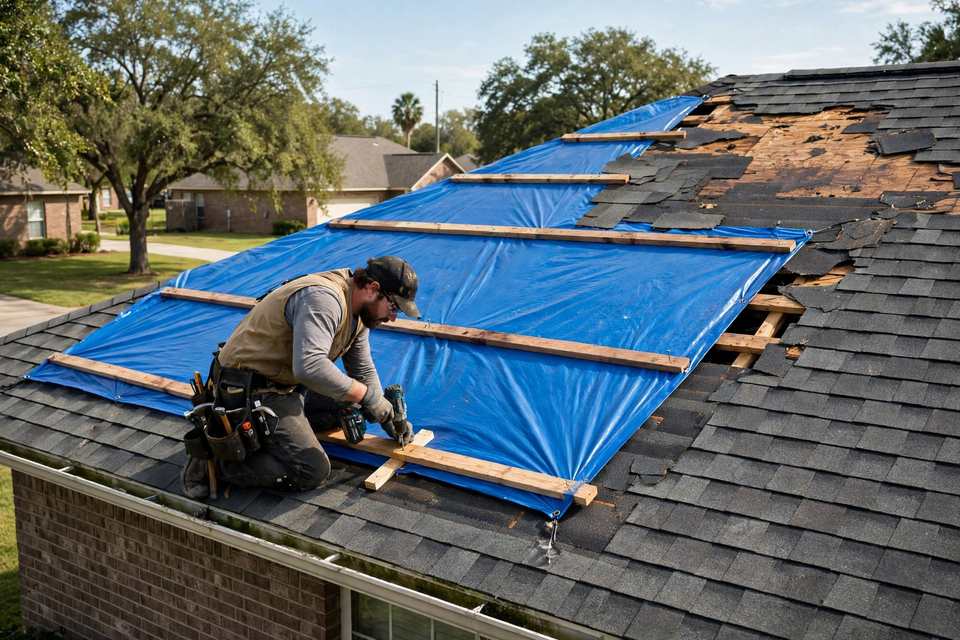
Step one is the weather, not the repair. We get the opening covered and sealed so the house stops swallowing rain. On a dark call that might be a tarp pulled tight and battened down properly, or a patch sealed over the torn spot. The job is done when we can step back and watch: nothing coming through any more.
Then the site gets made safe. Anything loose comes down, and nobody stands or works beneath a damaged slope. A limb hanging over the roof is either secured or left completely alone until it can be handled right. Cracked boards get marked so no boot lands on them. From the yard this part can look slow. It is why everything after it can move fast.
We photograph the damage and the finished fix, then walk you through the pictures in plain words before we leave. The split boot. The gap where the porch roof ties in. Nails riding up out of the shingles. Then the same spots, repaired. Anything too awkward to photograph comes down the ladder and gets shown to you in hand. In emergency roof repair Buda Texas work, showing proof is not a courtesy. It is part of the job itself.
With the roof dry and fully checked, the lasting repair gets written down as a scope before anyone starts. The scope names the parts, the work, and the order the work runs in. If the daylight check turns up damage the night visit could not see, it goes in the scope, with photos, before that extra work is touched.
The order of a visit never changes, and there is a reason. Skip the evidence and rush the repair, and you end up dry but holding no proof of what was wrong. Open with a sales pitch instead, and you stay wet while someone talks. So the sequence holds: stop the water, clear the hazards, show the proof, then repair. Book an emergency roof repair Buda Texas call and that is the visit that turns up, in that order, every time.
Our promise
Most emergency roof repair Buda Texas calls end with a repair, not a new roof, and on Buda's young streets that is doubly true. If a boot, a flashing joint and an hour of careful work will hold, that is what we will recommend, and we will show you the photos so you can judge for yourself. We do not invent emergencies, and we do not treat a young roof like a worn-out one. If a roof truly is failing early across every slope, the evidence will show you that on its own, slope by slope. You will never get a countdown clock from us.
On a new-build roof, repair-first has a plain meaning. One failed part sits behind most single leaks: a split pipe boot, a flashing joint that never sealed, a valley laid the wrong way, a handful of shingles torn loose by a storm. The fix that matches that kind of damage is small, often a matter of inches rather than whole squares of roofing. So when a crew looks at one cracked boot on a six year old roof and starts talking about replacing everything, the leap did not happen on your roof. It happened in the sales plan. Our emergency roof repair Buda Texas crews work to the opposite rule: take the smallest repair that will genuinely hold, then let the photos prove it was enough.
Repair-first also means we will tell you when a repair is NOT the honest answer. Once in a while a young roof was laid badly in ways that run through every slope: nails wrong everywhere, courses that never sealed anywhere, flashing skipped at joint after joint. Patching that roof one leak at a time is not thrift. It is a subscription to leaks. In that case we show you the evidence plainly, explain why this roof is the rare exception, and let you decide in your own time. No countdown, no tonight-only anything. The evidence does the talking, and it talks just as well next week.
The details decide
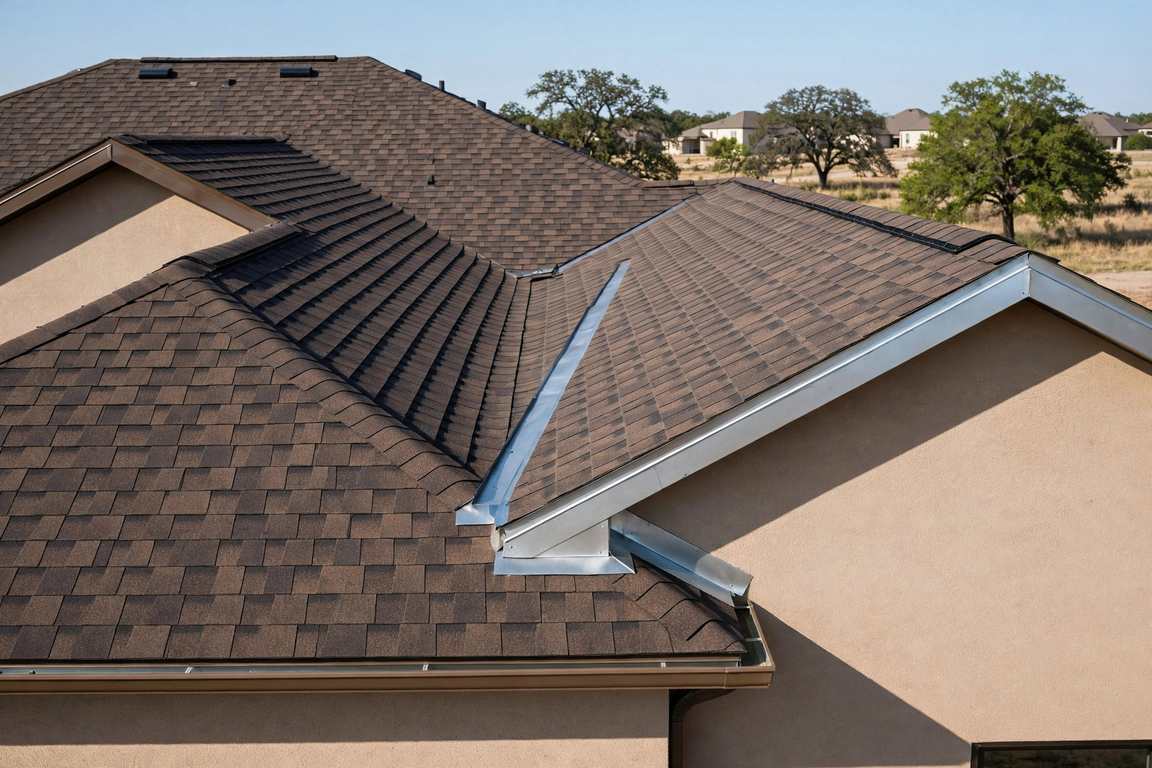
Ask a Buda homeowner where their young roof leaked and the answer is almost never "in the middle". The middle of a shingle field is the simplest part of the roof: flat boards, overlapping courses, gravity doing the work. Shingles there can be ordinary and still shed water for decades. The leaks live where the roof is interrupted, joined, pierced or turned. Every pipe that pokes through, every wall that meets a slope, every valley where two slopes drain into one channel, every place a porch or an addition ties into the main roof: those are the engineered moments of a roof, the places where a part has to do a clever job, and clever jobs are the ones that fail early when they are done fast or made cheap. An emergency roof repair Buda Texas trace on a young home is really a tour of those moments, one by one, until the guilty one shows itself.
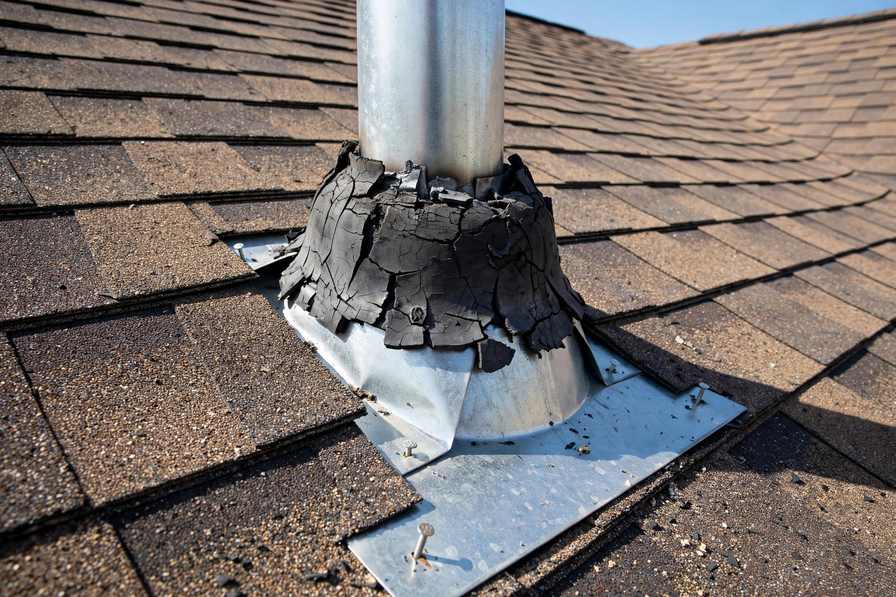
Every house has pipes that vent through the roof, and every one of those pipes wears a boot: a flashing base with a rubber collar that hugs the pipe. The rubber is the weak point. Texas heat bakes it, season after season, until it hardens and cracks, and the crack opens a neat little funnel that pours rain straight down the pipe and into the attic. Builder-grade boots, the ones fitted by the thousand on new streets, are often the thinnest version of the part. On older roofs a boot might last fifteen years. On a fast-built Buda roof in full sun, on emergency roof repair Buda Texas calls we meet boots split at five. The fix is small and specific: a new boot, fitted right, sealed right. The lesson is bigger. When a young roof leaks, the boot is where an honest trace starts, because it is so often where the story ends.
Flashing is the shaped metal that keeps water out of the joints: along walls, around chimneys, at the edges of dormers, where a porch roof dies into a wall. It works by overlap and by order, each piece shedding water onto the next, and it fails in quiet ways. A step flashing piece left out where a wall meets a slope. A counter flashing sealed with a bead of goo instead of being cut into the joint. A kick-out flashing never fitted at all, so water running down a wall edge pours behind the siding instead of into the gutter. None of these leak on the day the house is sold. They leak after a few years of heat movement and driven rain have worried the weak point open. Flashing faults are the classic emergency roof repair Buda Texas finding on homes under ten years old, and they share one trait: the shingles around them look perfect, which is why stain-aimed repairs keep missing them.
Buda homes love a porch, a patio cover, a bump-out. Each one ties a small roof into the main roof or into a wall, and each tie-in is a joint that has to be built in the right order: the small roof's covering running up under the main roof's covering or flashing, so water always lands on top of a surface, never behind one. Tie-ins built in a hurry get the order wrong, or rely on a line of sealant to do a flashing's job. Sealant ages in Texas sun faster than any other part of the roof, so a tie-in that was watertight at the walkthrough can be a funnel by the third summer. If your leak sits under a porch line, a garage tie-in or the seam where an addition meets the house, that joint is the first place we look, and it is the first place you should point to when you call an emergency roof repair Buda Texas crew.
A valley is the channel where two slopes meet, and in a storm it carries the water of both. New-build rooflines in Buda are full of valleys, because the styles buyers like, hips, gables, dormers, crossed slopes, create them everywhere. A valley has to be lined and lapped so that a river of driven rain can run down it without ever finding an edge. Valleys fail young when shingles are cut short of the centre line, when nails sit too close to the channel, or when the lining under the shingles was skimped. The leak then shows up in the room under the valley, which is often not the room anyone suspects. Valley work is slow, fussy and exact, which is precisely why it suffers on a fast build, and why valley tracing earns its keep on an emergency roof repair Buda Texas visit.
Once in a while the trace does end in the open field, and on a young roof that points at how the shingles were laid rather than how they aged. Courses set with the wrong overlap leave the nail line exposed to driven rain. Shingles laid over a deck that was not flat telegraph every bump and crack early along the ridges of those bumps. A slope facing the worst of the sun can cook faster than its neighbours and lose its grit years ahead of them. These are laying faults, not wear, and the honest report says so in plain words, with photos, because a laying fault in one slope raises a fair question about the others. That is a conversation we have with evidence on the table, never with pressure in the room.
Built fast, tested slow
A new subdivision roof is a promise that gets tested a few hundred times a year: every heat wave, every storm line, every night the temperature swings. Most of those roofs pass. The ones that call us tend to fail in one of a handful of ways, and each way has a plain name and a plain fix. No builder is named here, and no street is singled out. These are patterns, and you will find them in fast-built streets in every growing Texas town.
A shingle is held by a small number of nails in a narrow strip, and the strip matters. Nails driven too deep, by a gun set too strong, cut through the shingle instead of holding it, and the tab above is then held by habit rather than by metal. Nails placed too high miss the double layer they are meant to catch. Nails too few let a course creep and lift in wind until the seal below gives up. None of this shows from the street. It shows on a ladder, nail by nail, which is why a proper emergency roof repair Buda Texas check on a young roof includes lifting a few tabs and looking at the pattern, not just admiring the surface. A bad pattern in one spot is a repair. A bad pattern everywhere is a finding we will show you with photos and talk through calmly.
Shingles seal to each other with a strip of tar that softens in the sun and bonds the course above to the course below. That bond is the roof's wind defence. It fails to form when shingles are laid in cold weather and the strip never gets its warm day, when dust or grit coats the strip before it can bond, or when a course is laid slightly off line so the strip lands on the wrong surface. An unsealed course looks identical to a sealed one from the ground. The difference appears in the first hard wind, when tabs lift, fold and sometimes leave. If your Buda roof sheds a tab or two in every big blow while your neighbours' roofs hold, unsealed courses are the likely story, and re-sealing and securing the loose field is a real repair with a real end point. An emergency roof repair Buda Texas crew can test the bond by hand, tab by tab, on a dry day.
A roof needs the attic under it to breathe: air in low, air out high. Fast builds sometimes short-change that flow: too few vents, a ridge vent run that stops short, vents blocked by insulation pushed tight against the deck. A hot, still attic does two kinds of damage. It cooks the shingles from below and shortens their life, and it traps moist air that condenses on the cold parts of the deck in winter, dripping inside the attic in a way that looks exactly like a roof leak. We have traced more than one "leak" on an emergency roof repair Buda Texas call to a bathroom fan venting straight into the attic, soaking the insulation with every shower. Ventilation faults are not dramatic, and nobody sells them at a doorstep. They are simply common in fast-built homes, and they belong on the checklist whenever a young roof misbehaves.
Builder-grade does not mean fake. It means the lightest version of each part that passes: thinner boot rubber, lighter felt under the shingles, the basic shingle line rather than the heavy one. Each part is legal, each part works, and each part has less margin when Texas weather leans on it. The practical meaning for a Buda homeowner is timing. Parts that might last twenty years in a mild climate can be done at eight or ten here, and the roof's first round of small failures arrives earlier than the brochures suggest. That is not a scandal and it is not a reason to replace a young roof. It is a reason to fix the small parts as they fail, with better parts than the ones that came off. Every emergency roof repair Buda Texas visit we run swaps failed builder-grade parts for heavier ones, so the same spot does not call twice.
Central Texas weather
Buda sits in the middle of the Texas storm corridor, and its weather year has a shape every homeowner here learns. Spring brings the storm lines: fast fronts rolling in with wind that tests every edge and ridge, rain driven sideways hard enough to climb under laps, and hail in the mix often enough that spring is when we check the most roofs. Summer trades storms for heat, the long bake that cracks boot rubber and cooks unsealed courses. Autumn can swing back to heavy rain. Winter is mostly kind, with the odd freeze to remind pipes and parts that Texas is not always warm. A Buda roof does not face one enemy. It faces a rotation, and each season tests a different detail. That rotation is what emergency roof repair Buda Texas work is built around.
Hail deserves a straight paragraph, because it is the word that sells the most fear in this trade. Just up I-35, Austin has recorded 59 hail days since 2010 within fifteen miles of its centre, and Buda shares the same sky, the same fronts and the same season. Hail rarely opens a roof on the day it falls. It bruises the mat inside the shingle, the grit washes away over the following months, and the bruised spots age years ahead of the rest of the slope. That is why a storm check matters even when nothing drips, and also why it should be a check and not a sales event. A counted, photographed hail check tells you whether your street took real bruising or just noise. Our storm page walks through the full method, and any emergency roof repair Buda Texas homeowner can ask for the count to be shown, square by square, before believing a word of it.
Wind is the quieter test, and on Buda's young roofs it may matter more. A new subdivision is often open country on one side, fields and new roads with nothing tall to slow the gusts, so the first streets built take the weather at full strength. Wind works a roof from its edges: lifting tabs on unsealed courses, worrying at ridge caps, pushing rain uphill under laps that shed falling water perfectly well. Most wind leaks on young roofs start at a detail the wind could reach, which is why our storm checks here start at the edges and corners rather than the middle. If a storm has just passed over Buda and you are reading this with dry ceilings, the daylight routine is simple: walk the yard for shingles and grit, look at the slopes from the street, then put your head in the attic and breathe in. Clean yard, flat slopes, dry smell: your roof most likely rode it out. Grit in the gutters, a lifted edge, a musty smell: book the check and get the photos taken while the storm is still easy to date.
When a storm does open a Buda roof, the shape of the work is the shape you have already read on this page: stop the water, make it safe, show the proof, then repair on a dry day. The full storm service, with the check method and the tarping that often follows, lives on our storm damage page, and the cover itself is covered in depth on our tarping page. This page's job is narrower: to make sure a Buda homeowner can tell a real storm problem from a sales pitch, and a tonight problem from a morning one.
Leak tracing
Here is the thing nobody tells you until the second failed fix: the wet patch on your ceiling is almost never under the hole. Water gets in at a high point, a cracked boot, an open tie-in joint, a valley that has split its lining. Then it runs along the boards, sometimes eight feet or more, before it finds a seam and drips through. In a Buda two-storey, it can run along a joist, drop onto a duct, and appear in a room that is not even under the slope that leaked. That is why a leak can survive two repair attempts aimed at the stain. The stain is where the water gave up, not where it got in. Every emergency roof repair Buda Texas leak call we run starts from that fact.
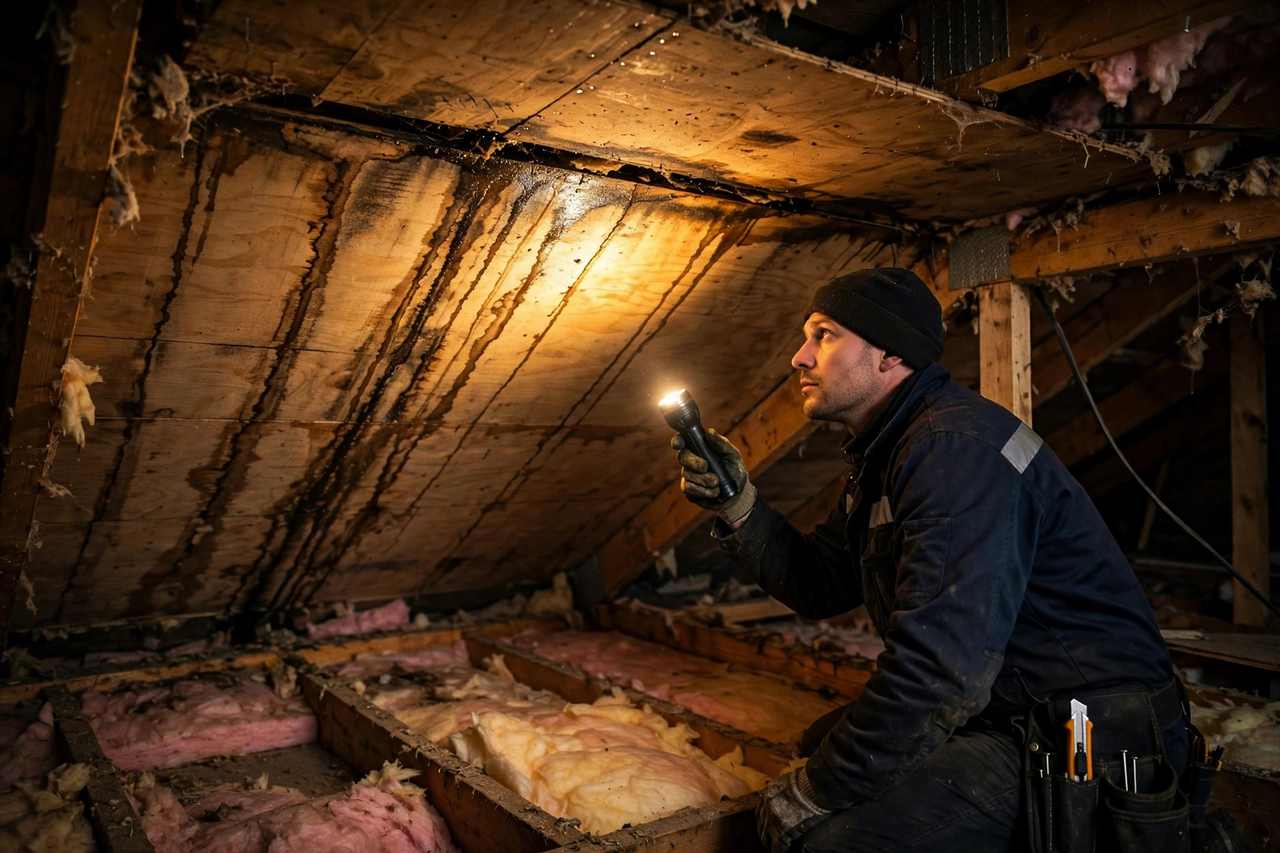
So we trace before we seal. The attic comes first, then the roof, section by section, working the way water moves. In the attic the clues are easy to read once someone shows you: boards streaked dark below the entry, nail tips rusted where water keeps passing, insulation pressed flat and stained from being soaked over and over. Follow the wet marks upward, because water never climbs. The topmost mark sits nearest the hole. On the young roofs around Buda that trail tends to end at one of the details covered above: a boot, a joint, a valley. Fix that single point well and the stain dries out for good.
When the leak shows up tells its own story, and callers usually give away more than they realise while they describe it. A stain that appears only in the heaviest rain is pointing at a joint or flashing that holds in ordinary weather and gives way once water runs deep and the wind drives it. A stain that turns up hours after the sky has cleared means the water wandered a long route through the roof before it found a place to fall. And a drip on a dry day often has nothing to do with the roof at all: a plumbing line or an air-conditioning drain up in the attic is the likelier source, a mix-up we run into often in newer Buda homes with their long, tangled attic plumbing runs, so we ask about it on every call. A good emergency roof repair Buda Texas crew asks when it leaks before anyone sets a ladder, because the answer cuts the search in half.
When the trail is not clear from the attic, the hose test ends the guessing. One person stays in the attic with a torch, watching the boards. The other runs a hose on the roof, one small section at a time, starting low and working up, a few minutes on each section. The moment water shows inside, the section being soaked is the section with the entry. Slow work, wet work, and it settles the question for good. It is also a two-person job on a dry day with a stable ladder, which is why it belongs to a crew and not to a homeowner at midnight. The full tracing method lives on our roof leak repair page. This page just needs you to know that in Buda, as everywhere, the stain is the end of the story, not the start of it.
Know your own roof
You cannot inspect a roof from the yard, and nobody should pretend otherwise. But you can read one, and on a young Buda roof, reading is often enough to catch a problem in the season when it is still small. Most of what sends an emergency roof repair Buda Texas crew up a ladder first shows itself from the ground: a lifted edge, a slipped shingle, grit where grit should not be, a stain on the siding under a joint. Twice a year, once before the spring storm season and once after the summer bake, walk your house slowly with your phone in your hand and look up. Ten minutes, four sides, no ladder. Here is what to look for, in the order an emergency roof repair Buda Texas crew would look for it.
Start with the edges. Wind works a roof from its edges inward, so edges are where young roofs confess first. Look along the eaves and the rake edges for tabs that sit lifted, curled or out of line with their neighbours. A sealed course lies flat and boring. An unsealed one casts a shadow line you can see from the street once you know it exists. Check the ridge cap along the top for pieces that have shifted or cracked. Then look at the gutters: a spoonful of grit after a storm is normal wear, but grit building up month after month, or a sudden pile of it under one downspout, is a slope aging faster than it should, and that is a finding worth a call before it becomes an emergency roof repair Buda Texas visit at midnight.
Next, the details you can see. Stand where you can sight along each wall and look for the places the roof is pierced or joined: the vent pipes, the wall lines, the porch tie-in, the valley mouths. You are not judging the work. You are looking for change. A boot that has slipped down its pipe leaves a gap you can sometimes see with binoculars. A valley that is collecting leaves and grit is holding water against its lining after every rain. Siding stained dark under a roof-to-wall joint is water going where it should not, written on the wall in plain sight. Take a photo of each spot from the same place each time. Dated photos, six months apart, turn "it looks worse" into proof, and proof is the currency of every honest emergency roof repair Buda Texas conversation.
Then do the inside half of the walk-around, because the attic tells the truth the yard cannot. On a dry day, put your head through the hatch with a torch and look at the underside of the deck above the rooms you care about. You are looking for dark streaks, for nail tips gone rusty in a line, for insulation that lies flat and dark where the rest is pale and fluffy. Breathe in while you are there. Warm wood and dust is a healthy attic. Sweet and musty is water sitting somewhere, and it is worth tracing while the trail is fresh. None of this needs crawling, touching or bravery. If the hatch view is awkward in your home, skip it and say so when you call. Reading the attic is built into every emergency roof repair Buda Texas visit we run, and a crew would rather read it themselves than have you miss a step in the dark.
Know which findings change the walk-around into a phone call. A drip, a growing stain, a bulge, water near wiring: those are tonight findings, and the emergency test near the top of this page is your guide. A lifted edge, a grit pile, a slipped boot, a musty attic smell with dry ceilings: those are this-week findings, booked in daylight, fixed while they are still one-part problems. A clean walk-around, twice a year, is the quiet best case: it means your young roof is doing what it was built to do, and you have the photos to prove that too. That proof matters more than people think. If a storm ever does bruise your street, your own dated photos from before the storm are the clearest record of what your roof looked like when it was sound, and any emergency roof repair Buda Texas crew will tell you that record settles arguments before they start.
One limit, stated plainly: the walk-around reads the roof's surface story, not its whole story. It cannot see under the shingles, inside the valley lining, or along the nail line, and it cannot test whether a course has sealed. That is what a roof-level check is for, and our inspection page explains how that check runs. The walk-around and the inspection are partners, not rivals. The walk-around, done twice a year, tells you when the inspection is due. For a young Buda roof in its first decade, that rhythm, ground reading twice a year, roof-level check when the ground reading says so, is how small parts get swapped while they are still small, and how an emergency roof repair Buda Texas call stays the rare exception instead of the yearly habit.
Services in Buda
Every service below runs in Buda on the same order: stop the water first, repair second, proof throughout. If you are not sure which one your roof needs, that is normal. Describe the drip, the stain or the sound, and the sorting happens on the call. Every one of them is emergency roof repair Buda Texas work in the end: water stopped, cause proven, fix done right.
The full night service lives on this page: water stopped, roof made safe, and the lasting repair scoped once the roof is dry and checked. A call-out, a cover or a seal, photos of everything, and a written scope for the permanent fix. If water is getting in and you cannot tell which service it belongs to, it belongs to this one.
Wind, hail and fallen limbs. A storm hits the whole roof in one night, so the check runs from the ridge down to the gutters before anything gets fixed: an edge lifted on one slope, bruising on another, a limb lying at the back. That is wider work than a single leak. On Buda's open new streets the wind side matters most, and you see the count with your own eyes instead of hearing a number called down.
A tarp only earns its keep when it is fitted flat, pulled tight and held with battens, so the next storm leaves it in place instead of tearing it apart. Done that way it buys about 30 to 90 days of dry cover while the real repair is booked and the roof dries out. Done badly, it turns into a sail dragging on the shingles below it. Boards, edges and patience are the whole difference.
A drip gets traced before it gets sealed, or the same drip is back with the next storm. Sealing without tracing is guesswork done with a sealant gun. The crew starts in the attic and works uphill along the water's path to where it gets in, then fixes that single point. On an emergency roof repair Buda Texas leak call, that point usually has a name: a boot, a joint, a valley.
Not every repair is an emergency. The boot that is cracking but not yet leaking, the course that lifted in last month's wind, the flashing that needs reseating before the spring lines arrive: booked in daylight, done properly, photographed the same way. Young roofs reward early small repairs more than any other kind, because the rest of the roof still has its years ahead of it.
A counted, photographed check of the whole roof: slopes, details, attic signs. For Buda homes the natural moments are after a big storm line passes, before you buy or sell, and when a subdivision street reaches the age where the first boots start to split. You get the photos and the plain-words report, and the findings are yours to use with any crew.
The honest version of the hardest question in roofing. On a young Buda roof the answer is nearly always repair, and our page on the question shows the working: what counts as a roof at the end of its life, what counts as a roof with one bad part, and how to check anyone's verdict, including ours, against the evidence in the photos.
Hail bruises hide. The mat inside the shingle breaks, the grit washes off over months, and the slope ages years in one spring afternoon. Our hail work is a counted check with chalk and photos, slope by slope, so an emergency roof repair Buda Texas homeowner can see exactly what the storm did and what it did not do, before deciding anything at all.
Sometimes, rarely on Buda's young streets, the honest answer is a new roof: a build laid badly through every slope, or damage too wide for patches to hold. When that day comes, replacement should be a calm, planned job with a written scope, not a midnight decision. Our page explains how we run it and how to judge any crew's plan, ours included.
Our guide walks through the question itself: what makes a roof problem an emergency, what the first 24 hours should look like, and which problems are morning problems in disguise. It is the page to read before you need it, and the page to check at 2 a.m. when you do. It is where emergency roof repair Buda Texas questions get answered before they become emergencies.
A town growing up together
A subdivision is a strange thing in roofing terms: dozens of roofs installed in the same season, with the same materials, by the same few crews, all meeting the same weather on the same days. They age in step. That has a practical side a Buda homeowner can use. When the first house on a street needs its boots swapped, the street is entering boot years. When one neighbour's valley opens up, the same valley detail on your roof is worth a look. Roofing news travels well on a young street, and a street that shares what it learns gets its small repairs done years earlier than a street that does not. Many emergency roof repair Buda Texas calls we take begin with the words "our neighbour just had the same thing", and the neighbour is usually right.
The first big storm is a young roof's first real exam, and it deserves a calm word. A roof can pass a hundred ordinary rains on the strength of its overlaps alone, then meet one driven storm that tests every seal, joint and edge at once. Failing that exam at one joint does not make the roof a bad roof. It makes it a roof with one joint to fix, and fixing it early is what keeps the exam from being repeated at the same weak point every spring. If your street has just had its first serious storm since the houses went up, a check is not panic. It is homework, done once, with photos.
Two habits protect a young Buda roof better than any product. The first is paper: keep the photos, the written scopes and the visit notes from every call in one folder with the house papers. A young house will outlive several rounds of small repairs, and that folder becomes the roof's memory: what failed, what was fitted, what was left alone on purpose. It makes every future crew faster and every future decision easier, and it is gold when the house is sold, because the next owner inherits the truth about the roof instead of a guess. The second habit is the attic smell test. About a week after any repair, and once each season besides, put your head through the hatch on a dry day and breathe in. A drying attic smells like warm wood and dust. A trapped-damp attic smells sweet and musty, and that smell means water is still sitting somewhere it should not. The smell alone is worth a call, and catching damp in week one is the whole difference between drying a roof and opening a ceiling in month three.
A last note on timing. Buda is growing toward its roofs' middle age all at once, and the streets built in the town's first big wave are now entering the years when the small parts start their slow failures: boots first, then sealant lines, then the felt at the hardest-worked valleys. None of that is an emergency today. All of it is a reason to treat the first small leak on a young street as information rather than bad luck. An emergency roof repair Buda Texas visit that ends with one boot replaced and a folder of photos is not a bad night. It is the simplest education a roof can give you, and it arrives right on schedule.
The honesty check
Texas has no state licence for roofers, so a card and a truck prove nothing, and a fast-growing town is exactly where that fact gets tested. New streets are easy to find, full of young roofs and busy owners, and an emergency roof repair Buda Texas homeowner has to sort callers without a licence register to lean on. After every storm the knockers arrive: someone "working just down the street" who would love a look at your roof. Some of them are fine. Some find damage that was never there. You do not have to guess which kind is standing at your door. Ask these questions before anyone climbs:
Our crews answer all of them before we touch a shingle. Any emergency roof repair Buda Texas roofer should pass the same test, and any roofer who gets annoyed by the questions has just answered them. One more check takes two minutes: watch how a crew talks about the roof they cannot see yet. Honest roofers talk about what they will check. Sellers talk about what they will find. The first kind says "we will trace it and show you". The second kind has the verdict ready before the ladder is up.
Service areas
This page is Buda's, and Buda is where this page's work happens: ZIP code 78610, the subdivisions along I-35, the older streets near the town centre, and the Hays County roads running out of town. Crews reach Buda from the Austin side, twenty minutes in ordinary traffic, and Buda calls are answered by the same emergency roof repair Buda Texas line as every other town on this site: (512) 555-0147, day or night. The neighbouring towns each have their own pages, with their own local details, because a roof's problems follow its town's age and weather, not a template.
Buda's big neighbour up I-35 and our crews' home base. Hard storms, hot summers, and pipe boots that crack early in the heat. Austin roofs also sit under a lot of live oak, so limb damage and leaf-blocked valleys are steady work there. Many Buda callers work in Austin and meet our crews there first; the same crews answer in Buda.
The closest neighbour, just north of Buda on the way into Austin. Manchaca mixes older homes on big lots with newer builds, and its roofs split the difference: some young detail leaks like Buda's, some slow hidden leaks in older fields. If your street sits between the two towns, either page will tell you the truth; the crews, the number and the emergency roof repair Buda Texas standard are the same.
Older roofs under a steady lake wind, and leaks that can sit hidden for months. The open water keeps the gusts coming, and each season lifts the edges of those older shingle fields a little further. Most of the work up there is slow, quiet leaking, so careful tracing beats rushing.
Wide slopes, tall rooflines and a long hail record. Plano houses give wind-driven rain plenty to work on, with flashing and valleys on every slope where water can push in. After spring storms, a hail check is simply part of the calendar there.
Gulf weather on a bigger scale: heavier rain, stronger storm surges of wind, and roofs that face standing water and driven rain in the same night. Houston is a separate crew area with its own page, because Gulf storms write different rules than Central Texas ones.
Your town not listed? Call (512) 555-0147. If your home is beyond where we can reach in time, we will say so on the call instead of leaving you hanging on a promise. An honest no at nine beats a hopeful maybe at midnight, and any emergency roof repair Buda Texas crew worth hiring will tell you the same.
Aftercare
Other pages finish when the repair does. A house does not. The month that follows an emergency roof repair Buda Texas visit has a pattern of its own, plus a short list of things worth watching.
Get the inside drying, fast. Stopping the leak starts a second clock, and this one runs indoors. Carpet, insulation and plaster that stay wet past a day or two grow mould in places you will never see. When the rain clears, open the windows. Aim fans at the wet patch. Pull anything flat off a damp wall so air can get behind it. Nobody is asking you to rebuild a flooded house. You are only making sure one bad night does not turn into a second repair.
Do not paint that stain yet. A stain that is drying out stops growing and fades pale and dusty at the edges. One that spreads, darkens or shows up again after rain is a working alarm: water is still coming in, and the right move is a call back to us. Paint over a live leak and you have silenced the only warning you had. Give it a few rains. Three solid storms with no change, and the stain has earned its coat of paint.
After hard wind, walk out and study the tarp from the yard. Lifted edges, a corner flapping, water pooled in a sag: any of those means the cover has shifted, and a shifted tarp needs a visit before the next rain, not after it. You never need to climb to spot this. Everything a tarp does wrong shows from the ground.
The photos, the written scope and the visit notes belong in the folder with your house papers, not in a memory. On a young home that folder becomes the roof's history: what failed, what was fitted, what was left alone on purpose. It makes the next crew faster, the next decision easier, and the next owner grateful.
If your five year old roof had a split boot, the same boot on the same build two doors down is the same age, in the same sun. Telling your neighbours what failed on your roof is the simplest warning system a young street has, and it is how whole subdivisions get their small repairs done early.
If one of these checks turns up a problem, ring the number you already have: (512) 555-0147. A repair that fails brings us back to fix it, because that part is on us. And judge any emergency roof repair Buda Texas crew by this: one that will not return to its own work has told you what its work was worth.
Questions
No sales talk. The questions emergency roof repair Buda Texas callers ask, answered the way we answer them on the phone:
If water is coming through right now, it counts. A hole, a section torn away, shingles gone with bare deck showing, a branch punched through, a ceiling dripping or starting to bulge. On a young Buda roof, count one more sign: a ceiling stain that grows while the rain is still falling.
Because young roofs leak at details, not in the open field. The rubber boot around a vent pipe can split in the Texas heat within five years, a flashing joint may never have been seated right, and a porch tie-in can rely on sealant that ages fast. The shingles are usually fine.
Some leaks cannot wait for daylight: water pouring in, a tree down on the roof, daylight showing through the deck, or drips falling close to lights or wiring. Those mean a call tonight. A slow drip is another matter. Rain stopped, bucket holding it, nothing spreading: that can wait, and a call first thing in the morning does it.
Move furniture, rugs and electronics away from the drip and put a bucket under it. If the ceiling bulges, drain a small, growing bulge through one small hole into the bucket, but leave a wide, sagging ceiling alone and empty the room. Take clear photos, and never climb on a wet roof.
Usually not. One leak almost always means one part failed: a boot, a flashing joint, a valley, a tie-in. A roof built badly through every slope does exist, but it is rare, and the difference shows in the photos. We show you which one you have before anyone talks about bigger work.
No. A tarp is a stopgap. It holds the rain off while the weather settles so the proper repair can be done in the dry. Fitted flat, tight and battened down, one will guard a home for roughly 30 to 90 days. Leave it up for months and it works loose, rips and lets water back in.
Yes. We work across Buda, ZIP code 78610, including Sunfield, Garlic Creek, Whispering Hollow, Shadow Creek, Elm Grove, Ruby Ranch and Elliott Ranch, plus the Hays County roads around town. If you are just outside Buda, call anyway. If we cannot reach you in time, we will tell you plainly.
Texas does not licence roofers at state level, so after a storm a printed card and a smart truck tell you nothing. Ask for a real address near Buda, a scope in writing before work starts, and photos of what they find. Treat doorstep callers right after a storm with care, and favour crews that answer plainly.
A quick daylight check is worth it. Walk the yard for shingles and grit, look at the slopes from the street, and put your head in the attic and breathe in. If the yard is clean, the slopes sit flat and the attic smells dry, your roof most likely rode it out.
Stopping the water normally happens on that first visit. Tarping one damaged section runs about one to two hours, and a small leak is often repaired there and then. With bigger damage the crew makes the roof weather-tight first, then books the permanent repair for when everything is dry and checked properly.
Yes. A leak that needs heavy rain is usually wind-driven water finding a lifted edge, an unsealed course or a tired joint, and it is still soaking the boards every time it rains hard. It can often wait for a morning booking rather than a night call, but it should be traced soon.
No. In Buda, the large share of emergency calls finish as a repair, and on the young roofs out here that goes double. We mend the damaged part, take photographs before and after, and show you every one. And if a roof really is at the end of its life, the pictures will show you that too.
The water keeps its own schedule. It rots the deck boards around the entry, soaks insulation flat so it stops working, and feeds mould where you cannot see it. A one-part repair this month becomes board work and ceiling work next season. Small leaks are the simplest roofing problem there is, early.
Water does not wait, and neither should you.
This is a 24 hour emergency roof repair Buda Texas service: one number that Buda homes can call at any hour.
(512) 555-0147