Roof Leak Repair · Texas
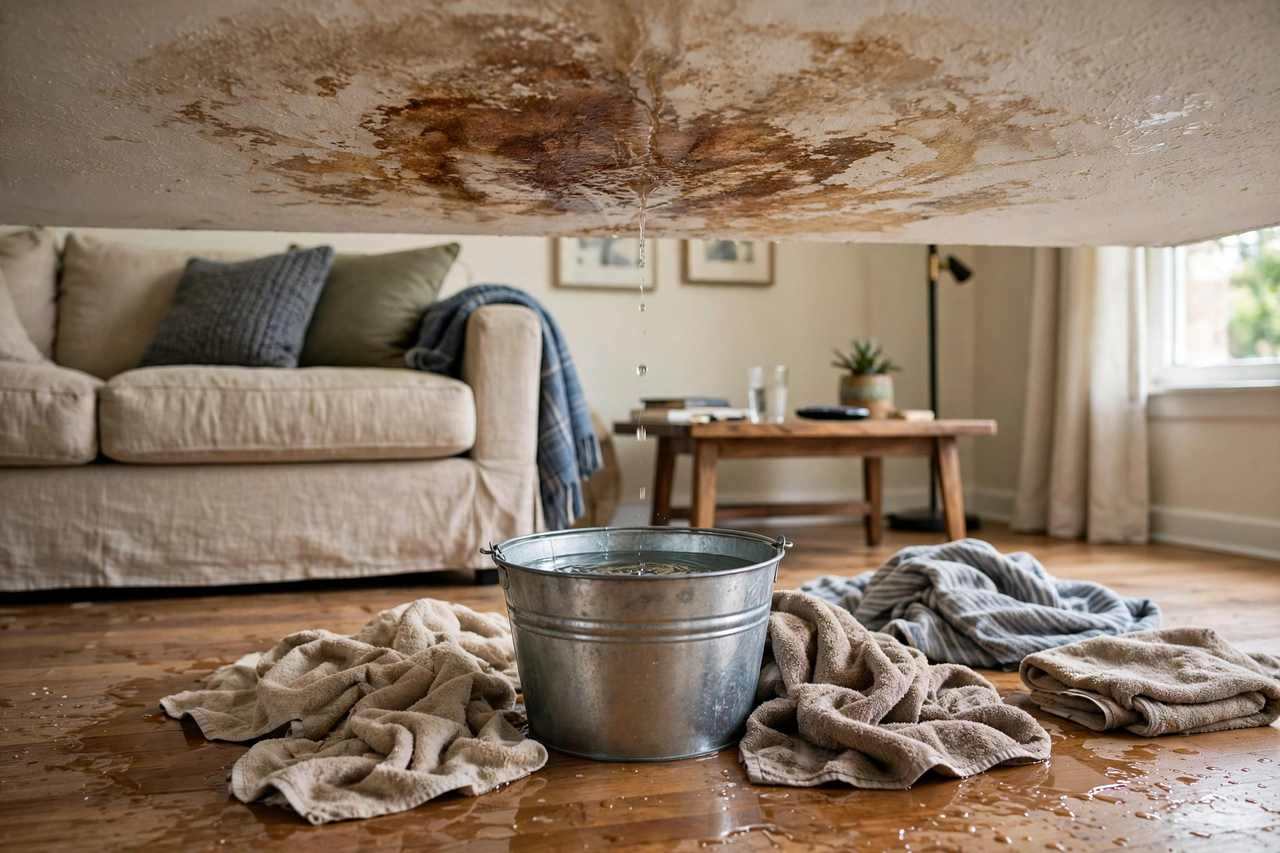
A drip through the ceiling is never just a drip. It is water on the move, and water on the move needs tracing, not guessing.
If water is coming in right now, skip down to the first steps on this page and call (512) 555-0147. If you have a minute, read on. This is the emergency roof leak repair page of Emergency Roof Repair Texas, and it explains the whole job the way we run it: find where the water really gets in, show you the proof, and fix that one point so the drip does not come back with the next rain.
Leak crews working from the towns they live in, across the Austin area and the towns around it.
Emergency roof leak repair is the same-day work of finding where water gets into a roof and stopping it at that exact point: the entry traced from the attic, the failed part repaired or covered, and the inside of the house protected while the work happens. It is not a smear of sealant over a ceiling stain. The stain is where the water ends up. The repair belongs where the water gets in.
The leak test
Yes, if water is actively dripping, spreading across the ceiling, or pooling above lights and wiring. A slow stain that has been there for months is urgent but can usually wait for a daytime visit. The test is simple: moving water is an emergency, a dry old stain is not.
Every emergency roof leak repair call starts with this one question, because the answer sets the pace of everything after it. Moving water does damage by the hour. It soaks insulation flat, softens the boards above the ceiling, and finds the wiring. A dry stain does none of that tonight. It is a warning, not a flood. Learn to tell the two apart and you will never panic over the wrong leak or sit calm through the wrong one either.
Still not sure? Call (512) 555-0147 and describe what you see. A two minute talk settles it, and settling it is part of the job.
Grey cases
Plenty of leaks refuse to pick a side, neither clearly tonight nor clearly morning. Here is how an emergency roof leak repair crew sorts the common ones on the first call.
The water does not care which room it falls in. It rots the same boards and feeds the same mould as a drip over a bed. The only thing that changes is how much you have to move out of the way. Treat it the same, and use the extra calm to take good photos. An emergency roof leak repair crew treats a garage drip exactly like a bedroom drip.
Plenty of homeowners wave this one off, and that is a mistake. When a leak only shows up in a downpour, wind is usually pushing rain under a curled shingle edge or through a worn seal. The entry point is real even if the drip is small. A bucket under it and a firm ceiling buy you until morning, but get the tracing booked: the next downpour will soak the same boards all over again.
Book a daytime visit. An old stain with a dry ceiling is the mark of a leak that may only open in one kind of weather, or of a leak that fixed itself when debris shifted. Either way it needs eyes on it, in the attic and on the roof, before the next storm season tests it again.
Call now. Before anything else, turn that circuit off at the breaker. A wet ceiling can sit for a few minutes. Live wiring touched by water cannot. It can shock whoever reaches for a switch, and it can start a fire inside the ceiling, where nobody sees it start.
That sound usually means water is falling inside a wall or onto the attic floor, out of sight. It counts as moving water, and on the phone that sound alone is enough to book an emergency roof leak repair visit. Call, and while you wait, move anything stored in the attic below that spot and check the nearest ceiling below for a stain that is just starting.
Good news for tonight, and no reason to cancel the visit. Many leaks only run while rain is falling or blowing. The entry point is still open, the boards around it are still wet, and the next storm will run the same path. A stopped leak is a leak you can trace in daylight, which is the best kind to have.
First steps
The crew is on its way, or the rain is still falling and you are deciding who to call. Either way, this first hour is yours, and in most emergency roof leak repair jobs the worst damage happens indoors, in this hour, not up on the roof. Seven things, in this order:
Electricity and a wet ceiling are a bad pair. The moment you see water coming through a light fitting, or running anywhere near an outlet, that circuit goes off at the breaker box, before buckets, before towels, before anything. Never wade through standing water to get to the box. If reaching it means wet feet, skip it, shut the door, and keep the whole household out of that room until help arrives.
A bucket under the drip, towels around it, furniture and rugs pulled clear. Put a folded towel in the bottom of the bucket and the dripping sound will stop keeping the whole house awake. If the drip splits into two spots, use two buckets. Chasing one drip while the second soaks the floor is how a small leak wins the night.
A bulge means water is pooling on top of the ceiling, and the plaster is holding it like a bowl. A small bulge that is still growing can be drained on purpose: bucket under the lowest point, one small hole with a screwdriver, and let it run out in a thin stream you control. A wide bulge, a sagging ceiling, or cracks spreading out from it means hands off. Keep people and pets out of that room. A ceiling that is letting go needs an empty room under it, not a hero with a screwdriver.
Get the things water wrecks off the floor and onto dry ground: laptops, chargers, documents, books and anything made of cloth. Cardboard gives up fast once it sits in water, so empty the box and save what was packed inside. Pull curtains off a damp wall, and leave a wet cupboard open so air can move through it.
The stain, the drip, the bulge before you drain it, the bucket where it stood. Photos taken tonight are proof tomorrow, whatever you decide to do next. They also help the crew more than you would think: a photo of the drip's true spot, and the time it started, can cut the attic search in half. Send them ahead if you can, and the emergency roof leak repair crew starts the attic search one step ahead.
Stay off the roof tonight. Rain makes shingles slick, soft boards can drop you, and a ladder in mud shifts as you climb. Nothing useful happens up there tonight. Your job this hour is indoors. The roof can wait for daylight, and you should be there when it comes.
(512) 555-0147. A roof letting water in needs roofing hands: attic work, ladders, test gear, and an eye trained to follow water uphill to where it gets in. That tracing is the heart of emergency roof leak repair, and it is not a general handyman's trade.
One more job for this hour, if it is safe: a quick look from the attic hatch. Stand on the boards, keep off the insulation, and shine a torch along the underside of the roof. If you can see which slope the water is coming from, tell the crew when they arrive. If the attic is cramped, dark or wet, skip it. And once the dripping stops, start the drying the same day: fans on the wet patch, cupboard doors open, wet rugs outside. Drying that starts within a day or two is what keeps a leak from becoming a mould problem after the roof is fixed. Get this first hour right, and the emergency roof leak repair visit starts ahead of the water instead of behind it.
Leak tracing
Here is the fact that surprises almost every caller: the wet patch on your ceiling is almost never under the hole. Water gets in at a high point, at a cracked pipe boot, a lifted flashing or an opened valley. Then it runs along the boards and rafters under the shingles, sometimes eight feet or more, before it finds a seam or a nail hole and drops. The stain is where the water gave up. It is not where the water got in. Everything in emergency roof leak repair hangs on that one fact.
This is why a leak can survive two repair visits aimed at the stain. Both crews sealed the end of the journey and never looked at the start of it. Real emergency roof leak repair begins with tracing, not sealing, and tracing begins in the attic, not on the roof. The attic is where water leaves its evidence in plain sight, written on the wood in a trail that points back uphill to the entry.
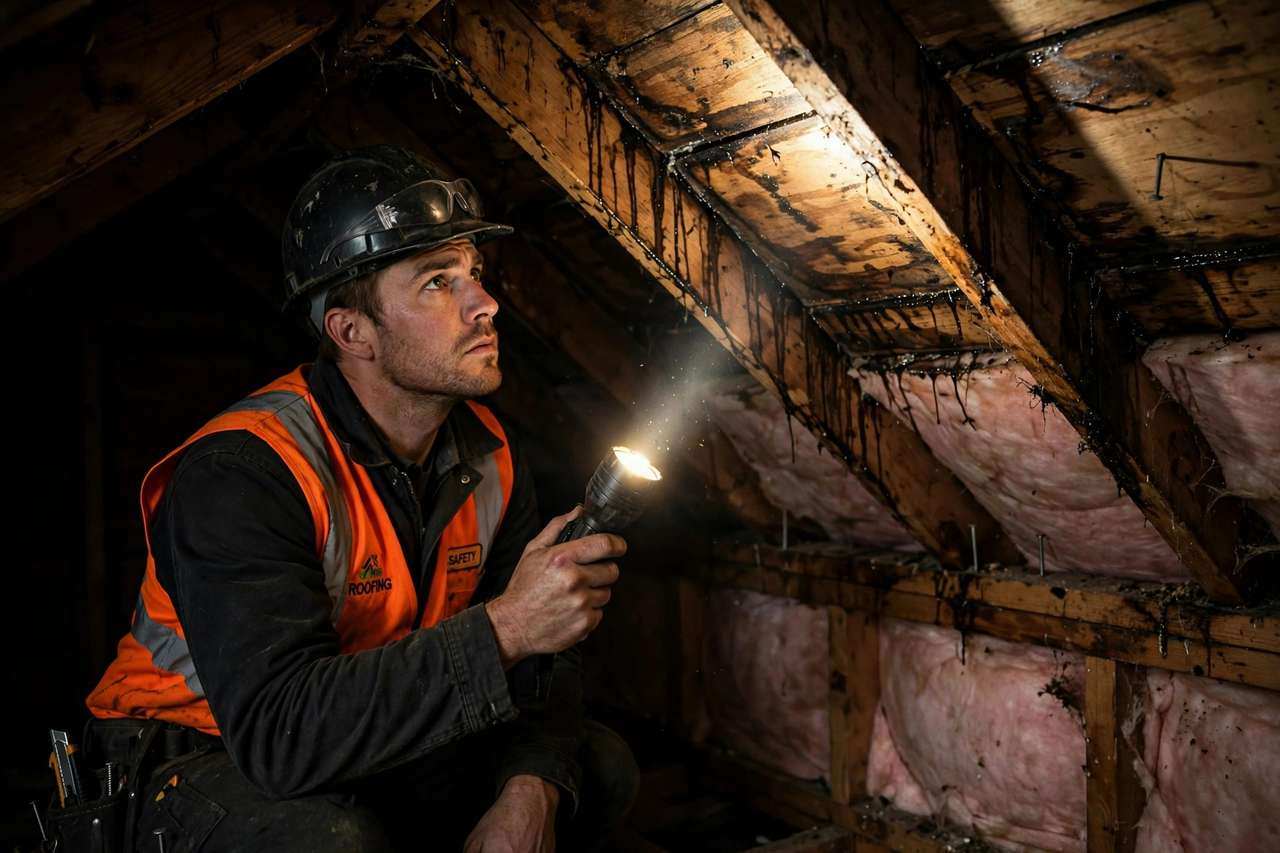
In the attic, the signs are plain once you know them. Dark streaks run down the boards and rafters from above the stain, marking the path the water takes when it rains. Nail tips that poke through the deck have gone rusty where water passes them again and again. Insulation under the trail lies flat and dark, soaked so many times it has stopped springing back. There may be a musty smell in one corner and none in the rest. Each sign is a word in the same sentence, and the sentence always reads uphill.
The highest wet mark is the one that matters. Water only runs down, never up, so the top of the trail is the closest point to the entry. From that mark, the crew looks at what sits above it on the roof: the nearest pipe boot, vent, flashing or valley. Nine times out of ten the entry is one of those parts, within a short climb of the highest stain. This uphill reading is the first skill of emergency roof leak repair, and it cannot be learned from a ladder or a drone photo. The open field of shingles in between is usually innocent, however guilty it looks from the street.
There is a second lesson in the attic: how long the leak has been running. A fresh leak leaves bright wet wood and a small stain. A leak that has run for months leaves blackened boards, soft spots that give under a careful hand, and insulation that smells like a wet dog. That age matters, because it decides whether the visit is a simple part swap or a repair that also has to deal with tired wood. An honest emergency roof leak repair crew will show you which one you have, with photos, before any work starts.
The stain has a language too. A sharp brown ring is a leak that runs, dries and runs again, one ring for every wetting. A pale, soft edged stain has usually been damp for a long time at a slow rate. A dark centre with a wide halo is water that pooled above the ceiling and spread before it dropped. Two stains in one ceiling can mean two entry points, or one entry whose water found two seams on its way down. The attic decides which. None of this replaces the attic check, but it does something almost as useful: it tells the crew, before the hatch even opens, roughly how old the leak is and how it behaves. And it tells you what to report on the phone. When you book an emergency roof leak repair call, describe the stain: where it sits, when it grows, what the ring looks like. You are not wasting anyone's time. You are starting the tracing from your sofa.
One more thing the attic settles: whether the water is roof water at all. A drip that runs when no rain has fallen often turns out to be a plumbing line or an air conditioning drain in the attic, sweating or leaking above the ceiling. Finding that in the attic saves a roof crew from repairing a healthy roof, and it saves you from paying for the wrong trade. Tracing is not just about finding the hole. It is about proving the water's source before anyone picks up a tool.
Reading the pattern
Before anyone climbs, the timing of a leak already tells a trained ear most of the story. Callers describe the pattern without knowing they are doing it: it only leaks when the rain is hard, it leaks for hours after the rain stops, it drips when there has been no rain at all. Each pattern points at a different part of the roof. Here is the pattern book our crews work from.
Water that needs a heavy downpour to get in is usually entering at a part that only fails when water runs deep and fast: a pipe boot, a flashing joint, a vent. In light rain the water is too shallow to reach the crack. In hard rain it stands over it. Look at the parts that poke through the roof first. On an emergency roof leak repair call, hard rain only is the pattern that sends the crew straight to the pipes and joints.
Rain that arrives sideways, pushed by storm wind, climbs under laps and edges that falling rain never tests. A leak that only shows when the wind blows from one direction is pointing at the edges, the ridge, and the side of the roof the wind hits. The entry is where the wind can lift and push.
Water that arrives late took the long way. It got in high, ran along the deck and the rafters, soaked into insulation, and only dropped when the trail was full. A late drip means travel, and travel means the entry is some distance uphill from the stain. This is the pattern that makes people swear the leak moves. It does not move. It commutes. Late drips are the ones that make emergency roof leak repair a tracing job instead of a sealing job.
If water falls on a dry day, suspect the house, not the sky. A plumbing line in the attic, a blocked air conditioning drain, or a sweating duct can all drip like a roof leak and stain like one too. The attic check comes first, and the fix may belong to a different trade. An honest crew tells you that straight.
This is also the answer to the question callers ask with some embarrassment: why does my roof leak sometimes and not others? Because rain is not one thing. A soft rain from the south tests one set of joints. A storm from the north tests another. A leak is a door that only opens for one kind of weather, and until that weather comes back, the roof looks sound. That is not the roof healing itself, and it is not you imagining things. It is the pattern, and the pattern is the map. Tell the crew the pattern when you book the emergency roof leak repair visit, and you have done half the diagnosis from your kitchen.
And no, it is not normal for a roof to leak in heavy rain. Homeowners get told that a real downpour will find its way through any roof, as if leaking were weather. It is not. A sound roof sheds the hardest rain Texas sends. If water gets in when the rain is hard, a part has failed: a boot, a joint, a flashing. Heavy rain is the test that finds the failure. It is never the cause of it. Every emergency roof leak repair visit treats a hard rain leak as a failed part with a name, and the job is to find which one.
The proof
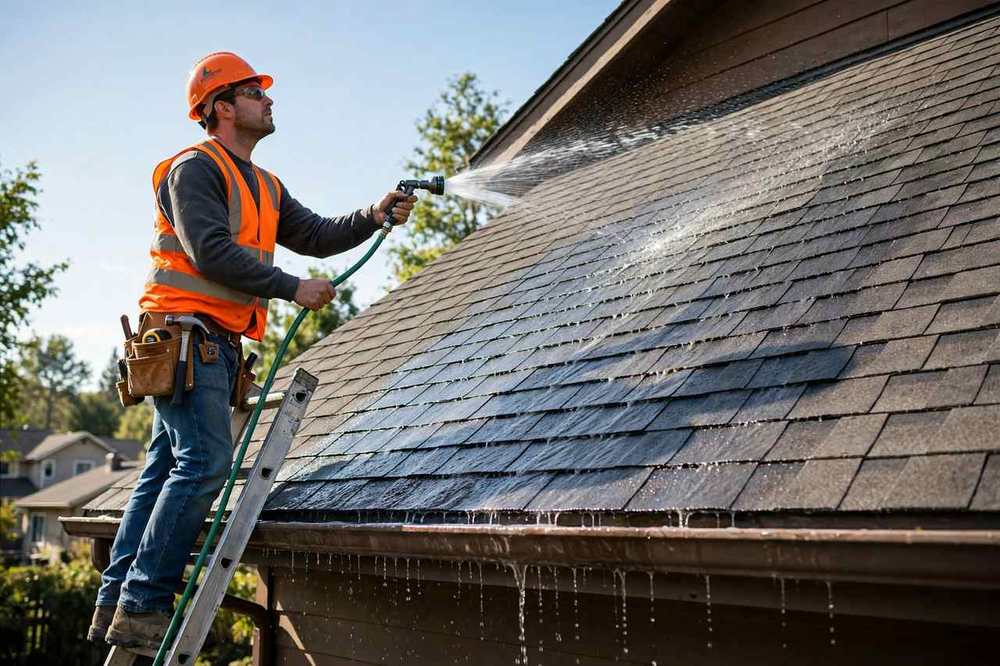
Some leaks show themselves in the attic. Some hide. A stain with no clear trail, a leak that only runs in one rare wind, a roof where three parts sit above the wet mark and any of them could be guilty: those need proof, not opinions. The proof is the hose test, and it is the most honest tool in emergency roof leak repair. It turns guessing into watching.
The hose test has rules, and they are safety rules. It is a daylight job, on a dry roof, with two people and a stable ladder. Nobody sprays a roof at midnight in a storm, and nobody should ask them to. On a night call, the crew contains the water inside, reads what the attic can tell them in the dry light of a torch, and books the hose test for the first dry morning. A leak that has run for weeks will keep for one more night. A fall will not undo itself. That patience is part of emergency roof leak repair done right.
The test has one honest limit, and a good crew admits it: a hose cannot summon weather. A leak that only opens in wind driven rain from the north may stay bone dry under a hose on a calm day, because the hose cannot push water uphill and under laps the way a storm wind does. For those leaks the crew works the pattern instead: the windward edges, the laps, the joints on the storm side, checked one by one, and sometimes the likely joints get renewed and the next real storm grades the work. That is not the method failing. That is the method knowing its edges, and an emergency roof leak repair crew that says so out loud is one you can trust with the rest of the roof.
Callers sometimes ask why the crew does not just seal everything above the stain and be done. Because sealing everything is how you get a roof patched in five places and still leaking, with each patch hiding the trail a little more. Water is patient and it keeps records. The hose test reads them. When a crew offers to find the entry point first, before naming any work, that is the sound of emergency roof leak repair done in the right order.
The entry points
Roofs rarely leak through the middle of a shingle. They leak where the roof is interrupted: where a pipe pokes through, where two slopes meet, where a wall rises out of the slope, where a window sits in the roof. Every interruption is a joint, every joint is a seal, and every seal is a part with a lifespan. This is the tour our crews take on every emergency roof leak repair call, in the order they check, most common first.
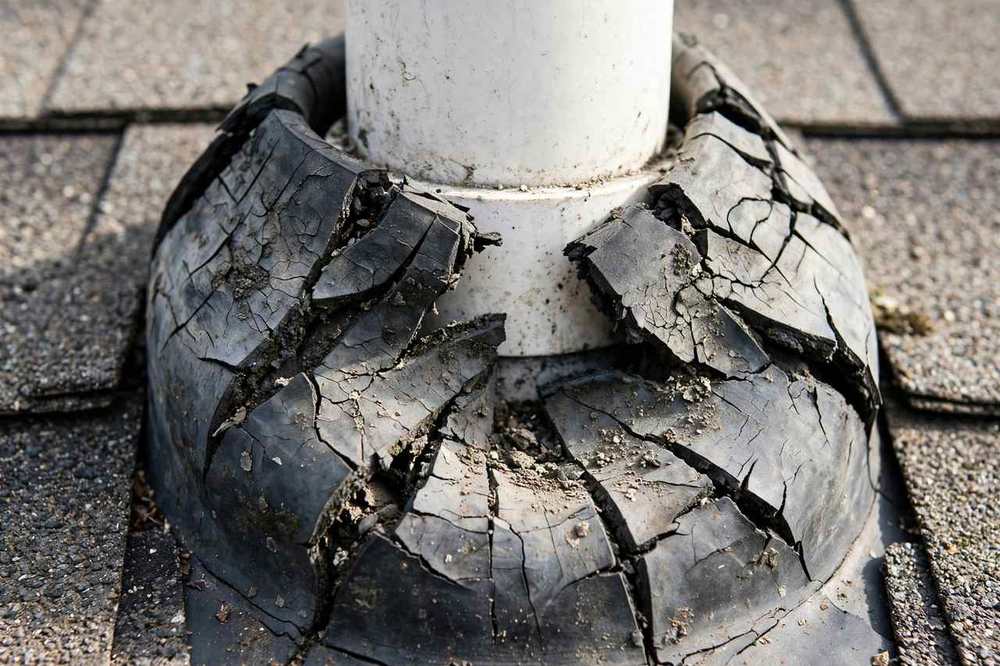
A pipe boot is the collar that seals a plumbing vent pipe where it comes through the roof. The pipe itself is metal or plastic. The collar that hugs it is rubber, and rubber is the weak link. Texas heat bakes it. Sun cracks it. Within a handful of summers on a hot slope, the rubber splits along the pipe, and every rain sends a thin stream down the outside of the pipe, into the attic, and onto the ceiling below. It is the most common single cause of a roof leak, full stop, and it is the first thing an experienced crew looks at, because so often it is the last thing they need to look at.
The signs are plain up close: cracks you can see in the rubber, a collar that has pulled away from the pipe, a dark trail on the deck below it. From the ground you see nothing at all, which is why boot leaks confuse people. The roof looks fine. The shingles look fine. One small rubber ring, cooked by the sun, is letting the house get wet. The good news travels with the bad: a failed boot is a small, clean repair when it is caught before the deck around it softens.
Flashing is the thin metal work that seals the turns of a roof: where a slope meets a wall, where a chimney rises, where a dormer cuts in. It is bent, layered and tucked so that water running down is always pushed out and over, never in and under. Flashing fails in three ways. The metal rusts through in pinholes. The seal along its edge dries and lets go. Or a storm lifts a corner and folds it back, opening a lip that catches driven rain. Each failure is small. Each one leaks like a door left open. Flashing is where emergency roof leak repair turns from finding into craftsmanship.
Step flashing deserves its own word, because it hides. It is the set of small metal pieces woven between shingles along a wall, one piece per course, invisible when the job is done right. When one piece rusts or slips, the leak shows up far below, inside the wall or on the ceiling of the room under that wall. Tracing a wall side leak means thinking in courses, uphill, piece by piece. It is slow, exact work, and it is why flashing leaks are the ones that beat sealant every time: the failed piece is hidden under the shingles, and no smear on the surface reaches it.
A valley is the inside corner where two roof slopes meet, and it carries the water of both slopes in one channel. In a hard rain a valley runs like a small river. Anything wrong in that channel gets tested at full pressure: a nail placed too close to the centre line, a shingle cut short, debris dammed up behind a fallen branch, metal worn thin by years of grit washing down. Valley leaks tend to be generous leaks, because the water supply is generous. They also travel well, running along the valley boards before they drop, so the stain can sit a long way from the fault.
Valleys fail quietly, too. Leaves and grit build a slow dam. Water that should run off in seconds ponds behind it, stands over the joints, and seeps. A valley that leaks only in autumn, when the oak leaves fall, is telling you its story in the calendar. Clearing the channel is part of the fix, but the tracing still comes first: a dam explains standing water, and standing water finds the nearest weak point, which still has to be found and named.
Every vent is a hole in the roof with a hat on it, and the hat has to work in wind. Turbine vents spin to pull hot air out of the attic; when their bearings wear, they wobble, and a wobbling turbine in a storm can throw its cap or let driven rain straight down the shaft. Box vents sit still and rely on their flashing flange and seal; when the plastic cracks in the heat or the flange seal lets go, they drip neatly into the attic below. Ridge vents run along the peak and shed weather by shape; fitted badly or damaged at one end, they admit wind driven rain along the whole ridge line.
Vent leaks have a signature: they are fussy about wind direction. A turbine that leaks only when the storm comes from the north is not being mysterious. It is reporting which way its weakness faces. Tell the crew the direction, if you know it. On an emergency roof leak repair call, that one detail can take an hour off the search.
A chimney is a wall that stands in the middle of a slope, and water hits it like a dam. The uphill side collects everything the slope sends down, which is why a proper chimney has a small peaked diverter behind it, called a cricket, to split the flow. The flashing around a chimney is a system, not a strip: base flashing on the slope, step flashing up the sides, and counter flashing cut into the brick or stone to cap the whole joint. When any layer fails, water gets behind the system and runs down the chimney's inside faces, showing up as stains on the ceiling beside the fireplace, or worse, inside the wall.
Chimney leaks also hide in the cap and the crown. A cracked crown washes water into the brickwork. A missing or rusted cap lets rain straight down the flue. Those are not flashing failures at all, and a crew that only checks the base will miss them. The chimney gets checked top to bottom: crown, cap, counter flashing, step flashing, cricket. It is the one entry point where the tour has five stops. Miss one stop, and the emergency roof leak repair visit ends with the leak still alive.
A skylight asks a lot of its seals. It lies flat in the slope, takes the full run of the water, bakes in the sun, and expands and shrinks with the heat more than the roof around it. The seals age, the flashing kit around it ages, and the first sign is usually a stain at one corner of the ceiling opening below. Corner first is the skylight's signature: the water gets in at the low corner of the frame and drops straight down, which makes skylight leaks the honest exception to the travel rule. The stain really can be under the fault. They are the one case where emergency roof leak repair crews get the easy version: the water tells the truth about where it came in.
Skylights also sweat. On a cold morning, warm house air condenses on the inside of the glass and drips, and the drip looks exactly like a leak. The attic check settles it: condensation leaves the roof deck dry and the frame wet from inside. A real leak wets the deck and the boards around the frame. Naming which one you have is a two minute job for a crew and an impossible one from the kitchen floor.
The edge of the roof works harder than it looks. Wind gets under the first course. Driven rain climbs the rake edges, the sides of the slope. At the eaves, the lowest edge, water that runs off can curl back under the shingles if the metal drip edge is missing, bent or buried under old layers. Ice is not a Texas problem, but leaf dams are: a clogged gutter fills, stands water against the eave, and the eave joints, which were built to shed running water, not to sit in it, start to seep.
Edge leaks stain the outside wall and the ceiling near it, and they rot the fascia board and the ends of the rafters, the parts you can see from the ladder. They are also the leaks most likely to be blamed on the gutter alone. Sometimes the gutter is guilty. Sometimes it is just the messenger, standing water reporting a joint that failed above it. Tracing decides, and on an edge leak, tracing is what separates an emergency roof leak repair from a gutter cleaning.
Shingles are held by nails, and nails can work themselves up. Heat cycles expand and contract the deck, the nail rides a fraction higher each season, and one day it lifts the shingle above it into a small tent. Wind catches the tent. Rain drives under it. The nail hole itself, exposed, drinks. A single nail pop is a tiny leak with a tiny fix, but pops travel in families: a slope that pops one nail has often popped several, all along the same sunny line. The crew checks the whole line, not just the one that leaked.
Exposed fasteners matter even more on metal roofs, where every screw is a penetration with a rubber washer. The washers age like pipe boots, in the same sun, on the same schedule. A metal roof leak at a seam or a screw line is a known pattern with a known repair, covered in the roof types section below. On any roof, the lesson is the same: the smallest parts fail first, and they fail on a schedule set by heat.
Now and then the entry really is in the open field of shingles: a shingle cracked by a fallen branch, a hail bruise that split the mat months after the storm, a shingle torn away and never noticed because the felt under it shed water for a season. Field leaks are the rarest kind, and the crew proves the parts innocent before blaming the field. But they exist, and the hose test is what proves them: every part above the trail runs dry, and the water still comes in at one plain spot of slope. Then the fix is a shingle repair, done course by course, and the mystery ends without drama. Even then, emergency roof leak repair ends the same way it always ends: proof, then a local fix, then a test.
The repair work
Once the entry point is proven, the repair is usually smaller than the homeowner feared. Leaks live in parts, and parts can be swapped, rebuilt or reset. This is the work itself, method by method, so you know what a crew is doing up there and why. None of it starts until the tracing is done. That order is what makes it emergency roof leak repair and not just repair. Every method here follows the same rule: water must run over the repair, never under it.
For a small hole in the field or a split at a joint, the classic repair is the slide-under patch. The shingle above the fault is lifted, gently, on a warm day when it bends instead of breaking. A rigid piece of flashing metal is slid under it, wide enough to carry water past the fault on every side, and fixed through the metal into the deck, never through the shingle above. Then the shingle settles back over the metal. Rain runs down the shingle, across the hidden metal, and off. The water never learns the hole is there. It is a small repair with a long life, and it is the opposite of a smear: nothing shows, and everything sheds. Ask to see the metal before it goes under. On an emergency roof leak repair job, the parts should never be a secret.
A cracked pipe boot is not patched; it is replaced. The shingles around the pipe are lifted in order, the old boot comes off, the new boot goes on with its flange tucked under the uphill shingles and over the downhill ones, so the layering sheds water the way the roof was first built. The pipe gets a sound collar again, the deck hole is sealed by design, not by goo. Where the deck around the pipe has softened from months of dripping, that small section gets dealt with in the same visit, while it is open and easy to reach. This is the most common emergency roof leak repair in Texas, and on a sound roof it ends the story: the drip that came with every rain simply never comes again.

Failed flashing is rebuilt, not coated. Rusty or lifted pieces come out, new metal goes in with the laps facing the right way, and step flashing along a wall gets woven back course by course with the shingles. Counter flashing on a chimney is cut into the mortar joint and sealed there, so the cap of the system is anchored in the wall itself. This work is slow because the layering is the whole point: each piece must shed onto the next. A crew that rushes flashing is building the next leak on a schedule.
A valley repair starts with the channel itself: debris out, the whole line exposed. Then the fault gets its fix: a nail too close to the centre is removed and sealed the right way, worn valley metal is replaced, cut shingles are reset to the correct line. If the valley has been leaking long enough to soften its boards, the boards are part of the repair. A valley is a river bed. The repair is finished when the river runs clean from top to bottom without touching wood anywhere.
A leaking skylight usually needs its flashing kit renewed and its seals replaced, and sometimes the honest answer is a new unit, when the frame itself has warped or the glass seal has failed and fogged. Vents are simpler: a cracked box vent is swapped whole, a tired turbine is replaced, a ridge vent section is refitted and its ends sealed the way the maker intended. In each case the principle is the same as the boot: the part has a life, the life ended, the part gets replaced. Sealing around a dead part only rents a few more storms.
Sealant has a place in leak work, and the place is small. It seals a nail head under a shingle tab. It beds a flashing edge where the design calls for it. It is a helper inside a layered repair, never the repair itself. The difference shows in the order of work: in a real repair, the parts are right first and the sealant is the last touch. In a fake one, the sealant is the only touch. When a crew explains your repair, listen for the parts. If the whole plan is a tube, the plan is the problem, and that holds for every emergency roof leak repair you will ever be offered.
A repair that is not tested is a hope. So the crew tests: a hose run over the repaired section, the attic watched, the ceiling checked. Water over the fix, no water inside, that is the pass mark. You get photos of the failed part, the repair in progress, and the finished work, and the dry attic to go with them. If the test finds a second entry, better to learn it now, in daylight, with the ladder still up. Testing is not doubt. It is how a repair earns the word. Every emergency roof leak repair visit we run ends with that test: pass, or learn.
Know your roof
The tracing method never changes, but each roof type fails in its own way and hides its leaks in its own places. Knowing which roof you have tells you where the water is most likely getting in, and what the repair will look like when the crew finds it. Here is how emergency roof leak repair reads each one.
The common Texas roof, and the most forgiving to repair. Leaks live in the parts: boots, flashing, valleys, lifted or missing shingles, nail pops along the sunny lines. Tracing is attic first, then the parts above the trail. Repairs are local by nature: one boot, one flashing run, a few courses lifted and reset. A shingle roof rarely needs a big answer to a single leak, and any crew that gives it one should be asked to show the photos twice. Most emergency roof leak repair calls in Texas end on a shingle roof, with a part swapped and a test passed.
Panels shed water fast and shrug off hail, so metal leaks live at the seams and the screws. Every fastener is a penetration with a rubber washer, and the washers age in the sun on the same schedule as pipe boots. Seams open as panels expand and contract through the heat cycles. The signs: a slow drip that only shows in driven rain, rust freckles around screw heads, a stain that sits under a seam line. The repair is sealing and securing done with care: failed washers and screws renewed, seams reset, and no dents or scars left in the panels by the work.
The tile is a shield; the felt under it is the waterproofing. That one fact explains tile leaks. A cracked or slipped tile lets water onto felt that may be years past its best, and the water runs under a roof that still looks perfect from the road. Tracing means lifting tiles around the suspect area and reading the felt: dark, brittle, torn felt is the confession. The repair is felt work and careful tile setting, piece by piece, without breaking the neighbours. Slow work, skilled work, and the reason tile leaks are never a ladder and a tube job.
These roofs do not shed water; they hold it for a while, and that changes everything. A small split in the surface can drink rain for hours and drop it far from the hole, through a ceiling two rooms away. Ponding is the warning sign: a puddle still standing a day after the rain means the slope or the drain has failed. Tracing starts at the pond and works the seams and edges around it. The repair is membrane work: the split cleaned, patched with material that bonds to the surface, and the ponding itself addressed, because a patch under standing water lives a hard life.
Whichever roof you have, notice what does not change. The attic tells the truth. The highest wet mark points uphill. The parts fail before the field. And the repair, once the entry is proven, is almost always smaller than the fear that came before it. Emergency roof leak repair is a method, not a material, and the method works on every roof Texas builds.
Inside the house
When water is coming in at midnight, the inside of the house is the only workshop you have. Some inside work is genuinely useful. Some of it feels like fixing and is not. Here is the honest line between the two, because knowing it saves ceilings.
The useful inside work is all about control. Buckets catch the water before the floor does. A small hole drains a bulge in a stream you choose instead of a collapse you do not. Towels and moved furniture shrink the damage list. Fans and open doors start the drying that keeps mould out of the story. Plastic sheeting pinned inside the attic can, on some roofs, catch drips and run them to a bucket, buying a dry night. All of that is real help. None of it is a repair, and it does not pretend to be. It is the house being defended while the roof waits for daylight and a crew.
The inside work that fails is the kind that tries to plug the leak from below. Sealant pushed up around a pipe from the attic. A patch stuck to the ceiling. Foam sprayed at the underside of the deck. The problem is simple physics: the water is still getting in above, and now it cannot get out below. It spreads sideways into fresh decking, soaks new insulation, and rots wood that was dry last month. The drip stops showing, which feels like success, while the damage moves house into a bigger area. Worse, the hidden trail makes the real tracing harder when the crew finally comes. An emergency roof leak repair crew would rather arrive to an honest drip in a bucket than to a sealed ceiling and a swamp above it.
There is one more inside temptation to refuse: painting over the stain. Paint hides the only gauge you have. A drying stain that stays the same size through the next rain is good news you can see. A growing one is the alarm bell. Paint it, and the first sign of a returning leak becomes the smell of mould or a ceiling that sags. Let the stain live until the repair has passed a few real rains. Then paint, and enjoy it. On an emergency roof leak repair visit, the crew reads that stain like a gauge, so leave it readable.
So the rule for inside work is easy to hold: control the water, never plug it. Catch it, drain it, dry it, photograph it. Leave the stopping of it to the roof side, where the entry is, where the layers can be rebuilt in the right order. Inside work buys time and saves belongings. Roof work ends the leak. A good visit uses both, in that order, and never confuses one for the other.
The product shelf
Every hardware shelf has a corner that promises to stop a roof leak from a can or a roll. The ads are confident. The questions pour in after every storm: will this tape fix it, will that spray seal it, what do roofers actually use? Here is the straight answer, product by product, from the crews who get called when the shelf has had its turn.
Start with the tapes, the famous sticky rolls that promise to seal anything. On a clean, dry, flat surface, tape sticks. A roof is none of those things for long. It is gritty, hot, and moving: shingles expand in the afternoon sun and shrink at night, and every joint the tape crosses works it a little looser each day. The edges lift. Water gets under the patch and now travels, hidden, under a waterproof skin, which is worse than no patch at all. Tape on a roof is measured in weeks on a good day, and the day it fails is always a rainy one.
Spray sealants and brush-on coatings fail a different way. They go on thin, they bridge nothing, and they crack where the roof moves, because a sprayed film cannot flex the way a joint flexes. Sun cooks them. Within a season the film is a map of fine cracks, each one a small door. And like tape, a coating hides the entry point. The crew that comes later has to trace through a layer of rubberised paint to find a crack that used to be visible, and the coating has to come off before real flashing work can bond. The shortcut adds work to the repair it delayed.
Roof cement, the black smear in the tub, has the saddest history of all. It has been the quick answer for a hundred years, and it dries, cracks and peels on the same schedule every time. Smeared over a flashing joint, it hides the joint while the joint keeps failing underneath. Smeared over shingles, it glues them down so the next repair tears them. There is a reason experienced roofers use it rarely, thinly, and only as bedding inside a layered fix. As the fix itself, it is a promise that expires.
So what do roofers use to stop leaks? Parts and layers. A new boot. New flashing, woven in. A slide-under patch of real metal. A valley rebuilt so the river runs clean. And when the weather will not wait for the full repair, a cover: a tarp fitted flat and battened down, which is a roof-shaped answer, not a glue-shaped one. That is the honest shelf: metal, rubber collars, boards and patience. Nothing on it comes in a spray can, and everything on it can be photographed, tested with a hose, and pointed at a year later, still working. When someone asks what stops leaks fast, that is the answer an emergency roof leak repair crew gives: the right part, fitted the right way, tested before the ladder comes down.
What waiting does
A leak never stays the size it started. Water is patient, wood is not, and the gap between a small repair and a big one is mostly time. This is the road a leak travels when nobody answers it, stage by stage, so you can see where on the road yours is standing. It is also the reason emergency roof leak repair exists as a same day trade at all.
The first rains are gentle about it. A stain appears, grows a ring, dries. The insulation under the trail gets wet and dries, wet and dries. Each cycle it packs a little flatter and holds a little more water next time. The deck boards along the trail are damp more often than they are dry. Nothing hurts yet. This is the stage where the repair is at its smallest: one part, one visit, and a ceiling that needs nothing but time and then paint.
Give it a season and the wood starts to change. Decking that stays damp grows soft at the edges of the trail. Nails lose their bite in soft wood, so shingles along the trail sit a little looser, so more water gets in: the leak begins to feed itself. Mould finds the insulation and the top of the ceiling, out of sight, announced only by a musty smell when the attic hatch opens. The stain grows a second ring. Callers at this stage say the leak is getting worse, and they are right in a way they cannot see: it is not the hole growing. It is the roof around the hole weakening. This is the stage where an emergency roof leak repair stops being one part and starts being two trades.
Give it a year and the damage changes trades. Now it is not only a roofing problem. The ceiling plaster, soaked and dried a dozen times, loses its grip and starts to sag between the joists. A bulge that never drains becomes weight the ceiling was never built to carry, and one heavy rain can bring a section of it down in the night, plaster, soaked insulation and all. That is the collapse path, and it is why the bulge rule in the first steps matters: drained early, a ceiling is a bucket problem. Left loaded, it is a falling problem. Wiring that runs through wet insulation ages in the damp. Timber that stays wet invites rot that spreads along the grain, turning a two foot repair of decking into a slope side project.
None of this is said to frighten anyone into a phone call. It is said because the pattern is so regular that a crew can date a leak by its damage, and because the turning point is so early. A leak caught in the first days is usually a small repair. The same leak caught in the second year is a repair plus carpentry plus a ceiling. The water does the same work every day. The only choice a homeowner really has is when to stop it. An emergency roof leak repair call in the first week is not panic. It is arithmetic.
Our promise
A single leak, on a sound roof, ends with a single repair. That is the outcome we work for and the one the evidence usually supports. If a new boot and a rebuilt flashing will hold, that is what we recommend, with photos of the failed part in your hand so you can judge for yourself. We do not turn drips into roof sales. A leak is a part that failed, and a part that failed gets replaced, not used as a lever. That promise sits at the centre of how we run emergency roof leak repair: prove it, fix the part, test it.
Repair first also means saying so when a leak is not really a leak problem. Sometimes the tracing ends at a slope that is simply worn out: shingles brittle across the whole field, granules gone, every boot and joint at the end of its life at the same time. Patching that roof is not thrift. It is a subscription to leaks, one visit per storm. In that case we show you the evidence slope by slope and let you decide in your own time. No countdown, no tonight only anything.
How can you tell which kind of leak you have? The signs are readable. One leak, one entry point, sound shingles around it: that is a repair. Leaks in several rooms, in different corners of the house, in the same season: that is a roof at the end of its life announcing itself in chapters. A leak that returns after a proper, tested repair, at a new spot each time, is the same announcement. So is a deck that feels spongy underfoot across whole areas, shingles that snap instead of bending when a corner is lifted, and granules washing out of the gutters by the handful after every rain.
And the honest middle case exists too: a roof with good years left in most slopes and one tired slope, usually the one that takes the afternoon sun. Then the answer can be one slope renewed and the rest repaired, a decision made from evidence, slope by slope, not from a sales script. Whatever the tracing finds, the rule of an emergency roof leak repair visit stays the same: the evidence talks first, the recommendation follows it, and the decision is yours, made at your table, not on your doorstep.
Leaks around Austin
Austin roofs live a particular life. The summer heat is the headline: attic temperatures that cook the rubber collars on vent pipes until they crack, season after season, which is why the pipe boot is the first suspect on almost every Austin leak call. When locals search for roof leak repair austin help at midnight, the answer, more often than any other, is a small rubber ring that the sun ate. It is a good answer to get: a boot swap is a small repair, and the stain dries and stays dry. That one pattern, heat and rubber, shaped our whole approach to emergency roof leak repair in this city.
The second Austin pattern grows on trees. Live oaks hang over half the roofs in the older neighbourhoods, and they shed: leaves that dam the valleys, small branches that ride the storms down onto the shingles, shade that keeps a slope damp long after the rain. An Austin leak that starts after a windy night, under a big oak, gets its tracing started at the valley and the impact points, not the boots. And the third pattern is the storm itself: Austin has recorded 59 hail days since 2010, and hail bruises shingles in ways that leak months later, which is why a leak with no obvious cause, on a roof that took a spring storm, deserves the chalk test as part of its tracing.
Our emergency roof leak repair crews work from Austin and the towns around it, and each town has its own page with its own leak patterns written out:
Home base. Heat cracked boots, oak shaded valleys, and hail that shows up as a leak a season later. When an emergency roof leak repair call comes in at night, it most often comes from an Austin attic.
Young roofs in new subdivisions, leaking at the details: boots, flashing, and the joints where additions meet the main roof. Tracing in Buda is a parts tour, not a field search.
Lake wind drives rain under edges and laps, and older roofs hide slow leaks for months. In Pilot Point the pattern is patience: stains that grow a ring a season.
Big roofs, tall trees, and a long hail history: 113 hail days recorded since 2010. Plano leak calls often trace back to bruised slopes and tired flashing on wide, complex rooflines.
Do not see your town? Call (512) 555-0147 anyway. If a crew cannot reach you in time, we say so at once, instead of leaving you hanging on a promise.
Not just a leak?
If the leak started with a storm, torn shingles, a fallen limb or hail, the problem is bigger than one entry point, and the whole roof needs the storm check, ridge to gutters. That work lives on our storm damage page, and it starts the same way: stop the water, then prove the damage.
If the entry point is a hole, a torn section, or damage that cannot be repaired in the weather you have, the right move is a tarp fitted flat and battened down, buying dry days while the repair is planned. That work lives on our tarping page, with the honest lifespan of a tarp stated plainly. And a tarped leak is still an emergency roof leak repair in progress, just paused at the dry stage until the real fix lands.
And if the water is still coming in and you are not sure which page you are on, you are on this one. Call (512) 555-0147. Sorting out what kind of problem you have is the first thing an emergency roof leak repair call does, and it takes about two minutes of describing what you see.
Questions
No sales talk. The questions leak callers ask most, answered the way we answer them on the phone:
Yes, if water is actively dripping, spreading across the ceiling, or pooling above lights and wiring. A slow stain that has been there for months is urgent but can usually wait for a daytime visit. The test is simple: moving water is an emergency, a dry old stain is not.
Start in the attic, not on the roof. Water runs along the decking and rafters, so the ceiling stain is often feet away from the real hole. Trace the wet trail uphill to the highest damp point, then check the nearest pipe boot, vent, flashing or valley above it.
Put a bucket under the drip and move anything the water can ruin. If the ceiling bulges, poke a small hole in the lowest point with a screwdriver so the water drains in one place instead of spreading. Then take photos and call a roofer who handles emergency leak calls.
Roof decks are sloped, and water follows the slope. It enters at a cracked boot or lifted flashing, runs down the wood under the shingles, and drops off a rafter or seam well away from the entry point. That is why sealing the stain area alone almost never stops the leak.
Call a local roofer who does leak tracing, not a general handyman. Ask two questions before you book: will you find the entry point first, and will you show me photos of what you found? A roofer who wants to seal first and look later usually has to come back.
Not properly. Sealants pushed up from the attic or a patch on the ceiling only slow the water down, and they can trap it in the decking where it rots the wood. Inside work is a holding step: bucket, drain the bulge, dry the area. The real repair happens on the roof.
An active drip should be made safe the same day and repaired within days, not weeks. Every rain pushes more water through the same hole, softening decking and feeding mold in the attic insulation. A leak caught in the first days is usually a small repair. Left alone, it rarely stays small.
Failed parts, not failed shingles. The rubber collar on a vent pipe cracks in the heat, flashing joints open, valley metal wears, vent seals age. Water gets in where the roof is interrupted, at pipes, joints and turns. The open field of shingles is the last place a good crew blames.
The damage grows in stages. Insulation soaks and packs flat, decking along the trail softens, and mould takes hold where you cannot see it. Given a year, a loaded ceiling can sag or fall, and rot spreads along the timber. Caught in the first days, the same leak is usually one small repair.
Only for a short while, and sometimes it makes things worse. Tape lifts at the edges in the heat, sprays crack where the roof moves, and both can trap water under a skin and hide the entry point. Roofers stop leaks with parts: a new boot, rebuilt flashing, a metal patch.
Because some entries only open under pressure. A cracked boot or a tired flashing joint sheds light rain, but a downpour stands water over it and pushes through. Wind driven rain finds edges and laps the same way. It is a failed part reporting itself, not a roof being overwhelmed.
A minor leak is slow, single and caught early: one drip, one entry point, dry decking around it, and a stain that is not growing. Minor describes the damage, not the urgency. A minor leak traced and repaired in its first weeks stays minor. Left alone, it graduates.
With the hose test. One person watches the attic while the other wets the roof one small section at a time, low to high, a few minutes each. The section being sprayed when the drip appears holds the entry point. It ends the guessing, and it is a two person, daylight job.
The drip will not trace itself.
Call (512) 555-0147.
A roofer answers, day or night. One number for emergency roof leak repair across Texas: we find the entry point, show you the proof, and fix the part that failed.