24/7 emergency response · A roofer answers, day or night Serving Austin & nearby Texas towns
Emergency Roof Repair TexasEmergency Roof Repair · Texas

Emergency Roof Tarping · Texas

Emergency Roof Tarping in Texas

Water is coming in tonight. A tarp done right keeps the next rain out while the real repair gets scheduled.

A roof tarp is the fastest way to stop water coming into your house tonight. It is not a repair. It is a cover that holds the rain out while the real repair gets scheduled and done. Done right, an emergency roof tarping job homeowners can trust buys you weeks of dry time. Done wrong, it makes the leak worse: it pools water, funnels it into the house, and tears off in the next gust, leaving a bigger hole than the one it was covering. Call (512) 555-0147 and we will start with the opening, not with a sales talk.

Emergency roof tarping crews working from the towns they live in, across Texas.

  • Over the ridge, never just over the hole
  • Battens, never nails through shingles
  • Photographed from the ground when done
Tell us what is happeningWe call back fast, day or night.
30 to 90Days a good tarp holds
4 ftPast the damage, every side
5Checks on a good tarp job
0Nails through the shingles

Emergency roof tarping is the work of covering a damaged roof with a heavy tarp so rain stays out until a permanent repair can be done. The tarp runs over the ridge or tucks under the shingles above the damage, and its edges are held down with wooden battens, not nails through the shingles. It is a temporary cover, measured in weeks, never a repair on its own. An emergency roof tarping call starts with that cover, not with a repair.

The basics

What a tarp is, and what it is not

A tarp is a raincoat for a wounded roof. It does one job: it keeps the next rain out of a house that has an opening in it. It does not mend a single shingle. It does not seal a single crack for good. The damage under it stays exactly as damaged as it was the night the storm hit. What changes is the water. With a sound tarp over the opening, the rain that would have poured into the attic runs down the sheet and off the roof, the way rain is supposed to travel.

That one job matters more than it sounds. Most of the harm after a storm does not come from the hole itself. It comes from the second rain, and the third, soaking insulation, softening decking, and feeding mould in places nobody can see. An emergency roof tarping job done in the first hours cuts that chain off at the start. The house stays dry while the slower work, the dry inspection, the materials, the permanent repair, gets planned properly instead of rushed in the dark.

What a tarp is not matters just as much. It is not a reason to stop worrying about the roof for a season. It is not a patch you can forget until next year. And it is not a sign that the roof was fine after all. A tarp is a bridge: one end sits on the night of the storm, the other end sits on the day of the real repair, and the bridge is only built to be crossed, not lived on. Everything on this page follows from that one idea. Hold on to it, and every rule of emergency roof tarping makes sense.

The decision

When a tarp is the answer, and when it is not

A tarp is the answer when water is getting in and the permanent repair cannot happen tonight. That covers most emergency calls: shingles torn off by wind, a limb through the deck, hail that cracked shingles open, a section of roof laid bare after a storm. In all of those, the job tonight is one thing, keep the next rain out, and a tarp does it. That is the job an emergency roof tarping crew is called for most often.

Call for a tarp tonight if:

  • Rain is still coming and the roof is open
  • A limb or a tree has come through the deck
  • Wind has torn shingles off and the boards show
  • Hail has cracked shingles open across a slope
  • A cover that was already up has blown off or is pooling water

A tarp is the wrong tool if:

  • The roof section is sagging or the decking has gone soft
  • The drip is slow, with no storm damage behind it
  • A vent boot or a flashing joint has worked loose
  • The wind is still strong enough to lift a sheet

A tarp is not the answer when the roof itself cannot hold one. If a section is sagging, if the decking underneath has gone soft, or if a whole slope has lifted, a tarp over the top hides the problem and adds weight where the roof is weakest. An emergency roof tarping crew will say so before any tarp goes up. Then the honest move is a temporary dry in, boards and felt over the weak section, or, if the structure is unsafe, keeping everyone out of that room until a crew can look at it in daylight. A roofer who tarps a sagging roof without saying so is selling you a cover for a problem that needs a different fix.

It is also not the answer for a slow drip with no storm damage behind it. A vent boot that has worked loose, a cracked flashing joint, a seal that has dried out, those are small repairs, and a small repair done properly beats a tarp every time. If a small repair will honestly hold, that is what we do. A tarp is for the nights when a repair cannot be done yet, not a substitute for one that can.

There is one more case worth naming, because it fills half the calls after a big storm: the roof is open, more rain is on the way tonight, and nobody yet knows how bad the damage really is. That is a tarp case, plain and simple. The cover goes on first, in the dark if it has to, and the full check waits for dry light. Trying to judge a whole roof by torchlight, with rain coming, leads to rushed calls and missed damage. An emergency roof tarping visit splits the work into the right order: dry tonight, judged tomorrow, repaired when the roof can be read properly.

And there is the case where the storm has passed, the sky is clear, and the damage is small and dry: one or two shingles gone, felt intact, nothing dripping. That one can often wait for a morning repair visit, and a crew that tells you so is a crew worth keeping. The tarp is a tool for open roofs and coming rain. Used at the right moment it saves a house. Used for every small thing, it is just a sheet on a roof that needed a repair.

If the damage on your roof came from a storm, the cover is only the first half of the job. The full storm check, slope by slope, lives on our Storm Damage Roof Repair page, and it is where the repair plan starts once the tarp is on.

What to expect

The first night, hour by hour

People picture a tarping call as a truck, a ladder, and a sheet. The sheet is only the middle of the story. Here is the whole night, the way it usually runs, so you know what each hour of it asks of you.

It starts inside your house, not on your roof. The rain finds the opening the storm made, the ceiling starts to drip, and the first jobs are buckets, towels, and furniture dragged clear. If water is anywhere near a light, the power to that room goes off. If the ceiling bulges, it gets drained into a bucket on purpose, one small hole at the low point, before it comes down on its own terms. None of that is waiting around. All of it is damage control, and it is worth a great deal in harm avoided.

Then comes the call. You describe what you see: where the drip is, how fast it is coming, what the yard looks like. The questions you get back are sorting questions, and they matter, because they decide whether the cover is a tonight job or a first light job, and what the crew carries up the ladder when they come. This is the part of an emergency roof tarping call that happens before anyone has seen your roof, and a good crew does it carefully, because a wrong guess here wastes the hours the house does not have.

Then the fitting, which has its own section next, because it deserves one. From the ground it looks slow. It is meant to. Reading the roof, sizing the sheet, clearing the run, tucking the top edge, battening the edges down: each step is unglamorous, and together they are the difference between a cover and a decoration. It is the heart of emergency roof tarping, and it gets the next section to itself.

And then, the quiet. The dripping stops. The crew photographs the finished cover from the lawn and walks you through what they found under it. The damage gets written down while it is still fresh: what tore, what cracked, what the water touched inside. You end the night with a dry house, a record of the damage, and a plan for the repair that has a date on it. That is the whole shape of an emergency roof tarping night, and once you have seen the shape, the rest of this page is just the details filled in.

The method

How a tarp goes on, step by step

This is the part most pages skip, and it is the part that decides whether the cover holds. An emergency roof tarping job is not a sheet and a prayer. It is a sequence, and each step has a reason. Here is the whole sequence, the way our crews run it on every emergency roof tarping job, so you can follow the work from the ground and judge it when it is done.

1Read the roof before touching it.

The first look is from the ground and from the attic, not from a ladder. Where is the water coming in, how big is the opening, and is the decking around it sound enough to hold fixings? A crew that starts unrolling before it has read the roof is guessing, and the guess shows up at the first rain.

2Measure the damage, then size the sheet.

The sheet is picked for the opening it has to cover, with about four feet to spare past the damage on every side, and enough length to run over the peak or tuck under the shingles above. Sizing is done on purpose, out loud, not by grabbing the biggest sheet on the truck.

3Clear the ground the sheet will lie on.

Loose shingles, broken branches, and torn felt come off the area first. A tarp laid over debris sits on bumps, and every bump is a place where water can sit and work at the edges. The sheet needs a clean, flat run.

4Position the top edge where the water starts.

If the damage sits near the ridge, the sheet runs over the peak, so rain from the far slope cannot get under it. If the damage sits lower on a slope, the top edge tucks under two courses of shingles above the hole, so water runs over the sheet, never under it.

5Lay it flat and pull the wrinkles out.

The sheet is worked smooth from the top down. Wrinkles are not untidy details, they are channels and pockets: a wrinkle can funnel water sideways under the sheet, and a pocket can hold a puddle that pulls at every fixing.

6Fix the edges with battens, not nails.

Wooden battens, two by fours or furring strips, are screwed down through the sheet edges into solid decking, with cap nails where the method calls for them. The middle battens can sit at a shallow angle, like a wide V, so water sheds off them instead of sitting against the wood.

7Trim the excess.

Loose extra sheet is cut back and tidied. A flapping tail is not harmless: the wind works it like a flag, it tires the fixings, and it is a trip hazard for anyone who walks the roof later.

8Photograph the finished cover from the ground.

The last step happens with both feet on the lawn. Photos of the whole sheet, its edges, and its top line, so the homeowner can check the five points in the next section without climbing anywhere.

Two details in that sequence deserve their own lines, because they are where quick jobs cut corners. The first is the tuck. On slope damage, feeding the top edge under two lifted shingle courses takes longer than laying the sheet on top, and it is the step that makes rain run over the cover instead of under it. The second is the battens. Nails punched through the middle of a sheet are fast, and every one of them is a hole the rain will find. Battens at the edges are slower, and they are why an emergency roof tarping job from a careful crew still looks flat and tight a month later.

Weather sets the limits of the whole sequence. If the wind is still strong enough to lift a sheet out of a crew's hands, the fitting waits and the inside work comes first. If the roof is wet and slick, footing rules every choice. A tarp fitted an hour later in safe conditions beats a tarp fitted now by someone sliding on wet shingles, every time.

The call

What happens when you call us for a tarp

No scripts, no pressure. Here is how an emergency roof repair tarp texas call actually runs, start to finish:

1We ask where the water is, and how fast it is coming in.

That tells us whether the tarp is a tonight job or a first thing in the morning job, and whether you need to turn the power off to a room or drain a bulging ceiling first. That first hour advice is part of the call, and it is the same advice on our homepage.

2We cover the opening.

The first visit is about one thing: a tarp that sheds water, fastened with battens, running over the ridge or tucked under the shingles above the damage. We photograph it from the ground when it is done, so you can see the five points above for yourself.

3We document the damage underneath.

Photos from the attic and the roof, measurements, and notes on what caused it, a full written record of what happened and when, kept with your repair paperwork.

4You get a written scope for the permanent repair, before we start it.

If the honest answer is a small repair, that is what we do. If the roof needs more, the photos will show you why before we ever use the word replacement.

One thing that surprises callers: the call itself does real work before any truck rolls. In a few minutes on the phone we can usually tell whether the cover is a tonight job, whether a room needs its power off, and whether the ceiling needs draining before it comes down on its own. That sorting is part of every emergency roof tarping call we take, and it is the reason the crew that arrives already knows which ladder, which sheet size, and which battens to carry up.

Judge it yourself

What a good tarp job looks like, check ours, or anyone's

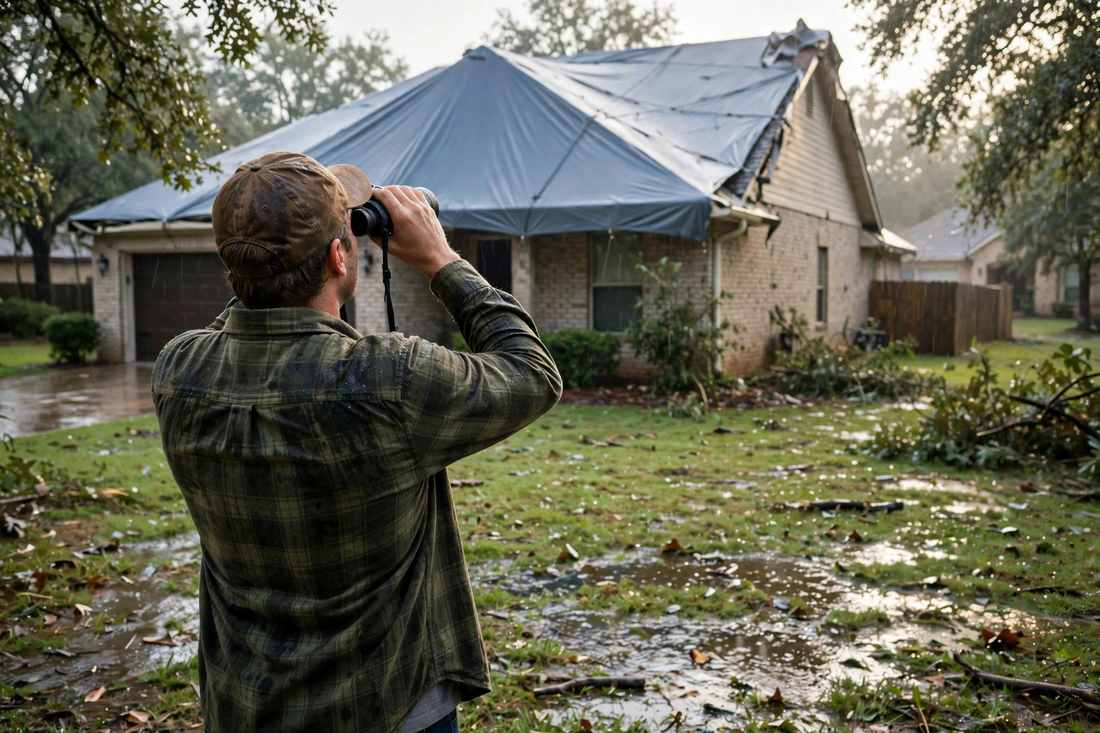
You do not need to climb up to check an emergency roof tarping job. From the ground, with binoculars if you have them, a good emergency roof tarping job has all five of these:

  1. It runs over the ridge, or tucks under the shingles above the damage. Water must flow over the tarp, never under it. If the top edge just stops in the middle of a slope, rain will run straight underneath.
  2. The edges are held down with wooden battens. Long strips of wood screwed through the tarp edge into solid decking, not a row of nails punched through the shingles, and not bricks or branches sitting on top.
  3. It is pulled tight and flat. No sags, no pockets, no low spot where water can sit. A tarp that holds a puddle is a tarp that will fail.
  4. It extends well past the damaged area on every side. Not just over the hole you can see, past it, because water travels under shingles further than the visible damage.
  5. Nothing is held down by hope. No brick, no branch, no loose corner flapping in the wind. If a corner can lift, the wind will lift it.
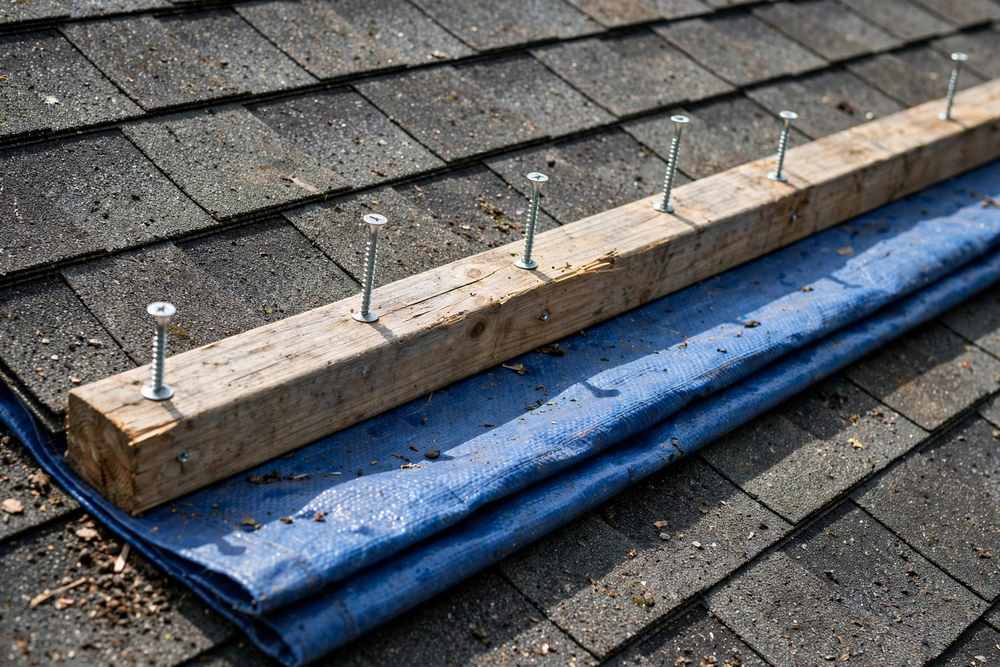
A roof tarp held down with wooden battens along its edge in Texas
Illustration: battens along the tarp edge, screwed into solid decking. No nails through the shingles.

If the tarp on your roof is nailed through the shingles, sagging in the middle, or flapping in the wind, it will make the leak worse, not better. Call us and we will fix it, and we will show you the difference from the ground, so you can see it for yourself. That is the standard for an emergency roof tarping job, and it can be checked from the ground.

Read those five points once more and notice what they have in common: every one of them can be seen from the lawn. That is deliberate. A cover you cannot check is a cover you have to take on trust, and trust is exactly what a homeowner should not have to spend at midnight after a storm. When our crews finish an emergency roof tarping job, the photos we take from the ground are matched against these same five points, one by one, before the ladder comes down.

The points also tell you what questions to ask any crew, including ours, before the sheet goes up. Where will the top edge sit? What will hold the edges down? How far past the damage will the sheet run? A crew with real answers is a crew with a method. A crew that shrugs at the questions is planning to improvise on your roof, and improvisation is how the failure stories further down this page begin.
The sheet itself

Choosing the sheet: what a roof tarp is made of

Not all tarps are the same sheet, and the difference decides how long the cover lasts. The sheet a crew carries for an emergency roof tarping job should be heavy duty woven polyethylene, thick enough that you cannot see light through it when it is held up to the sun. Woven sheet flexes without cracking, shrugs off the scuffs of being dragged across a roof, and holds its fixings without tearing out around them. Reinforced edges and strong grommets help where ropes or ties are part of the fixing.

Sun resistance matters as much as thickness here. Texas sun is hard on plastic. A sheet with real UV resistance ages in months. A sheet without it ages in weeks: it fades, goes stiff, and starts to crack along every fold. That is why the thin blue sheets handed out after storms fail so fast. They are made for covering a woodpile for a weekend, not for sitting on a roof in August. On a roof, a thin blue sheet is a short clock: fine for a few nights, risky after that, and a poor bet for the full wait until a repair.

Thickness is usually described in mils, and the plain version is this: if the sheet feels like a bin liner, it will live like one. A proper roof sheet feels like a heavy jacket by comparison. It also behaves better while it is being fitted: it lies flatter, holds a straight edge, and does not stretch out of shape the moment a batten pulls it tight.

There are other covers in the trade, and each has its place. Adhesive backed emergency sheets stick straight to shingles and need no fixings at all, which makes them the kind choice on a roof that will be kept, and on tile, where screws have no business. Sandbags and ropes over the peak can hold a sheet with no holes made anywhere, though they hold less hard in high wind. Felt paper, the dry in layer, is a cover of its own kind and gets its own section further down this page. The sheet is a choice, not a habit, and on an emergency roof tarping job the choice is made for the roof in front of the crew, the weather that is coming, and the wait the cover has to survive.

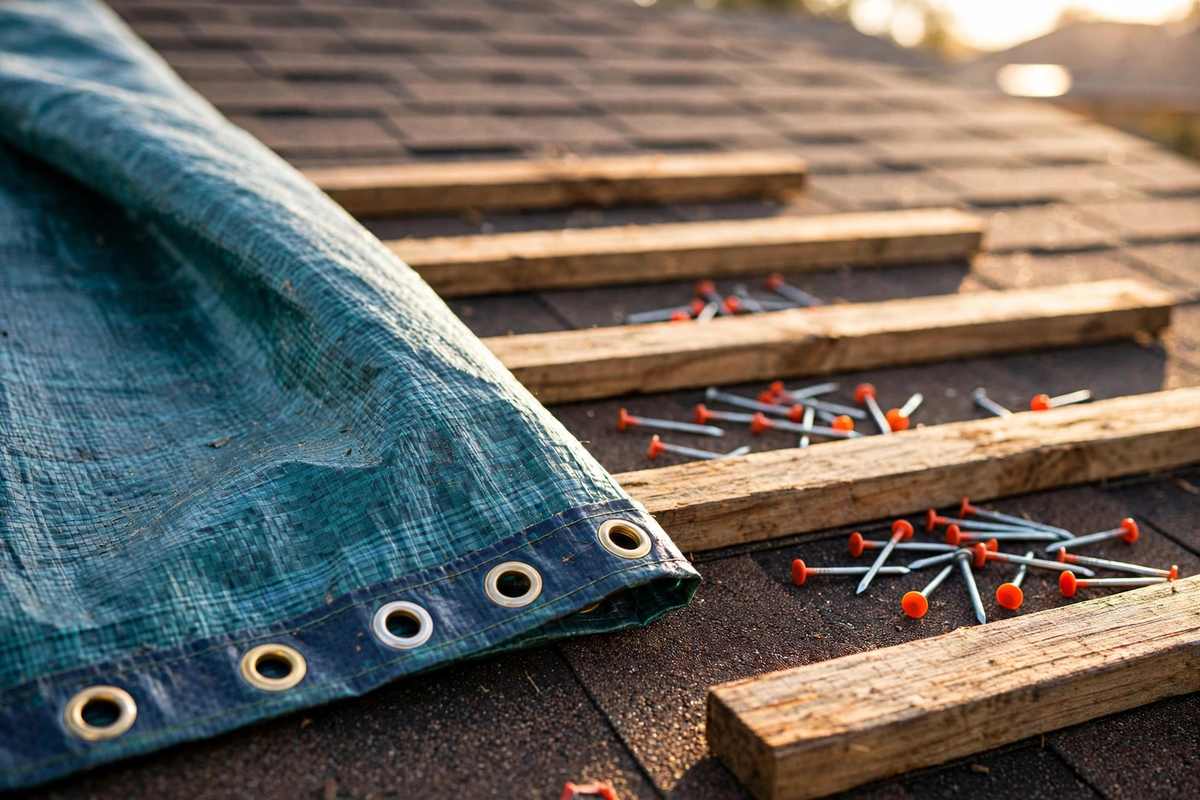
Heavy duty woven tarp sheet and battens ready for a Texas roof

The honesty part

Size it right: the honesty part of tarping

Two questions come up on almost every tarping call, and both have a plain answer. The tarp has to be bigger than the hole, by a lot. It has to run past the damage on every side, and it has to run 4 feet over the peak, so rain running down the far slope cannot get under the top edge. A tarp that only just covers the hole is a tarp that will leak at its edges. On an emergency roof tarping job, size is not about the hole you can see. It is about the water you cannot see, travelling under the shingles past the visible damage.

The working rule is simple: the damage, plus about four feet past it on every side. Four feet up the slope matters most, because that is the direction the water comes from. Four feet across and below gives the edges room to sit flat and hold. A tear the size of a dinner plate, with sound shingles around it, might honestly need a sheet no bigger than a small rug. A crew that unrolls a sheet the size of a tennis court over that tear owes you an explanation.

Here is why this section exists. Some tarping work is paid by the square foot of sheet fitted. Paid that way, a bigger sheet is a bigger payday, and the pressure to oversize is built into the job before anyone climbs a ladder. Roofers say this out loud on camera: one damaged shingle has been covered with a small sheet that did the whole job, on a roof where a sheet many times bigger was being sold. The homeowner in that story nearly paid for canvas they did not need, to cover damage they did not have. That is the story behind this section, and it is why our emergency roof tarping crews size the sheet to the damage, say the size out loud before it goes up, and photograph the damage so the size can be judged against it.

A big tarp is sometimes the honest answer. There are three cases where a whole slope, or most of it, really does need covering. The first is torn underlayment: when the felt under the shingles is ripped across the slope, the slope has lost its second skin and the cover has to replace it. The second is scattered damage: wind and hail rarely sign their work in one neat spot, and a slope peppered with tears needs a sheet that takes in all of them. The third is a broken seal across the field: when the shingle bond has let go widely, rain can be driven under course after course, and a small sheet leaves most of the slope open. In those three cases a big sheet is not a sales trick, it is the shape of the damage. The difference between the honest big tarp and the sold big tarp is evidence: photos of the slope, and a reason you can repeat back.

So before any sheet goes up, ask two things. Ask to see photos of the damage, taken before the cover hides it. And ask why the sheet needs to be the size it is. A good crew answers both without blinking, because a good crew sized the sheet on purpose. If the answers are shrugs, slow the job down. The rain may be urgent, but the size of the sheet is a decision you are allowed to understand first. That is true on every emergency roof tarping job, ours included.

Over or under is the second question, and it matters just as much. The top edge of the tarp goes over the ridge, or it tucks under the shingles above the damage, so water runs over the tarp the whole way down. A tarp laid on top of the shingles with its top edge stopping halfway down a slope does the opposite: rain runs under it and straight into the holes it was meant to cover. The bottom edge sits on top of the shingles below the damage, so water runs off it and keeps going down the roof. Over at the top, on top at the bottom, tight and flat all the way across. That is the whole rule.

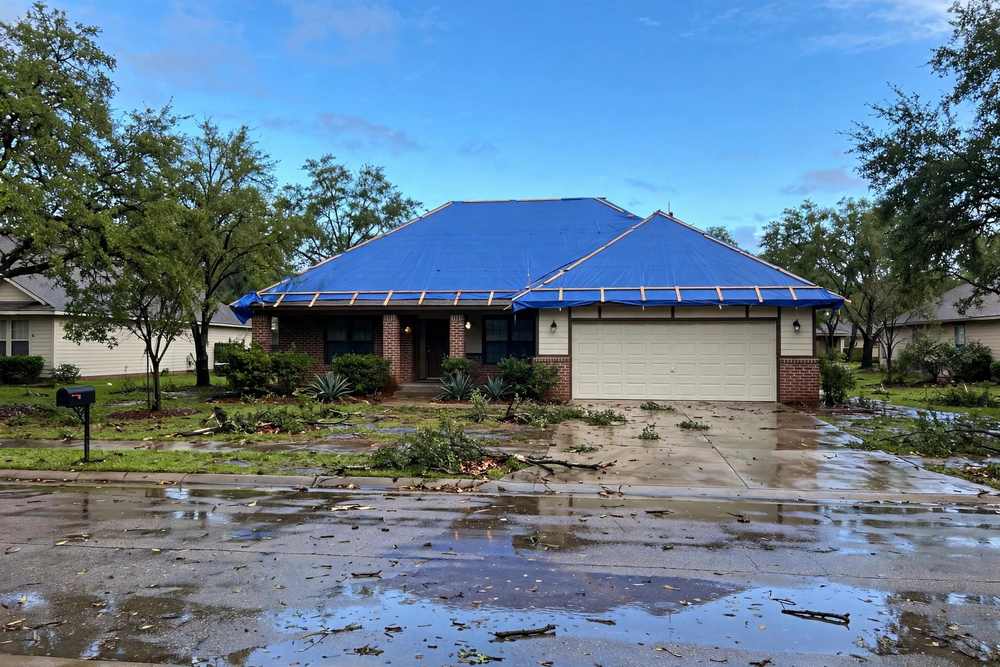
A tarp running over the ridge of a Texas home after a storm
The top edge of a roof tarp tucked under a course of shingles

One more thing people ask: can a tarp damage the shingles? A tarp fastened the right way, with battens at the edges, does not. A tarp nailed through the shingles does, every nail is a hole, and a tarp left flapping in the wind rubs the grit off the shingles underneath it. The damage comes from the fastening, not from the tarp itself.

The honest number

How long does a roof tarp last?

Plan on weeks, not seasons. A professionally fastened tarp in Texas sun and wind usually holds 30 to 90 days before the sun and the weather start breaking it down. That is the honest window, and it is why a tarp is a bridge to a repair, not a repair itself. On an emergency roof tarping job, the 30 to 90 day window is the plan, not a guess.

Three things shorten it. Texas summer sun is the first: sun eats a tarp from the top down, and a tarp that looked fine in June can be brittle by August. Wind is the second: every storm tests the fastenings, and a corner that worked loose in one storm will tear in the next. And standing water is the third: any sag that holds a puddle will stretch the tarp and pull at the fastenings until something gives.

So the rule is simple: if your permanent repair is scheduled further out than 30 days, the tarp needs checking, and possibly replacing, before it fails on you. We check our own tarp jobs when we come back for the repair, and if the tarp is ageing faster than the schedule, we say so. A tarp that fails quietly in the night is the one failure this trade should never have.

If you go looking for this answer online, you will find every number under the sun: a week or two, three months, six months, a year or more in a dry place. Homeowners comparing those answers cannot tell which one to plan around, and the confusion is real. The spread exists because the question hides three different things: the sheet itself, the fixing, and the weather it sits in. A heavy sheet, battened down, in a mild season, lives at the long end. A thin sheet, nailed at the corners, in a Texas summer, lives at the short end. The 30 to 90 day window is the honest planning figure for a proper sheet fitted the proper way, and it is the figure an emergency roof tarping plan should be built on.

Where does your tarp sit in that window? A few plain signs tell you. A sheet that has gone pale and stiff is near the end, however long it has been up. A sheet that still flexes, still sits flat, and still holds its edges after a storm is doing its job. Time alone does not retire a tarp. Condition does, and condition can be read from the ground, which is what the next section is for. That honest reading is part of every emergency roof tarping check we do.

Felt, the other common temporary cover, runs on a longer clock: a working roofer will tell you a felt cover lasts about three to four months before it starts to tear. That sounds better than the tarp window until you hear the rest: felt is not a sheet you can batten over a big open hole in the rain, and it does not shed a storm the way a fitted tarp does. Each cover has its job. The tarp is the fast, strong, short bridge. Felt is the slower dry in layer that belongs under a repair. Neither one is the repair itself.

Your two minute job

Checking your tarp from the ground

A tarp is not fitted and forgotten. It is fitted and watched, and the watching is the homeowner's share of every emergency roof tarping job: safe, quick, and done with both feet on the ground. After every storm that brings real wind or hard rain, walk out and read the cover the way you would read a flag. You are looking for five things.

Lifted edges come first. An edge that has peeled back or a corner that stands up has already let the wind get a grip, and the next storm will pull harder. Pooling comes second: a sag that holds water after the rain has stopped is a bowl forming over your ceiling, and it grows heavier with every shower. Flapping is third, and you will hear it before you see it: a loose section slapping in the wind is wearing its fixings out in real time. Fourth is the sheet itself: plastic that looks stiff, pale, or cracked along its folds is dying in the sun, and dying plastic tears without warning. Fifth is the ground around the house: a batten, a strip of sheet, or a scatter of cap nails in the yard means something up there has already let go.

None of that needs a ladder. Binoculars help, a phone camera zoomed in helps, and a photo taken after each storm gives you a record to compare, so a slow change does not sneak past you. If any of the five signs shows up, that is a call, not a wait. A refit on a calm morning is a small job. The same failure found during the next storm is an emergency roof tarping visit all over again, with water already inside.

Our crews check their own covers the same way when they return for the repair, and a cover that is ageing faster than the schedule gets said out loud, not discovered later. But the weeks between the fitting and the repair belong to the house, and a two minute look after a storm is the cheapest protection on this whole page. The tarp's one job is to be boring: flat, quiet, and unchanged, storm after storm, until the day it comes off for good.

Inside the house

While the tarp holds, look after the inside of the house

A fitted tarp stops new water. It does nothing about the water that already got in, and that water has its own clock. Wet insulation, wet plaster, and a wet carpet do not dry themselves just because the dripping stopped. Left damp, they start to smell within days, and mould follows the smell. The tarp buys you dry time. The inside of the house is where that time gets spent well or wasted.

Start the drying within a day or two. Open the windows when the weather outside is dry. Run fans toward the wet patch, not away from it. Lift rugs off wet floors and stand cushions on end so air can get at every side. If the attic took water, it needs air too: a hatch left open to a dry house is better than a sealed box of damp. You are not running a restoration site. You are just refusing to let one wet night settle in and become a second problem with a longer life than the first.

Watch the stain while you dry. A stain that is drying out stops growing and turns dusty at the edges. A stain that grows, darkens, or comes back after the next rain is telling you water is still finding a way in, and that is a call, not a paint job. Paint is the last step of a leak, never the first: paint over a live leak and you have hidden the only warning sign the house can give you. Give it a few rains. A stain that stays dry through three good storms is a stain that can be painted and forgotten.

About a week in, do the nose test. Put your head through the attic hatch and breathe in. A drying attic smells of warm wood and dust. A damp one smells sweet and musty, and that smell means water is still sitting somewhere it should not be. You do not need to crawl in or touch anything. The smell alone is worth reporting when the crew comes back, because trapped damp found in week one is a drying job, and trapped damp found in month three can be a ceiling opened up. An emergency roof tarping job ends at the repair, but the house tells you how it is healing the whole way there, if you know how to listen.

Learn from other roofs

Why tarps fail, the stories homeowners tell us

Ask Texas homeowners about tarps and you hear the same three stories, over and over, and every one of them starts with an emergency roof tarping job that was rushed.

The wind took it.

A tarp that is only held at the corners lifts like a sail. One gust gets under a loose edge, the whole sheet billows, and by morning it is in the neighbour's yard, or shredded across the roof, with the nails it was held by now torn through the shingles underneath. Wind does not tear a well fastened tarp. It tears a tarp that was never fastened properly in the first place.

It pooled water and poured in all at once.

This is the worst one, because it looks like the tarp is working right up until it fails. A tarp laid flat across a low spot, or sagging between two high points, collects rain in the middle like a bowl. The water gets heavier and heavier until the tarp gives way, and then every gallon it was holding comes into the house at once, through the same hole it was supposed to protect. Homeowners have watched a bad tarp do more damage in one night than the storm did.

It was nailed through the shingles.

Somebody, sometimes a well meaning neighbour, sometimes a crew in a hurry, lays the tarp over the damage and hammers nails straight through it into the roof. Every nail is a new hole. Worse, the tarp sits on top of the shingles, so rain runs underneath it and straight into those holes. The right way is the opposite: the tarp goes over the ridge, or tucks under the shingles above the damage, so water runs over it, and the edges are held down with wooden battens, not nails through the middle.

There is a fourth failure, quieter than the other three, and it belongs on the list: the wrinkle that became a river. A sheet thrown over a slope in a hurry keeps the folds it had on the truck. Rain finds a fold, the fold becomes a channel, and the channel delivers water sideways, under the sheet, to a part of the roof that was never damaged at all. The homeowner watches a new stain grow in a room the storm never touched, and swears the roof is leaking somewhere new. It is not. The cover is watering the roof from inside its own folds. Flat is not a style choice on an emergency roof tarping job. Flat is the whole mechanism: water that cannot sit and cannot sneak is water that leaves.

If any of that sounds familiar, you are not the first. A failed tarp is one of the most common reasons people call us the second time, and fixing a bad tarp job is part of the job, not an extra.

Read the stories once more and you will see the pattern: not one of them is a story about a bad sheet. They are stories about edges left loose, water left sitting, nails driven where battens belonged, and folds left to channel rain. Every one of those failures was preventable on the night the sheet went up, which is the whole argument for doing an emergency roof tarping job slowly and properly the first time. The sheet is the cheap part of tarping. The fitting is the craft. That is why this page spends more words on how a cover goes on than on what it is made of, and why the five point check further up is worth doing on any cover, whoever fitted it.

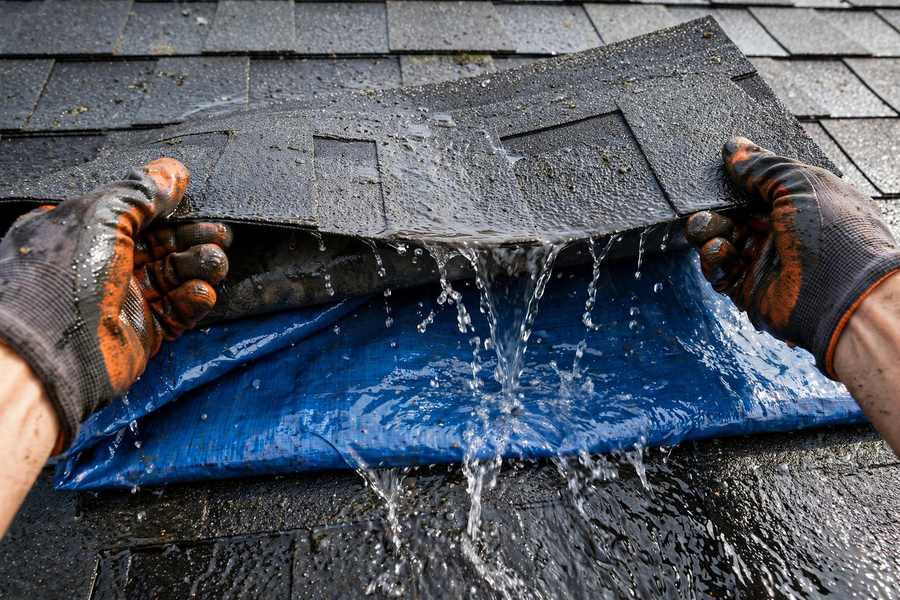
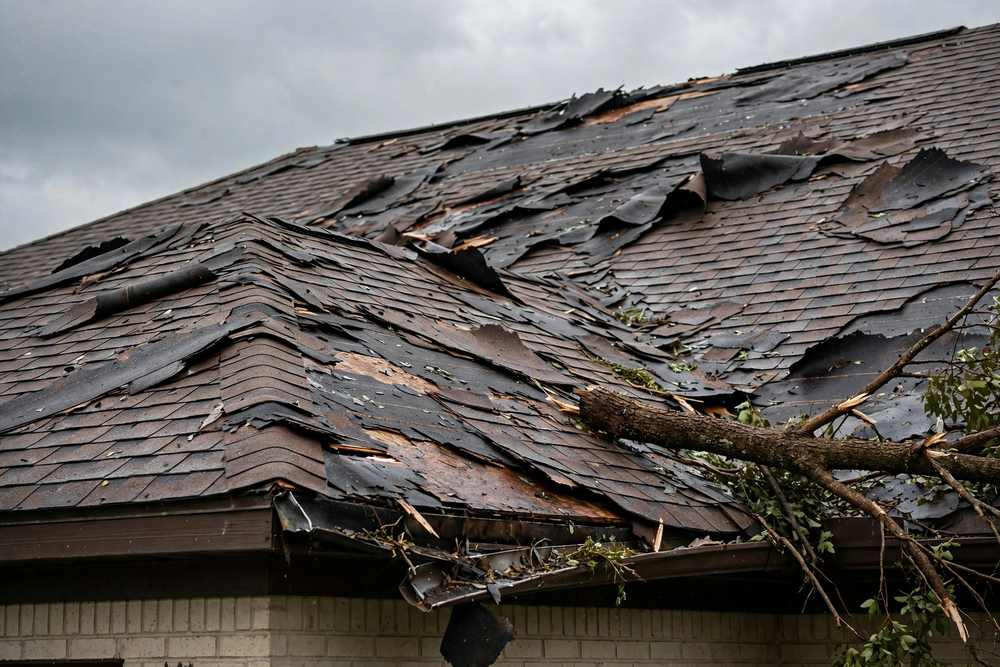
Storm torn shingles on a Texas roof before a tarp is fitted

Hard weather

Tarping in the rain

Can a roof be tarped while it is raining? It can, and emergency crews do it, because the nights when tarps are needed most are usually wet ones. But it is honest to say what it is: the most dangerous version of the job. Wet shingles are slick, wet ladders are slick, a wet sheet is heavy and awkward, and wind rarely travels alone with rain. Every part of the fitting gets slower and less sure in the rain, and the crew knows it.

That is why an emergency roof tarping call in the rain runs on judgement, not bravado. If water is pouring in and a ceiling is at risk, a careful two person job, with proper footwear, a secured ladder, and no heroics at the edges, beats waiting while the house soaks. If the drip is slow and a bucket is holding it, the safer call is often to ride out the wet spell doing the inside work, and fit the cover the moment the roof can be walked on safely. Both answers are professional answers. The weather and the water decide which one is right tonight.

There is also a hard line, and it does not move: while the storm itself is still passing, with gusts strong enough to lift a sheet out of your hands, nobody belongs on the roof. A sheet in high wind is a sail, and a sail on a roof takes its holder with it. The inside work, buckets, power off near wet lights, a drained ceiling, furniture moved, is not a lesser job during those hours. It is the job, until the wind drops and the cover can go on properly.

Homeowners sometimes ask why the crew that arrives in the rain works so slowly at the start. The slowness is the safety system working: footing tested before weight goes on it, the ladder tied, the sheet carried folded so the wind cannot grab it, one person on the roof and one on the ground in sight of each other. A rain fitting done at that pace holds. A rain fitting done at dry weather pace is how the accident stories start, and this trade has enough of those already.

Roof shapes

Flat roofs and valleys need a different temporary fix

Not every roof takes a tarp the same way, and two shapes catch people out. That is why an emergency roof tarping visit starts with looking at the shape of the roof, not just the hole in it.

On a flat roof, water has nowhere to run, so the first job is to clear the drain and get standing water off. A tarp laid over a ponding flat roof just traps the water underneath it, and a sealant patch on a wet, ponding surface will not hold. The temporary fix for a flat roof is a dry in: felt and boards over the damaged section, with the drain kept clear, until the permanent repair can be done on a dry surface.

A flat roof also changes the checking habit. On a slope, a failed cover announces itself. On a flat roof, water can sit on top of a cover for days, quietly finding the one seam that was not sealed, and the first sign inside may come long after the rain that caused it. After any storm, a flat roof needs its drain checked and its standing water read: a puddle still standing a day later is the roof telling you the water has nowhere to go, cover or no cover. That patience is standard on every flat roof emergency roof tarping visit we run.

In a valley, the inside corner where two slopes meet, the fix is to keep water moving down the valley, not to dam it up. Roofing cement or a silicone sealant can buy you days on a small crack you can get dry, but only as a stop gap: it is not a repair, and on a wet surface it will not bond at all. If the valley is leaking during rain, or the flat roof is holding water, that is a call tonight job, not a wait and see one.

A valley under a tarp needs care of its own. A sheet thrown across a valley bridges it, and a bridge over a channel is a dam: water backs up behind the sheet and spills sideways under the shingles on both slopes. The cover has to follow the valley down, lying in it, not stretched over it, with its top edge tucked well above the damage. Crews that tarp valleys the way they tarp open slopes create the very leak they were called to stop, which is why the shape of the roof gets read before the sheet is even unrolled. Shape first is a rule on every emergency roof tarping job, not a preference.

Tile roofs deserve a line of their own. Tile is heavy, brittle underfoot, and expensive to break, and a screwed batten has no place near it. On tile, the cover of choice is one that makes no holes: an adhesive backed sheet, or a sheet held by weight and ropes over the peak, fitted by someone who knows where a tile roof can be walked on and where it cannot. The wrong footstep on tile does more damage than the storm did, and it does it quietly, in cracks that leak next season.

Metal roofs change the job again. A sheet slides on smooth panels, so it has to be held with more care, and the fixings are planned so the panels are not scarred or dented by the cover that is meant to protect them. Metal also leaks differently: at seams and screws, not through open holes, so the opening being covered may be a long seam rather than a tear, and the sheet has to run with the panels, not across them. A crew that treats a metal roof like a shingle roof will fight the sheet all night. Metal is its own trade within emergency roof tarping, and it punishes shortcuts quietly.

Steep roofs are the last shape worth naming. On a steep slope everything slows down: the sheet is carried up folded so the wind cannot grab it, footing is tested before any weight goes on it, and the work is two person work, always, with one set of eyes on the ground. Some steep covers honestly wait for dry footing, because a tarp fitted by someone sliding is a tarp fitted badly, on top of being a risk no cover is worth. When a crew tells you the steep side waits for morning, that is not laziness. That is the craft knowing its limits. Steep work is where an emergency roof tarping crew earns its caution.

Honest safety talk

Can I tarp the roof myself?

We would rather you did not. Wet roofs are where homeowners get hurt after storms, and a badly fastened tarp can channel water into the house worse than the hole did. From inside, you can do real good: buckets, photos, moving furniture. The roof itself is our job, and it is what the emergency roof tarping call is for.

If you must do something before we arrive, do the inside work: turn the power off if water is near a light or an outlet, put a bucket under the drip, and drain a bulging ceiling so it empties on your terms instead of coming down at 3 a.m. Leave the ladder in the garage. The tarp will hold better, and so will you.

Never tarp during the storm itself, and never walk on a tarp. A wet tarp is slick underfoot, and damaged decking can give way under a person standing on it. If the wind is still strong enough to lift a sheet, it is too windy to tarp, and the inside work is the right work until the weather passes.

The warnings roofers repeat to each other are worth repeating here, because they were all learned the hard way. Never go up on a wet roof. Never go up in the rain, in the dark, or in high wind. Never go up if you are not fully comfortable up there, because a roof is no place to discover a fear of heights. And never go up alone: the person on the ground is not a helper, they are the rescue plan. No roof is worth a fall. That sentence is the whole safety section of this page in six words, and everything else is commentary.

One more honest word on sealants, because homeowners ask about them a lot: roofing cement and silicone sealant can hold a small, dry crack for days, and that is all they can do. They are not a repair, they do not bond to a wet surface, and they do not fix a valley that is leaking in the rain. That is the limit of what sealant can do on an emergency roof tarping job: buy days, not months. If the tube says permanent, the tube is lying. Use it only as a stop gap while the real repair is being scheduled, and stop the moment the job needs a ladder.

The same honesty applies to the tapes and sprays sold for leaks. They have their place in a drawer, as a holding measure on a small, dry, reachable crack. On a storm opening, in the rain, they do almost nothing, and a thick layer of the wrong product can trap water in the decking and give the real repair a mess to undo first. The thing that stops a leak is never a product. It is a cover fitted the right way tonight, and a repair done at the entry point after. If the drip you are chasing keeps moving, the problem is the entry point, and finding it is tracing work: that is what our Roof Leak Repair page is about.

The limits

What a tarp cannot do

A page that sells tarps would skip this section. This page is not selling, so here it is, plainly: the honest limits of the cover, so nobody leans on it for more than it can carry.

A tarp cannot mend what is under it. Cracked shingles stay cracked. Split decking stays split. A boot that has rotted through stays rotted. The cover keeps the weather off the damage; it does not undo a single inch of it, and the day the sheet comes off, the roof underneath is exactly the roof the storm left, no better and, if the cover did its job, no worse.

A tarp cannot stop a leak that enters somewhere else. Water travels. It gets in at a high point, runs along the boards, and drips somewhere that can be feet away from the entry. Cover the spot above the stain and you may cover nothing at all: the drip continues, now with a sheet over the wrong part of the roof. That is why a leak with no clear opening is a tracing job first and a covering job second, and why an emergency roof tarping crew that cannot find the opening will say so instead of covering a guess.

A tarp cannot be forgotten. It ages from the first morning it spends in the sun. Edges work at their fixings with every gust. A cover that was sound in week one is a question by week six, and nobody's memory is a checking schedule. The ground checks further up this page exist because forgetting is the most common way a good tarp becomes a bad one.

And a tarp cannot hold up a roof. If the structure is hurt, if decking has gone soft or a section is sagging, a sheet over the top is weight and false comfort on the weakest part of the house. That roof needs a dry in built for it, or a room kept empty until it is read in daylight. Knowing what the tool cannot do is most of knowing the tool. That boundary is the honest edge of emergency roof tarping. The rest of this page is what it can.

The better options

What is better than a tarp?

Homeowners ask this near the end of most calls, and it deserves a straight answer: the permanent repair is better than a tarp. A tarp is the bridge, the repair is the far bank. Nothing that sits on top of a roof beats the roof being whole again, and any crew that talks about a cover as if it were the destination is stalling the only job that finishes the story.

Between the storm and the repair, though, there are covers with longer clocks, and it is fair to name them. A felt dry in, fitted properly under the shingles at the top edge, lasts about three to four months before it starts to tear, which is longer than a tarp's 30 to 90 days. It is the better cover when the wait for a repair is long and the damage suits it. Shrink wrap, sealed tight over a whole section, can outlast both, and some crews reach for it on big storm work. It asks for the right gear and a dry spell to fit, which is why it is a planned job, not a midnight one.

There is also the honest case where the best cover is no cover: the small repair done the same day. A lifted shingle course reset and sealed, a cracked boot swapped, a flashing joint remade: when the damage is small and the weather allows, the repair itself is faster than the tarp would be, and the roof is finished, not bridged. A repair first crew reaches for that answer whenever it honestly holds, and reaches for the tarp when it does not. That judgement, cover or repair, tonight or tomorrow, is most of what an emergency roof tarping call is really for.

So the order of answers is plain. Best is the roof repaired. Next is the cover with the longest honest clock for the wait ahead. And under all of it is the rule this page started with: a tarp done right, checked from the ground, and replaced by the real repair on schedule, is not a compromise. It is the system working exactly as it should.

Checking a tarped roof from the ground after a Texas storm

The finish line

The day the tarp comes off

Every tarp on this page has been a bridge, and bridges get crossed. The day the cover comes off is the day the whole plan was pointing at, and it has a shape of its own worth knowing.

It starts in dry weather, on purpose. The crew peels the cover back section by section, and the roof underneath gets read properly for the first time since the storm: decking checked for soft spots, shingles around the damage checked for lifted seals and hidden tears, the attic checked for damp that never made it to a ceiling. The photos from the night of the fitting come out, and the roof is compared against them. Damage that grew gets named. Damage that held gets cleared.

Then the repair runs the way the written scope said it would. If the decking dried sound, the repair goes straight on. If a section stayed wet under the cover, it dries first, because new material over wet wood just seals the damp in to rot quietly. That patience is not a delay tactic. It is the difference between a repair and a time capsule of mould. It is also the last careful step of an emergency roof tarping job.

When the work is done, the sheet is folded, the battens are stacked, and the roof is a roof again, not a patient. You get the after photos, the same angles as the before ones, so the change can be checked with your own eyes. And the stain inside, the one you have been watching, can finally be painted once it has stayed dry through a few good rains. That is the end of an emergency roof tarping job: not the night the sheet went on, but the day it came off and was not needed anymore.

Keep reading

The pages around this one

A tarp is one tool in a bigger kit, and this page sits between two others on purpose. If a storm opened your roof, the tarp is tonight, and the full check is next: our Storm Damage Roof Repair page walks the whole roof after the cover is on, slope by slope, so the damage the storm scattered gets found by a crew and not by the next rain. If the water is coming in with no storm behind it, the problem is an entry point that has to be found before it is sealed, and our Roof Leak Repair page explains the tracing method that finds it. And if you are still deciding whether tonight is an emergency at all, our guide, What Is an Emergency Roof Repair, lays out the first 24 hours in order. Every one of those pages starts where this one ends: the house dry, the damage documented, and the real repair planned in writing. That is the kit an emergency roof tarping call belongs to: cover, check, trace, repair.

Where we tarp

Areas we serve

We run emergency roof repair tarp texas-wide, with dedicated local pages for the cities below:

Austin

Home base for our crews. Big live oaks over older roofs mean limb holes are steady work here, and a cover on an Austin roof has to survive real summer sun, so the sheet choice matters more in this town than most.

Buda

Fast growing and storm prone, twenty minutes from our tools. Young roofs get opened at the details: lifted edges and torn courses, the kind of damage an emergency roof tarping crew covers well in one visit.

Pilot Point

Lake wind country. A cover near the lake gets tested by wind off the water every single night, so battens and edges matter more here than anywhere we work.

Plano

Big roofs and tall trees. Wide slopes mean longer damage runs when a storm tears in, and covers sized to the slope when the damage honestly asks for it.

Somewhere else in Texas? Call (512) 555-0147. If your town just took a storm, say so. The plan starts with a tarp either way.

Straight answers

Emergency roof tarping questions, answered

No sales talk. The questions every emergency roof tarping caller asks, answered the way we answer them on the phone:

How long will a tarp last on my roof?

Plan on 30 to 90 days. A professionally fastened tarp in Texas sun and wind usually holds that long before the sun and weather start breaking it down. If your permanent repair is scheduled further out, the tarp needs checking, and possibly replacing, before it fails on you.

Can I put a tarp on my roof myself?

You can, but we would rather you did not. Wet shingles are slick, damaged decking can give way underfoot, and a tarp put on wrong, nailed through the shingles, or sagging so it pools water, makes the leak worse than the hole did. From inside you can do real good: buckets, photos, moving furniture.

How do I secure a tarp without nails?

Use wooden battens, long strips of wood screwed through the tarp edge into solid decking. The tarp runs over the ridge or tucks under the shingles above the damage, then battens hold every edge down tight and flat. Never hammer nails through the middle of the tarp into shingles, because every nail is a new hole for rain to find.

Should the tarp cover the whole roof or just the damaged area?

Just the damaged area, but with room to spare. The tarp has to run past the damage on every side, and 4 feet over the peak, because water travels under shingles further than the visible damage. Covering the whole roof is not needed when one section is sound, and a tarp that big is harder to keep tight and flat.

Will a tarp stop the leak in the rain?

Yes, if it is done right. A tarp over the ridge or tucked under the shingles above the damage, pulled tight and flat, sheds rain like a roof. A tarp that just covers the hole will not. Rain runs under it, and the leak comes back worse than before.

What if my tarp blew off or is pooling water?

Call us. A tarp that blew off has usually torn the shingles it was nailed to, so the hole is bigger than it was, and a tarp pooling water is holding gallons over your ceiling that will come in all at once when it gives way. We will take it off and cover the opening properly with battens.

Is a tarp enough, or do I need a real repair?

A tarp is never enough on its own. It buys you weeks, time for dry weather, materials, and a proper inspection, but the shingles underneath are still broken, and the tarp itself is ageing in the sun from day one. The permanent repair still has to happen.

How do you tarp a roof?

Unroll the tarp over the damaged area and carry it at least four feet past the hole on every side, over the peak if the damage is near the top. Anchor the edges with boards screwed through the tarp into the roof. Never leave a tarp held down by loose bricks or a few nails.

What is roof tarping?

Roof tarping is a temporary cover fitted over storm or leak damage to keep rain out until the real repair is done. A good tarp is sized past the damage, sealed at the edges, and fixed with boards, not just nails. It buys days or weeks of dry time. It is not a repair by itself.

What kind of tarp is best for a roof?

A heavy-duty polyethylene tarp, thick enough that you cannot see light through it, sized at least four feet bigger than the damaged area on every side. Thin blue tarps tear and go brittle fast in Texas sun. Reinforced tarps with grommets hold their fixings better when the wind picks up overnight.

Can you tarp a roof in the rain?

It can be done, and emergency crews do it, but it is the most dangerous version of the job. Wet shingles and wet ladders are where falls happen. If water is pouring in, a careful two-person job with proper footwear beats waiting. If the drip is slow, most homeowners are safer waiting for a dry spell and calling help.

What is better than a tarp?

The permanent repair is better. A tarp is a bridge that buys dry weeks, nothing more. For a longer wait, a felt dry in lasts about three to four months, and a same day small repair beats any cover when the damage allows it. The cover is never the finish.

Water coming in right now?

One call covers emergency roof repair tarp texas-wide. We stop the water tonight with a tarp that actually holds, document everything with photos, and set out the written scope for the real fix.

(512) 555-0147
Call (512) 555-0147