Emergency Roof Repair · Houston, Texas
When Gulf rain finds the weak spot in your roof at 2 a.m., you need the water stopped first and the truth about the damage second.
Houston rain does not fall the way rain falls in most cities. It arrives in walls of water, inches in an hour, and it tests every seam, boot and valley on your roof at the same time. When that test finds a weak spot, the clock starts. Soaked insulation, a spreading ceiling stain and a bulge over the bed are all measured in minutes here, not days. That is why emergency roof repair Houston homeowners call for has to start with one job: stop the water, then find out exactly where it got in.
Call now and a roofer answers, day or night. Tell us what the water is doing and where, and we will tell you plainly what to do in the next ten minutes, before anyone climbs anything. If it can safely wait for daylight, we will say that too. Honest first, ladder second: (512) 555-0147.
The Heights · Montrose · River Oaks · Memorial · Meyerland · and across the Houston metro
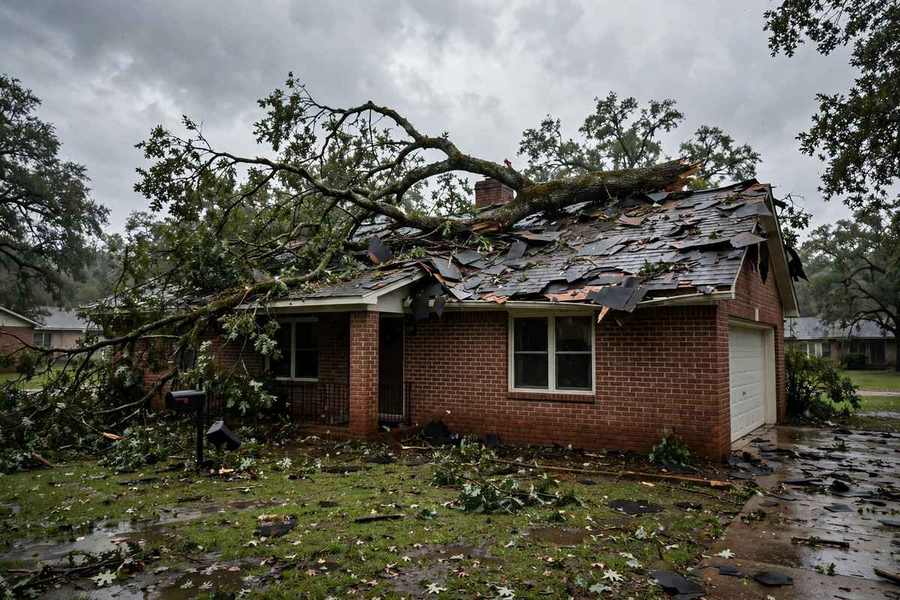
Emergency roof repair in Houston is the same day work of stopping water where it gets into a roof and fixing that exact entry point: a torn shingle field, a split vent boot, a lifted flashing, a limb through the deck. The water is stopped first, the entry point is traced and repaired second, and the inside of the house is protected while both happen. It is not a smear of sealant over a ceiling stain. The stain is where the water finished its trip. The repair belongs where the trip started.
Houston weather
Most cities get weather. Houston gets water, delivered fast. Warm air rolls in off the Gulf of Mexico loaded with moisture, meets a front or a slow tropical system, and unloads. A normal afternoon storm here can drop what other cities see in a month. Streets flood, bayous rise, and every roof in the metro takes the same hard test at the same hour. Emergency roof repair Houston crews stay busy for one simple reason: this city tests roofs harder and more often than almost anywhere else in Texas.
That test is not gentle. Rain driven sideways by storm wind gets under shingle edges that hold fine in a straight downpour. Water stands in valleys and tests the joints. Vents, chimneys and skylights, every place the roof was cut to let something through, get pushed from angles they were never tested from. A roof that has been quietly aging for fifteen years can pass a hundred normal rains and fail the one that comes in sideways at forty miles an hour.
Then there is the season. From June through the end of November, tropical weather is part of life here: tropical storms, and in the hard years a hurricane making landfall along the coast. You do not need a direct hit. The outer bands of a storm sitting over the Gulf can park over Houston for days and rain the whole time. Roofs fail in those long rains in a different way than in a single burst. Seams that hold for an hour give up in hour thirty. That long, soaking test is the one Houston roofs have to pass, and it is the one that sends people looking for emergency roof repair Houston help in the middle of the night.
Heat does the slow work between storms. Houston summers sit in the nineties with humidity to match, and a dark shingle roof runs far hotter than the air. That heat bakes sealant strips, dries out the rubber collars around vent pipes, and cooks the oils out of shingles year after year. The storm only reveals the damage. The summer caused it. Good emergency roof repair Houston work always looks at both: the storm that opened the roof, and the years of heat that made it ready to open.
It is worth saying how different this is from the rest of our own site. Austin gets storms, Plano gets hail, and both keep their crews busy. Houston gets water in a category of its own, because the Gulf is right there, an hour south, feeding every system that forms. The practical result: roofs here are tested by volume and endurance more than by any single dramatic moment. Emergency roof repair Houston work is therefore less about the spectacular hole and more about the tired joint, the ponding seam, the boot that split in the heat and waited for a three day rain to announce itself. If you moved here from drier Texas, recalibrate. A roof problem in Houston is rarely about whether water gets in during the worst hour. It is about whether your roof's weakest detail can hold for the worst week.
There is one more Houston habit worth copying from the locals: nobody here waits for certainty. A stain gets a phone call, not a coat of paint. A drip gets a bucket and a photo, not a hope that it was a one off. In a city where the next test is always on the radar, early is the whole game. An emergency roof repair Houston call made at the stain stage is the smallest, calmest version of that call there is.
Call now or wait
Houston changes the usual answer a little. In a drier city, a slow drip can wait for a dry weekend. Here, the next downpour may be this afternoon, and it may drop more water in an hour than your ceiling can hold. Use this test. If any item on the left is true right now, call. If only the right side fits, protect the room, take photos, and call first thing in the morning.
One Houston warning belongs on both lists. Never climb on a wet roof here, and never climb after dark. Wet shingles in this humidity grow a slick film that locals learn about the hard way. Everything on the call now list can be handled from inside the house until a crew gets there: buckets, towels, moved furniture, power off near the water. The roof will still be there in the morning. Make sure you are too. That inside first rule holds on every emergency roof repair Houston call we take, in every part of this city.
After the storm
After any serious Houston storm, you can learn most of what matters about your roof without leaving the ground. Crews do this survey before they ever unload a ladder. Here is the homeowner version, in the order we walk it.
Start with the lawn. Shingles or shingle pieces on the grass mean the field above them is open. Note roughly where they landed and look up: the gap is usually on the slope facing the wind that threw them. Photograph the pieces where they lie before you pick them up. Their position tells the crew which slope to open first.
Check the gutters and the ground below the downspouts. A drift of granules, the gritty coating from the shingle surface, means the roof above took a beating, from hail, from age, or from debris dragging across it in the wind. A handful after one storm is a story. A handful after every storm is a roof nearing the end. It is one of the first things an emergency roof repair Houston crew checks, because granules do not lie about age the way a sales pitch can.
Look along the edges and the ridge with binoculars if you have them. You are looking for lines that break the roof's pattern: a lifted edge, a cap shingle sitting crooked, flashing that flashes silver where it used to sit dark and flat. From the ground you will not see everything. You will see enough to know whether the phone call is urgent, and your description, north slope, ridge, near the chimney, is gold to the person taking it.
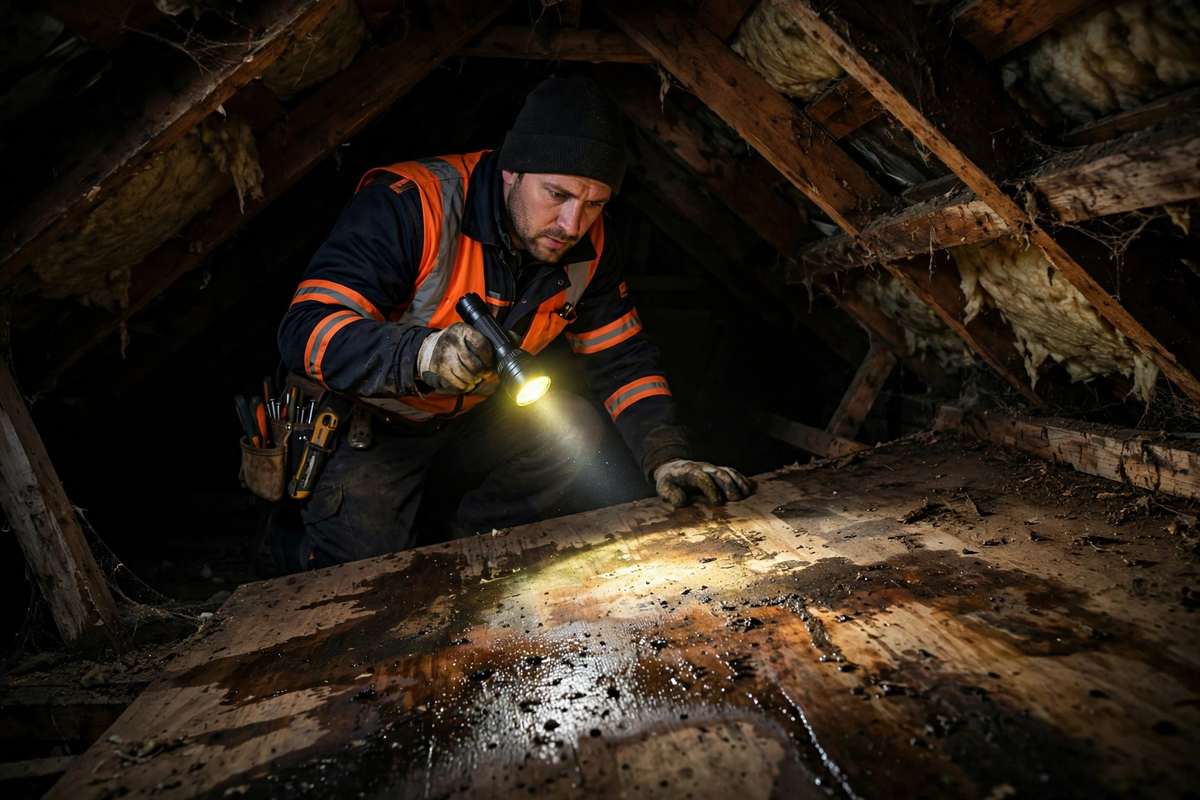
Then check the attic, in daylight, with a torch, from the hatch if the attic is not floored. You are looking for wet wood, dark streaks, daylight where no daylight should be, and drips on stored boxes. Smell matters too. A musty attic a day after rain is water sitting somewhere. This ten minute survey, done after every big blow, is how Houston homeowners catch the small version of every problem on this page. Emergency roof repair Houston work gets easier, smaller and calmer the earlier it starts, and it starts with a walk around your own yard.
From the call log
No names, no addresses, and nothing here that did not happen in some form on some Houston street. These are the shapes emergency roof repair Houston calls take, season after season.
A bungalow, a porch roof joint, and a downpour that found the seam the porch builder sealed instead of flashed twenty years ago. The water stopped that night with a cover. The repair was flashing, done properly, in daylight. It is the most ordinary emergency roof repair Houston call there is, and it is ordinary precisely because the detail was ordinary.
A flat roofed addition ponding water after every rain, and a stain that grew a little each month for a year. By the time of the call, the seam had split and the decking edge had softened. The lesson travels well beyond Montrose: on a flat section, a growing stain is never just a stain. It is a schedule.
A storm night, an oak limb through a long slope, and a family who did everything right: power off, room emptied, photos taken, nobody on the roof. The deck patch and rebuild took a dry day. The cover took an hour. This is the emergency roof repair Houston version of a bad night ending well, because the inside work was done right.
No drama, no hole, just a tropical soak that found a boot split by two summers of heat. The drip started on day three, an hour after the rain eased, right on the travel pattern this page describes. A boot swap ended a leak that a three day storm had spent itself revealing.
A stain that appeared twice a year, always after storms from the same direction, on a complex roof with crossing valleys. Two earlier patches above the stain had failed, because the stain was never the entry. The hose test found it in a valley joint that only opened to driven rain. Directional leaks are the argument for tracing, made in one house.
A fifteen year old roof in a master planned district, no drip at all, just a musty spare room. The attic told the story: two cracked boots and insulation that had been damp for months. The fix was small. The drying took longer than the repair. In Houston, the nose is a leak detector, and it usually reports early. Listen to it.
While you wait
Houston storms rarely give you a dry gap to think in. The rain that found your roof is probably still falling, and more may be on the radar behind it. These seven steps are in order. They protect your family and your home first, and they make the repair faster when the crew arrives.
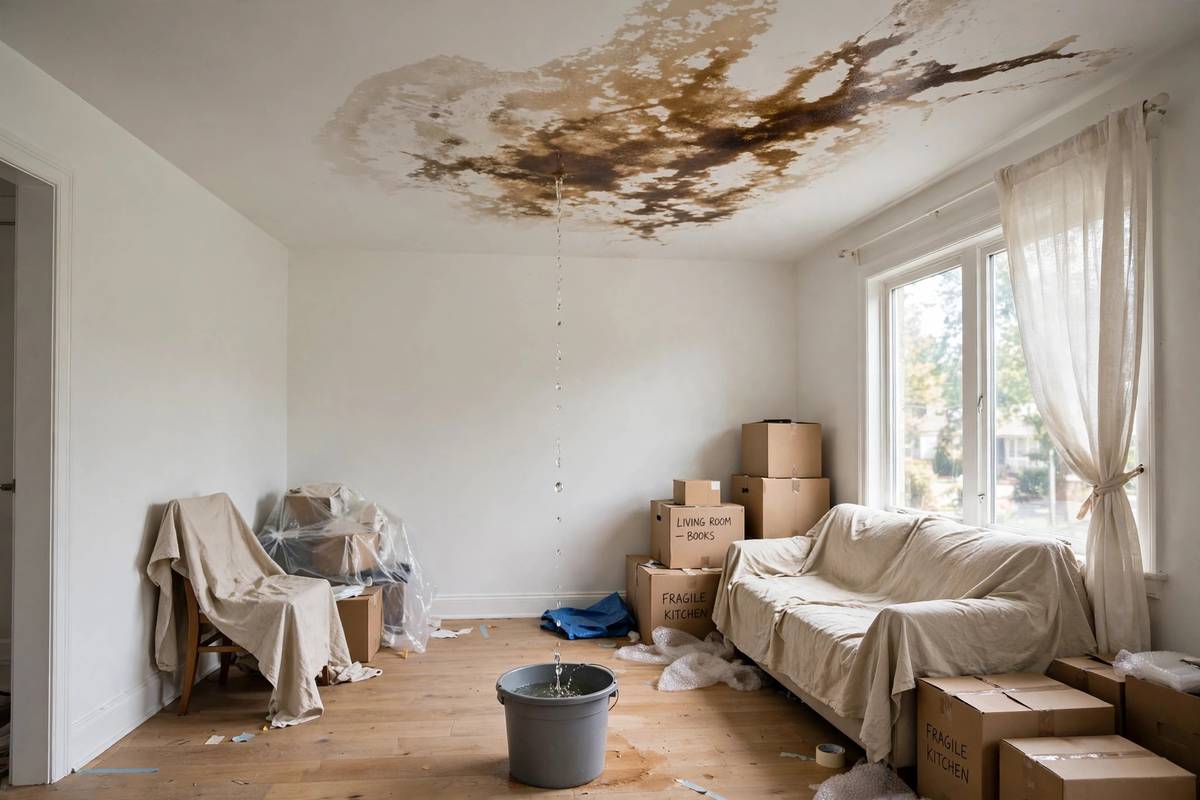
Put the biggest container you have under the drip. A bucket on a towel beats a bucket on bare wood, because drips splash wider than they look. If the drip splits into two, use two containers and do not chase it around the room. Mark the spot with tape on the floor so the crew can find the exact landing zone later.
Furniture, rugs, mattresses, electronics, photographs, paperwork. Water takes the cheap things and the priceless things with the same indifference. In Houston humidity, anything that gets soaked starts to smell within a day, so move fast and open the room up. If a piece is too heavy to move, lift it onto blocks or cans and cover it with plastic.
A ceiling bulge is water pooling on top of the plaster, and it is heavier than it looks. If the bulge is small and still growing, put a bucket under the lowest point and poke one small hole with a screwdriver. The water drains in a stream you control. If the ceiling is sagging wide or cracking, skip the hole, empty the room, and keep people out from under it.
If drips are landing near ceiling lights, outlets or switches, turn that circuit off at the breaker panel and leave it off. Water and wiring do not negotiate. This is the one step people skip because the lights still work. Working lights prove nothing about what the water is touching inside the ceiling.
The stain, the bulge, the drip, the yard, the tree, the shingles on the lawn. Stand in the yard when the rain eases and photograph the roof slopes you can see. Photos taken during the storm tell the truth about how the water moved, and they protect you later when anyone describes the damage from memory. Memory edits. Photos do not.
Not during the storm, not after dark, not in the morning while it is still wet. Houston roofs grow slick in this humidity, storm damage hides weak decking, and a fall from one storey changes a family forever. There is nothing on that roof worth it. The crew has the gear, the footing boards, and the habit of doing it every day. Let them.
Call (512) 555-0147 and describe what the water is doing: where it lands, how fast, whether the ceiling is bulging, whether a tree is involved. That description decides what the crew loads on the truck. An honest crew will also tell you if your situation sounds like it can wait for daylight. We would rather lose a night call than take one that did not need to happen.
Notice what is not on this list: climbing, sealing, nailing anything. The first hour belongs to the inside of the house. Crews who do emergency roof repair Houston work every week will tell you the same thing. The homes that come through a storm night best are the ones where the family worked the inside and left the roof alone.
The visit
Four steps, the same on every visit, in the same order. You will know what each step found before the next one starts, and the whole visit is written down, not remembered.
The first job is making the house dry again. That may mean a battened tarp fitted flat and tight, a temporary patch, or the real repair done on the spot if the damage is small and the roof is safe to work. Nothing else is discussed until the dripping stops. A dry house can wait for decisions. A wet one cannot.
Water rarely enters above the stain. It runs along decking, rafters and pipes, sometimes eight feet or more, before it drops. The crew works from the attic where possible, finds the highest wet point, and follows it to the hole, the boot, the flashing or the valley where the water actually gets in. That point is photographed before anything touches it.
You see the photos, on the ground, at eye level. What failed, why it failed, what is sound around it, and what the repair needs to be. If the damage is small, you will hear that. If a section of the roof is genuinely worn out, you will see that too, in pictures, not in a sales pitch. Questions are welcome at this step. They are the point of it.
The repair is written down in plain words: what will be done, what materials, what it covers, what it does not. You sign when you are ready, never on a doorstep under pressure, and the work follows the writing. When the repair is done, it is photographed again and, where the roof allows, tested with water before the crew leaves. A repair that has not been tested is a hope, not a repair.
That order, water first and paperwork before work, is the whole difference between emergency roof repair Houston homeowners can trust and the kind that makes the news after every big storm. It takes the crew a little time. It saves the homeowner every regret we have ever heard about.
The work itself
Homeowners hear the word repair and picture one thing. Crews see six different jobs wearing the same name. Here is what each one involves, so the written scope you sign sounds like plain English instead of a foreign language.
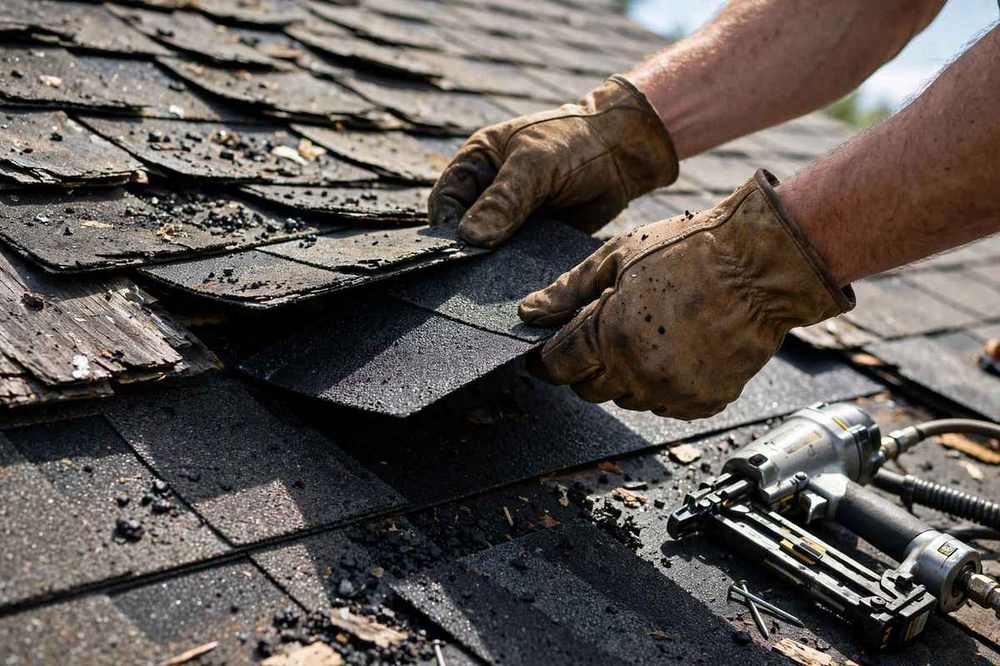
The shingle field repair. When wind takes a section of shingles, the repair is not nailing new shingles over the gap and hoping. The damaged courses come up, the underlayment is checked and renewed where it tore, and new shingles are woven into the old field so the laps shed water the way the roof was designed to. Done right, the patch disappears into the roof's pattern. Done wrong, it is a quilt square that lifts in the next blow. Houston wind finds wrong work quickly, which is why emergency roof repair Houston crews weave instead of overlay.
The boot swap. The smallest job on this list and the one that fixes the most leaks. The cracked rubber collar comes off, the pipe is checked, a new boot goes on, sealed and shingled in correctly. It is unglamorous, quick, and final: a leak that has stained a bathroom ceiling for a year can end in under an hour of work. When people ask why tracing matters, the boot is the answer. The stain said ceiling. The boot was the roof.
The flashing rebuild. Flashing is the metal that closes the joints: around chimneys, where a roof meets a wall, at the edges of dormers. When flashing fails, patching sealant on top of it buys weeks. The real repair lifts the surrounding shingles, removes the tired metal, and installs new flashing in the right order, lapped so water runs over it, never behind it. In the Heights and Montrose, where old flashing has been re-sealed for decades, this is the repair that finally ends the leak that five tubes of sealant could not.
The valley rebuild. Valleys carry the combined water of two slopes, and in Houston rain they carry it in volume. A valley repair means opening the valley, checking the liner beneath, and rebuilding the water path so debris cannot dam it and water cannot climb the edges. Leaf heavy neighbourhoods like Memorial live and die by their valleys, and a blocked or worn valley is a leak waiting for a date on the calendar.
The deck patch. When a limb comes through, or decking has rotted soft around a long leak, shingles alone cannot fix it, because shingles are only as sound as what they are nailed to. The damaged deck section is cut out, new decking is fitted to the rafters, and the roof is rebuilt over it in layers: underlayment, then shingles, then the details. This is the repair that turns a hole in the roof back into a roof. It is photographed at every layer, because once it is covered, the photos are the only proof of what is under there.
The temporary cover. Sometimes the repair cannot happen the same visit: the roof is too wet, the damage too wide, the light gone. Then the job is the cover, a tarp battened flat and tight, or a temporary patch, built to survive Houston weather until the dry day. A cover is not a failure of the visit. It is the visit doing its first job, stopping the water, while the second job waits for conditions that let it be done right. Every emergency roof repair Houston crew carries both skills. The honest ones tell you which one your roof is getting tonight, and why.
The rain itself
Start with the downpour. A Houston storm can drop an inch of rain before you finish reading this page, and several inches in an hour at its peak. On a roof, that is not a flow problem, it is a volume problem. Valleys carry rivers. Gutters overflow and pour water back against the fascia and the shingle edges behind them. Flat sections and low slopes hold standing water that pushes at every seam. Shingles are made to shed moving water. Very few roof parts are made to sit under water that has nowhere to go, and Houston rain regularly puts them there.
Driven rain is the second test. Storm wind here does not politely blow in one direction. It gusts, swirls around tree lines and rooftops, and drives rain upward under shingle edges, sideways into vent openings, and backward up valleys. Every roofer who does emergency roof repair Houston work knows the pattern. A leak appears only when the wind blows from one direction, because that is the direction that pushes water through a joint that sheds fine the rest of the year. Those leaks confuse homeowners for seasons. They are not mysterious. They are directional, and they are found by reading the wind as well as the roof.
Tropical weather is the third test, and the longest. When a tropical system stalls near the coast, Houston can rain for days. Not hard every hour, but steady, with bursts. By day two the ground is full and every bayou is high. By day three the roof itself is saturated in a way a single storm never achieves: underlayment damp at every lap, decking wet at every fastener, sealant joints soft and tired. Small weaknesses that hold for an hour open slowly in those long rains. This is why so many emergency roof repair Houston calls come on the second or third day of a storm, not the first. The roof did not break all at once. It was tested until the weakest joint gave up.
The fourth test is the one nobody photographs: rain on a hot roof, then sun, then rain again. Houston roofs cycle between baking and soaking all summer. Shingles expand and contract. Sealant strips bond and release. Nails work a fraction loose over hundreds of cycles. A roof here ages in dog years compared with a roof in a mild climate, and it ages fastest at the details: the boots, the flashing, the valleys, the edges. When people ask why their neighbour's identical roof failed and theirs did not, the honest answer is usually that the details failed first, and details differ on every single house.
None of this means Houston roofs are doomed. It means the standard here is higher. Materials have to be right for heat and volume. Details have to be sealed like the storm is already on the radar, because it usually is. And when something does fail, the repair has to be done to the same standard, or the next downpour will find the same spot and start the whole story again. That is the standard every emergency roof repair Houston visit on this page is held to.
Season by season
A Houston roof does not face one weather. It faces a rotation, and each season fails roofs in its own way. Knowing the rotation is how you stop being surprised by your own roof.
Spring brings the fronts. Cold air pushing down from the plains meets Gulf moisture over the metro and the meeting is loud: hard rain, straight line wind, and the occasional night of hail on the north and west sides. Spring is lifted shingle season. Wind gets under edges that winter contraction loosened, and the first big rain afterwards finds the gap. Most emergency roof repair Houston calls in spring start with a stain that appeared during a storm the homeowner slept through, on a roof that looked fine in February.
Summer is the slow cooker. Ninety degree days, humidity that never really leaves, and afternoon downpours that arrive like a tap opening. The downpours test volume; the heat between them does the aging. This is boot cracking season, sealant failing season, and the season when a small leak turns musty fastest. Summer is also when attic moisture does its quiet work, because the attic of a Houston home in August is one of the most hostile spaces in the house: hot, damp, and still. It is peak season for the emergency roof repair Houston call that begins with a smell instead of a drip.
Late summer and autumn are the tropical months, the heart of the season that runs from June to the end of November. This is when the long rains come, the multi day soaks that test every lap and seam for endurance instead of strength. Emergency roof repair Houston work in these months has a particular rhythm: the call rarely comes during the worst hour. It comes on day two or three, when a tired joint finally opens, or when the ceiling that was quietly loading with water announces itself. Crews plan their whole year around these weeks, and homeowners should plan their roof checks around them too: boots, seams and drains inspected before the season, not during it.
Winter is the quiet season, and the deceptive one. Houston winters are mild, with cold snaps rather than cold months, and roofs mostly rest. But contraction is real: materials shrink in the cold nights, sealant joints open a fraction, and the first spring front finds them. Winter is the season for the unglamorous work, the inspection, the boot swap, the seam renewed in dry weather, that decides whether spring is an emergency or a non event. Put plainly: the best emergency roof repair Houston visit is the one a winter inspection made unnecessary.
The slow damage
Storms get the blame, but in Houston the quiet damage runs all year. Heat and humidity work on a roof from both sides at once: the sun from above, and moist air trapped in the attic below.
Start in the attic. Houston air is wet air. When a roof system cannot breathe, that moisture collects in the attic, condenses on the underside of the decking on cooler nights, and feeds the dark staining you see on plywood in older homes here. Over years the decking softens. Nails lose their grip in soft decking. Shingles over a soft deck flex and crack in foot traffic and storms. By the time a crew steps on a roof like that during an emergency roof repair Houston call, the shingle problem on top is only half the story. The deck under it has been quietly rotting in the damp.
The rubber parts fail early here too. Every vent pipe that passes through your roof is sealed by a rubber collar, often called a boot. In a mild climate a boot may last as long as the shingles. In Houston heat and sun, the rubber hardens and cracks years sooner, and the crack opens right where the pipe meets the roof, the worst possible spot. Ask any crew that does emergency roof repair Houston work what the most common leak source is and you will hear the same answer: the boots. Not the shingles. Not the valleys. The humble rubber collar that cooked in the sun until it split.
Sealant ages the same way. The beads that close flashing joints and edge details are rated in years, and Houston spends those years faster. A joint sealed a decade ago in this climate is a joint living on borrowed time. This is why leaks here so often start at joints and penetrations rather than in the open field of the roof. The field is built for weather. The joints are built with materials that age, and Houston ages them fast.
Mould is the indoor half of the same story. A slow leak in a dry climate may stain a ceiling and stop. In Houston, a slow leak feeds moisture into insulation and wall cavities that never fully dry, and mould follows. The musty smell in a spare room, the bubbling paint along one wall, the stain that keeps coming back after painting: those are often a roof leak and a humidity problem shaking hands. Fixing the entry point stops the water. Drying the space properly afterwards is what stops the second problem, and in this city the drying matters as much as the repair.
The good news is that all of this is checkable. Boots can be inspected and swapped before they split. Attic moisture shows itself to a flashlight and an honest nose. Sealant joints can be renewed. None of it is glamorous, and none of it gets sold at a doorstep, which is exactly why it gets skipped. A proper emergency roof repair Houston visit looks at these slow causes while the fast one is being fixed, because today's boot crack is next season's ceiling stain. Slow causes are still causes, and in this climate they are the ones that decide whether you see us once or every year.
Where we work in Houston
Houston is not one roof market. It is dozens of small ones, built in different decades, under different trees, with different weak spots. An emergency roof repair Houston crew that treats a Heights bungalow and a Memorial two storey as the same job will miss what matters on both. Here is how the work changes by neighbourhood.
Bungalows and cottages from the early 1900s onward, many with layered roofs and low pitches. Charm above, tired details below.
The city's old soul: bungalows, fourplexes, conversions and flat roofed additions, packed close under mature trees.
Big roofs on big homes, tile and slate among the shingles, and some of the tallest, oldest oak canopy in Houston overhead.
Large homes, long slopes, deep lots and heavy tree cover along the bayou. Storm limbs and shaded, slow drying roofs.
Ranch homes with a known history of taking water in the city's worst storms. Roofs here get read alongside the ground story.
The Heights is where Houston keeps its front porches. The bungalows and cottages along the boulevard and the side streets were built when a roof was wood shingles and a prayer, and many have been re-roofed over the bones of the last roof more than once. Layered roofs are the local fact of life: two layers of shingles where one should be, old flashing reused because it looked fine, low pitches that shed water slowly on a good day. In a Houston downpour, a low pitch is a promise the roof cannot always keep. Water that would run off a steep roof lingers on a shallow one, and lingering water finds the laps, the nail heads and the tired flashing that a steeper roof would never test.
The emergency calls from the Heights follow that pattern. Leaks at the joints where a porch roof meets the main house. Leaks along the old chimney flashing. Water coming in at the low slope over a back addition that was roofed like an afterthought, because it was one. The fix here is rarely dramatic. It is patient detail work: real flashing where builders used sealant, boots renewed, laps corrected. Heights homeowners also tend to know their houses well and ask sharp questions, which suits us fine. Emergency roof repair Houston work in the Heights is a conversation with someone who plans to keep that house for decades, and the repair is planned the same way.
Montrose has been rebuilt in layers for a hundred years. A bungalow becomes a duplex, a garage becomes a studio, a flat roofed addition grows off the back of a house that never expected one. Every one of those changes cuts the roof and joins it to something else, and every join is a place water studies. The flat sections are the repeat offenders. Flat and nearly flat roofs in Houston do not drain, they negotiate, and after a heavy rain they hold ponds that sit on seams for days. A seam that would last twenty years on a slope can fail in five under standing water.
Tree cover is the other Montrose fact. The streets are shaded by oaks that were old when the houses were young, and in storm season those oaks drop limbs with weight behind them. A limb through a flat addition roof is a classic Montrose emergency, and it is two problems at once: the hole above, and the ponding roof around it that was already near the end of its life. Honest work here means saying both things out loud, fixing the emergency, and letting the owner decide about the tired flat section with photos in front of them, not a deadline. That patience is the local style of emergency roof repair Houston work, and Montrose rewards it.
River Oaks roofs are a different scale of problem. The homes are large, the rooflines are complex, and the materials run heavier: architectural shingles, tile, and slate on some of the older houses. A valley on a River Oaks roof can carry the water of a small swimming pool in a hard storm. The flashing is often copper or custom metalwork, done by craftsmen decades ago and now reaching the age where even good metal tires at the joints. When a leak starts in one of these houses, tracing it is a craft job: the rooflines cross each other, the attics are deep, and water can travel a long way along a beam before it shows.
The oak canopy is the emergency risk. River Oaks keeps some of the finest old oaks in Texas, and they hang over roofs that are worth protecting. In a Gulf storm, a falling limb here does not poke a hole, it can take out a whole section, tiles and all. After any big blow, the first job in River Oaks is the survey from the ground: what is on the roof, what is through it, and what is still hanging above it waiting for the next gust. Only then does the repair plan start. Emergency roof repair Houston crews earn their keep in River Oaks by slowing down at exactly the moment everyone wants speed.
West of the Loop, Memorial spreads out along Buffalo Bayou under deep tree cover, and the roofs match the lots: big, long sloped, and complex. Long slopes mean long valleys, and long valleys in a Houston downpour move serious water. When a valley is blocked by the leaf fall that Memorial produces in industrial quantities, the water backs up under the shingles at the valley edges. Many Memorial leaks that look like roof failure are really drainage failure: the roof is sound, the path was blocked, and the water went sideways instead of down.
Shade is the slow issue. Roofs under heavy canopy here stay damp long after a storm, dry slowly, and grow the dark algae streaking you see all over the neighbourhood. Damp shingles age faster, and moss at the edges lifts them a fraction at a time until wind driven rain can get under. Memorial homeowners are often surprised that their emergency began years earlier, in the shade. The repair fixes the leak. The honest conversation afterwards is about the trees, the valleys and a cleaning and checking rhythm that suits a roof living under a forest. More than a few emergency roof repair Houston visits in Memorial end with a tree conversation, and the roof is better for it.
Meyerland's ranch homes sit near Brays Bayou, and the neighbourhood's history with the city's worst storms is well known to everyone who lives there: in past major flood events, Meyerland streets and homes have taken water more than once. Many houses have since been raised, rebuilt or hardened, and the whole area thinks about water differently than the rest of Houston. That thinking belongs in roof work too. When a Meyerland home takes street water at the same time as a roof leak, the two problems feed each other: soaked walls, a wet attic, nowhere for moisture to go in the humidity that follows a flood.
Roof wise, Meyerland is ranch country: long, low slopes, wide eaves, and a lot of roofs that were renewed in the rebuilding years after the big storms. Those roofs are now reaching the age where boots and sealant joints need attention, right as the neighbourhood's owners are most alert to water in any form. Calls from Meyerland tend to come early, at the first stain, and that is exactly right. In a neighbourhood that has learned what water does when it gets a head start, catching a leak at the stain stage is not nervousness. It is experience. Emergency roof repair Houston work here respects that experience and answers it with evidence: photos, tracing, and a written account of what was found.
The five neighbourhoods above are all inside or near the Loop, where Houston is oldest. Cross the Loop outward and the housing changes: the big master planned suburbs, Katy, Sugar Land, Cypress, The Woodlands and the rest, where whole districts were built within living memory. Those roofs are young, uniform, and built fast by the standards of their day. Their emergencies look different: not layered history, but details done quickly at scale, boots and flashing and joints that age together across an entire street at once. When one roof on a suburban street starts leaking at the boots, its neighbours are usually not far behind, because they were all built in the same season with the same materials.
The suburban pattern has its own warning sign: the same stain, in the same room, appearing in house after house as a subdivision crosses the fifteen year line. It is not a conspiracy. It is a calendar. Homeowners in those districts who compare notes with neighbours learn more about their roof's real age than any doorstep opinion will tell them. And the response is the same in both Houstons: trace the leak, fix the detail, photograph everything. Emergency roof repair Houston work does not change its standards at the Loop. Only the roofs change.
If your part of Houston is not named here, the patterns still apply. Old roofs fail at details, flat sections fail at seams, shaded roofs fail slowly, and every roof in this metro fails first where it was cut, joined or penetrated. Tell us your street and your roof type when you call, and the crew arrives already thinking about the right weak spots.
Finding the real hole
Most Houston roof leaks start at a penetration, not in the open field of shingles: a vent pipe, a chimney flashing, or a valley where two slopes meet. That one fact shapes everything about how a leak should be hunted. The stain on your ceiling is the end of the story. Tracing is how the beginning gets found.
Water is a traveller. It enters at a split boot or a lifted flashing, runs down the underside of the decking or along a rafter, follows a pipe or a wire, and drops wherever the path ends. That can be eight feet or more from the entry point, sometimes in a different room. This is why the most common failed repair in Houston is a neat patch of sealant over the shingles above a ceiling stain. The stain was never the hole. The water just signed its name there. Crews who do emergency roof repair Houston work properly start in the attic, not on the roof: find the highest wet point, read the water tracks on the wood, and follow them up and back to the entry.
The patterns repeat, and naming them helps you describe your leak on the phone. A leak that only appears in wind driven rain points at edges, ridge caps and joints that face the wind. A leak that appears in every rain, even gentle ones, points at a penetration near the stain: a boot, a vent, a flashing. A leak that starts hours after the rain points at travel, water entering high and arriving late. A leak with no rain at all points away from the roof entirely, at plumbing or an air conditioning drain, and an honest crew will tell you that and save you a roof repair you do not need. Each pattern is a clue, and emergency roof repair Houston tracing is mostly the discipline of believing the clues instead of the stain.
The hose test settles arguments. One person in the attic with a light and a phone, one person on the roof with a hose, wetting one small section at a time, lowest first, waiting between sections. When the drip starts in the attic, the section being wetted is the entry zone. It is slow, it is wet, and it is certain. On a dry day it turns guesswork into a map. Not every leak needs it, but the stubborn ones, the ones that have already eaten one failed repair, are exactly the ones emergency roof repair Houston crews bring the hose out for. The full tracing method, attic signs and all, lives on our roof leak repair page, and Houston readers with a mystery leak should start there after this one.
One Houston twist deserves its own paragraph: the double leak. In this climate, two entry points often open in the same season, because the same heat aged every boot on the roof at the same rate. Fixing the first leak and stopping there is how a homeowner ends up with a second stain, a second call, and a suspicion that the first repair failed. It did not fail. Its neighbour did. A thorough emergency roof repair Houston visit checks the other penetrations while the ladder is up, photographs them, and tells you which ones are cracked, which are close, and which are fine. What you do with that news is your call. Having it is the point.
Flat and low-slope
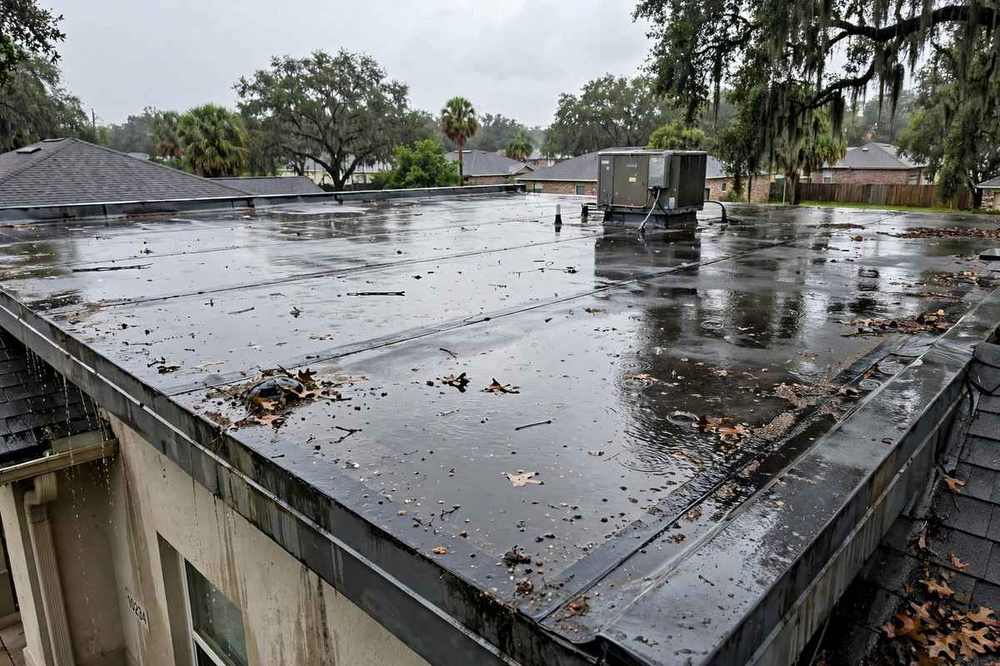
Houston is full of roofs that are not really roofs in the sloped sense. Flat additions, patio covers, garage tops, carport roofs, and the low-slope sections on commercial style homes and townhouses. They leak differently, they fail differently, and in this city's rain they live the hardest life of any roof type. A sloped roof sheds a downpour. A flat roof holds a downpour and thinks about it, and standing water is a patient enemy. It finds pinholes, worries seams open over seasons, and adds real weight: a few inches of ponded water across a wide flat section is measured in tons, pressing on decking that may already be soft.
The failure points are predictable. Seams split as the material ages and the Houston sun cooks the laps. Drains and scuppers clog with the leaf and seed fall this city produces year round, and a clogged drain turns a flat roof into a shallow pool with the leak points sitting in it. Edge metal lifts in storm wind, and once an edge lifts, driven rain goes straight under the membrane. Inside, the signs show up as long stains along a beam line, bubbling paint, or a drip that seems to come from nowhere after every heavy rain. Flat roof leaks also travel the furthest. Water under a membrane can wander the whole width of a building before it finds a seam in the ceiling to drop through. That is why flat roof tracing starts with the drains and the seams, not the stain.
The emergency answer on a flat section is usually a two part job. Clear the water path first (drains opened, ponding relieved). Then seal or patch the failed seam or, where the section is open, cover it properly until a dry day allows the real repair. Tarps sit badly on flat roofs, since they pond water themselves, so the cover has to be chosen for the roof, not by habit. If your Houston home has a flat addition that leaks every summer, that pattern is telling you the section is at the end of its life as a system. An honest emergency roof repair Houston crew will fix the night's leak and show you, in photos, why the section keeps failing, so the bigger decision can be made calmly, in daylight, with evidence. That two part honesty is what emergency roof repair Houston homeowners with flat sections should expect as standard.
By roof type
The Houston standard. Emergencies are wind lifted fields, lost tabs after a blow, and the slow detail failures: boots, flashing, valleys. Most shingle emergencies are repairable the same visit, and most trace back to heat aged details rather than the shingles themselves. This is the daily bread of emergency roof repair Houston work.
Long panels, long life, and leaks that start at fasteners and seams as the Texas heat works them through thousands of expansion cycles. A metal roof emergency is often a small entry with a long travel path, so tracing matters even more than usual.
Heavy, handsome, and common on older Houston homes in River Oaks and the museum district area. The tiles shed water; the underlayment beneath them does the waterproofing, and it ages out years before the tiles do. Broken tiles from limbs are the classic emergency, and the fix must respect the material: walking tile wrong breaks more than the storm did.
Covered in depth above: seams, drains and ponding. The emergency is usually water management first and membrane repair second.
Whatever your roof is made of, the emergency order never changes on an emergency roof repair Houston visit: stop the water, trace the entry, show the evidence, write the scope. Materials change the method. They never change the honesty.
Services in Houston
One emergency roof repair Houston call can lead to several kinds of work, and Houston readers deserve the map. These are the services this site is built around, each with its own page, its own detail, and the same rule on every one: the water stops first, and the evidence comes before the work. The full list also lives on our services page.
When the storm has already done its worst: torn fields, lifted edges, limbs down, water in. The page walks the first hours after a Gulf storm, the survey from the ground, and how storm damage gets separated into what is urgent, what is tired, and what is fine.
A tarp is a roof for a night, fitted flat, tight and battened so it sheds water instead of catching wind. In Houston it also has to survive the next band of rain, which may be hours away. The page covers sizes, battening, and why a tarp is a bridge to a repair, never the repair itself.
The tracing page. Attic signs, water travel, the hose test, and repairs at the real entry point: boots, flashing, valleys, vents. If your leak has already survived one repair attempt, start here.
The not-tonight work: the repairs that can be planned in daylight. Worn details, small failures, the fix that stops next season's emergency before the rain finds it.
A full look, on the roof and in the attic, with photos and a written account of what is sound, what is aging, and what needs doing now versus later. In Houston, an inspection after storm season and before it are the two that matter.
The honest fork in the road. When a repair is throwing good money after bad, and when a tired looking roof still has years of service in it. Evidence first, decision second, pressure never.
Hail reaches Houston less often than it reaches north Texas, but when it comes it comes with wind and rain behind it. The page covers bruised shingles, why hail damage hides, and how a proper check differs from a doorstep opinion.
When the evidence says the roof is done: what a replacement involves, how it is planned around Houston weather, and how to know the call is real when a crew makes it.
Not sure which one you need? That is normal, and it is what the phone call is for. Describe the water, and we will point you at the right page and the right visit. The guide to the first 24 hours is also worth ten minutes of any Houston homeowner's time before storm season, not during it.
Our promise
Houston after a big storm is one of the hardest selling environments in America. Thousands of roofs need help at once, crews pour in from everywhere, and every homeowner with a stain becomes a target. In that market, the easiest sale is the whole new roof, sold at the door, tonight, before the neighbour signs first. We run the opposite shop. Most emergency calls end with a repair, not a replacement, because most roofs that leak have one failed detail, not a failed system.
So the promise is simple and it is kept in writing. We stop the water first. We photograph what we find before we touch it. We show you the evidence and explain it in plain words. We write the scope before work starts. And if your roof truly is at the end of its life, you will see why in pictures and decide in your own time, on your own porch, without a clock running. A roof is a big decision. It should never be a doorstep decision. That is the standard behind every emergency roof repair Houston visit we run, storm season or not.
After the storm
Texas has no state licence for roofers. Anyone with a truck, a ladder and a printer can call themselves a roofing company the morning after a storm, and in Houston, after a big one, hundreds do. Some are honest travellers chasing storm work. Some are gone before the next rain tests their repairs. These questions sort them, and any good crew, ours included, will answer every one without flinching. More about how we work is on our about page.
We hold ourselves to the same list. Ask us all six. The answers, the photos and the written scope are the whole pitch. Emergency roof repair Houston homeowners can verify beats emergency roof repair Houston homeowners are asked to believe, every single time.
Aftercare
In a dry city, a finished repair ends the story. In Houston, the repair ends the leak, and then the drying starts, and the drying is a race against the humidity. Wet insulation, damp plaster and soaked carpet in a Houston house do not dry on their own in any reasonable time. They stay wet, and what stays wet here grows things. So the first two days after the water stops matter almost as much as the repair itself. Ask any emergency roof repair Houston crew: the repairs that fail in this city usually fail in the drying, not the fixing.
Fans on the wet area, air moving, windows open when the weather allows, wet rugs and padding out of the room. You are not running a restoration project. You are refusing to let one wet night become a mould problem with a roof repair attached.
A drying stain stops growing and turns dusty at the edges. A stain that grows or darkens after the next rain means water is still travelling, and that is a call back, not a paint job. Give it a few rains. Paint is the last step, not the test.
If a tarp or a temporary patch is holding your roof, look at it after every hard blow: edges lifted, corners loose, water ponding in a sag. Everything a cover does wrong shows itself from the yard. You never need to climb to check it, and a moved cover needs a visit before the next rain, not after.
And keep the paperwork: the photos, the written scope, the visit notes. In a city where storms return every season, that folder is your roof's medical record. It makes the next crew faster, the next decision calmer, and the next doorstep pitch much easier to refuse.
Across Texas
Houston is one end of this site's Texas. The base of the work is Austin, and each city page is written for its own weather, its own housing stock and its own storm history, not swapped from a template.
The home base: Hill Country storms, live oak limbs, and heat that cooks vent boots years early. The Austin page carries the full local picture.
Pipe boots, flashing, and the seams where later additions join the original roof: that is where Houston's young roofs leak, in a city that keeps growing and takes hard storms.
Lake wind and older roofs north of Dallas, where slow hidden leaks are the local pattern and tracing matters more than speed.
Big roofs, tall trees, and a hail history as long as any in Texas. Spring storm checks are a standing part of the year there.
South Austin's edge, where new subdivisions meet older ranch roofs and the same storm can test both kinds in one night.
Wherever in Texas the water is coming in, the order of the work is the same, and so is the number: (512) 555-0147.
Questions
No sales talk. The questions emergency roof repair Houston callers ask us, answered the way we answer them on the phone:
In Houston, an emergency means the roof is open or water is coming in now: storm-torn shingles, a limb through the deck, or a leak that is spreading. Houston rain arrives in inches per hour, so a small opening becomes soaked insulation and ceiling damage in a single storm. That speed is what makes it urgent.
Call a Houston roofer who works the storm season here and can prove it with recent local jobs. After big storms the city fills with out-of-town crews who leave when the work dries up. A local address, local references, and photos of finished Houston repairs are the checks that matter.
Houston heat and humidity age sealant and rubber vent collars fast, and heavy rain finds every weak joint. Most Houston leaks start at a penetration: a vent pipe, a chimney flashing, or a valley where two slopes meet. Tracing the water back to that joint is the repair. Sealing the ceiling stain is not.
Catch the water, move what it can ruin, and drain any ceiling bulge into a bucket with one small hole. Kill the power to wet lights or outlets. Then photograph everything and call. Houston storms can drop more rain while you wait, so the first hour is about limiting damage inside, not climbing outside.
For a night or a few days, yes, if it is fitted flat, tight and battened down. Houston rain tests a tarp harder than most cities do, and the next band may arrive within hours. Treat a tarp as a bridge to the repair, and check it from the ground after every blow.
Sometimes. If the drip is slow, the rain has stopped, the ceiling is flat and a bucket is catching everything, morning is fine. If water is pouring, the ceiling bulges, a tree is down or drips are near wiring, call now. Houston rain returns fast, so the wait is shorter here.
The crew stops the water first, with a tarp, a patch or the repair itself. Then they trace the entry point, often from the attic, and photograph it before touching it. You see the photos, hear the scope in plain words, and sign a written scope before any repair work starts.
Not here. Most Houston emergency calls end with a repair, because most leaks are one failed detail, not a failed roof. If your roof truly is worn out, you will see the evidence in photos and decide in your own time. A signature asked for on a doorstep, at night, is a warning sign.
Because Houston air is wet air. A leak soaks insulation and decking, and in this humidity they dry slowly, so mould starts where you cannot see it. Fixing the entry point stops the water. Drying the attic and the room below, fast and thoroughly, is what stops the smell and the growth.
Not always. The stain shows where water finished travelling, not where it entered, and in Houston a small stain can sit under a split boot or an open flashing eight feet away. Small stains are worth tracing early, while the fix is still small. They are early information, and worth acting on while the repair is still small.
Ask for the local address and drive past it. Ask for photos of recent Houston jobs, this season, on streets you can name. After big storms the city fills with travelling crews who leave when the work dries up. A local company answers these questions easily. A travelling one changes the subject.
Because driven rain is directional. Wind pushes water upward under shingle edges, sideways into vents and backward up valleys, but only from certain directions. A joint can shed a hundred straight downpours and fail the one storm that hits it from its weak side. Tell the crew which storms bring the drip.
Houston rain does not wait. Neither should the call.
This is a 24 hour emergency roof repair Houston service: one number, answered by a roofer, at any hour of any storm.
(512) 555-0147