Repair or Replace · Texas
The biggest call you will ever make about your roof, answered from the roof itself: its age, its deck, its history, and how much of it is actually failing.
Somebody has probably already given you a fast answer. A neighbour says patch it. A man at the door says the whole roof is done. This page slows the call down and shows you how it is really made, factor by factor, with the evidence a roofer should put in your hands. Whether you end up repairing or replacing, you will know why, and the why will be yours. If water is coming in tonight, that is a different page and a faster one: stop the water first with emergency roof repair, then come back here and make this call in daylight. The number, whenever you want a second pair of eyes on the roof, is (512) 555-0147.
Crews working from the towns they live in, not a call centre three states away.
Start here
Repair or replace a roof? Repair it when the failing part is small, the deck under it is sound, and the rest of the roof still has years of grip and granules left. Replace it when failure is spread across most of the roof, the shingles have gone brittle, or the deck itself is soft. Age alone settles nothing. Evidence settles it.
Here is the honest frame for the whole page. Most roofs that leak need a repair, not a replacement. A leak usually starts at one weak detail: a cracked pipe boot, a lifted flashing edge, a valley that has worn thin. The shingle field around that detail is often sound for years yet. On the other side, some roofs really are done, and patching them is good money spent on a roof that will leak again two slopes over by spring. The repair or replace roof decision is the work of telling those two roofs apart, and it cannot be done from the driveway, from a drone photo, or from the year the house was built. It is done on the roof and in the attic, with a count, a lift test, and a look at the deck.
Two wrong answers get given every day in Texas. The first is the whole roof, announced in the first ten minutes, before anyone has counted anything. That answer serves the person selling, not the roof. The second wrong answer is the endless patch: a tube of sealant and a hopeful sentence, on a roof whose shingles snap when you lift them. That answer serves nobody either. It just spreads the spending out until the deck rots and the job grows teeth. Between those two sits the real call, and it is made from five factors. None of them is the age of the roof by itself. All five together are hard to argue with, because they are things you can see in photos and touch with your own hand from a ladder your roofer holds steady.
One more thing before the factors. The emergency and the decision are separate jobs. If water is coming in, the water gets stopped first: a cover, a traced leak, a sealed entry point. That work is small and fast and it buys you the one thing a good decision needs, which is time. A fitted tarp protects a home for roughly 30 to 90 days. That is your window. Nobody honest needs your repair or replace roof answer tonight, and this page will keep coming back to that, because the pressure to decide fast is the surest sign the answer was written before anyone saw your roof.
The five factors · Factor one
Age is the factor everyone reaches for first, and it is a clue, never a verdict. Roofs do not fail on their birthday. They fail when the materials give up: when shingle mats dry out and go brittle, when the seal strips let go, when the granule coat thins until the mat itself faces the sun. Age points at those things. It does not replace looking at them. Still, you need the rough map, because a roofer who will not talk about age is hiding half the picture, and a roofer who talks about nothing else is hiding the other half.
Here are the commonly published working lives, written as the rough guides they are. A basic three tab asphalt shingle roof usually lasts about 15 to 20 years. The heavier architectural shingles most Texas homes wear now run roughly 20 to 30 years. Metal roofing, standing seam or screwed panels, often runs 40 to 70 years, though its screws, seams and sealants need care long before the panels wear out. Clay and concrete tile can pass 50 years, but the felt under the tile usually gives up at 20 to 30, and the tile roof leaks from underneath a sound looking surface. Flat and low slope roofs in modified bitumen or TPO often run 15 to 30 years, and they fail at seams and ponding spots rather than across the whole field. Wood shakes in Texas heat are usually a 20 to 30 year story, and a rough one near the end.
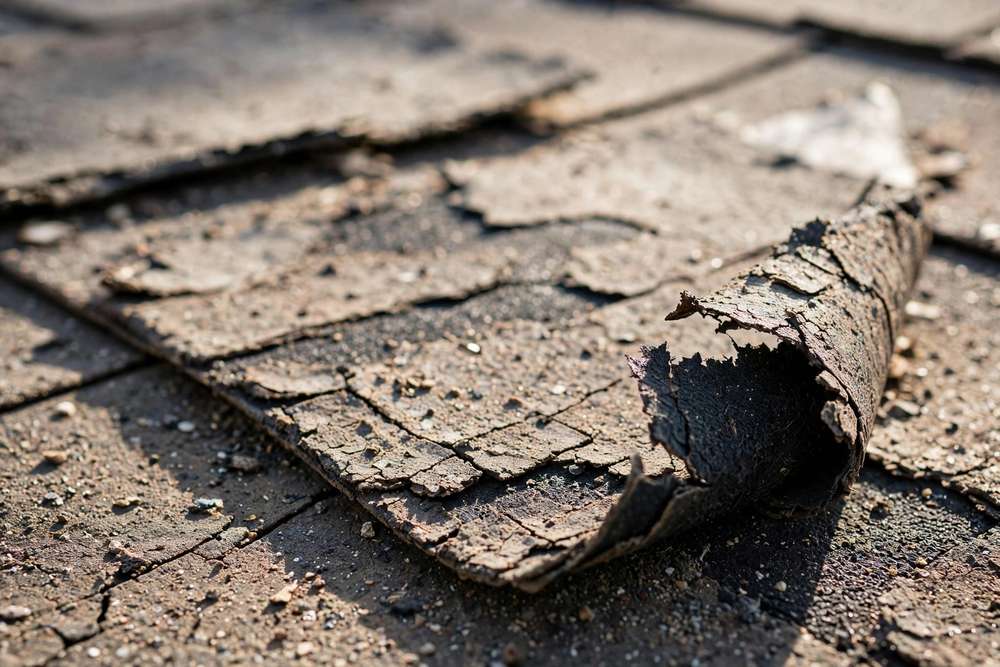
Now the Texas correction. Those ranges were not written for a roof that bakes through our summers. Heat is the aging force here. It cooks the oils out of asphalt, cracks the rubber boots around pipes years early, and works the seal strips loose one hot season at a time. A shingle roof that might see 30 gentle years further north can be an old roof at 20 here, and a roof that faces south and west with no shade ages faster than its twin under oaks. Hail country adds its own wear: a roof in Plano or Fort Worth, where the verified record counts well over a hundred hail days since 2010 within 15 miles of the city centre, has taken hits a roof in a quieter county never sees. Age on paper is the starting question. Age in Texas is the second one.
So how should age weigh in your repair or replace roof call? Like this. A young roof, under ten years, with damage or a leak, is a repair almost every time, and anyone who says otherwise owes you extraordinary proof. A roof in the middle of its rough range is where the other four factors do the talking. A roof past its range is not automatically done, we have stood on 26 year old shingle roofs that were still gripping and shedding water, but every repair on it has to answer a harder question: will this fix hold, on mats this dry, without breaking the shingles around it? When the answer keeps coming back no, age has cast its vote.
The five factors · Factor two
If age is the clue, spread is the measurement. The repair or replace roof call turns more on this factor than any other, because a roof is not one thing. It is a set of slopes, and each slope lives its own life. The south face bakes. The north face grows damp and moss in the shade. The face that takes the wind driven rain works harder than the face that never sees a storm head on. A roof can be finished on one slope and have a decade left on another, and honest work follows that map slope by slope.
Think of the failing share in plain sizes. A leak at one pipe boot, on one slope, with sound shingles all around it: that is a corner of the roof asking for a repair measured in single shingles and one new boot. Damage across one whole slope, a hail beaten face where the test squares fail from eave to ridge: that is a slope sized job, and replacing that one slope is a real and respectable answer. Failure on most slopes, seals letting go everywhere, granules washing off every face, mats fracturing wherever the test square lands: that is the whole roof talking, and at that point scattered repairs stop being repairs and start being rent paid on a roof that is leaving anyway.
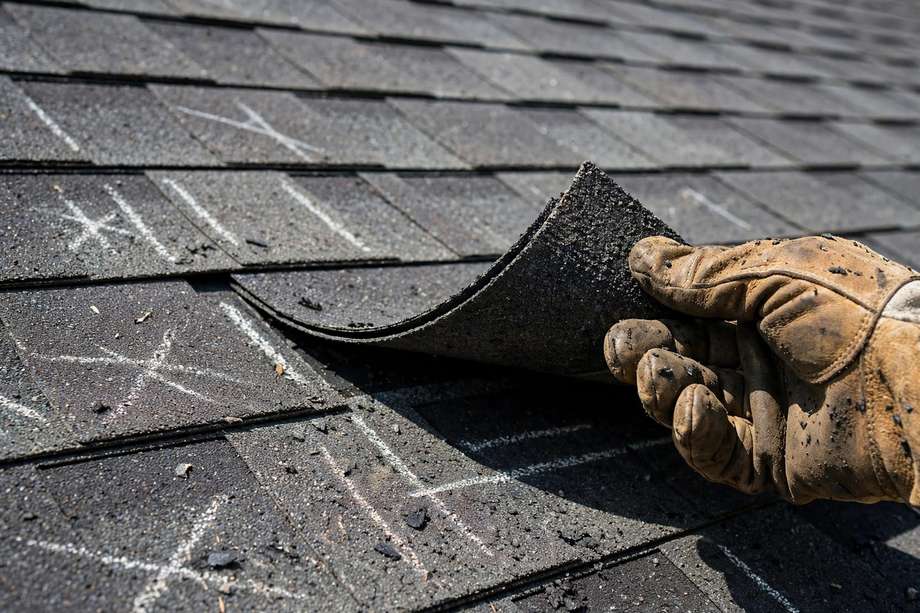
The way a crew measures spread is the test square. On each slope, a square of ten feet by ten feet gets chalked and every damaged shingle inside it gets counted and marked. One square can lie to you, a lucky patch or an unlucky one, so the count runs on more than one square per slope, and on every slope the storm or the years have touched. You should end up holding numbers, not adjectives: this slope, so many fractured mats per square; that slope, clean. When you repair or replace a roof on the strength of a count like that, the size of the job matches the size of the failure, and nobody has to take anyone's word for anything. The photos and the chalk are the argument.
Watch for the two ways spread gets misread. The first is the single bad photo: one ugly close up, shown large, standing in for a whole roof. A close up can make a teaspoon of damage look like a landslide. Ask what share of the roof it shows. The second is the opposite trick, the wide drone shot from high above, where a roof that is failing at every seam looks tidy and grey. Spread is counted on the roof, square by square, not photographed from the sky or from two inches away. When a roofer walks you through the count slope by slope, with the squares marked in chalk you can see from the ladder, you are watching this factor done right.
The five factors · Factor three
Under every shingle sits the deck: the wood panels the roof is nailed to. Homeowners rarely hear about it until it is the problem, and it changes the repair or replace roof decision more quietly and more completely than any other factor. Shingles are the raincoat. The deck is the shoulders. A new raincoat on rotted shoulders does not stand up for long, and a sound deck under tired shingles is a roof that can be repaired with confidence for years.
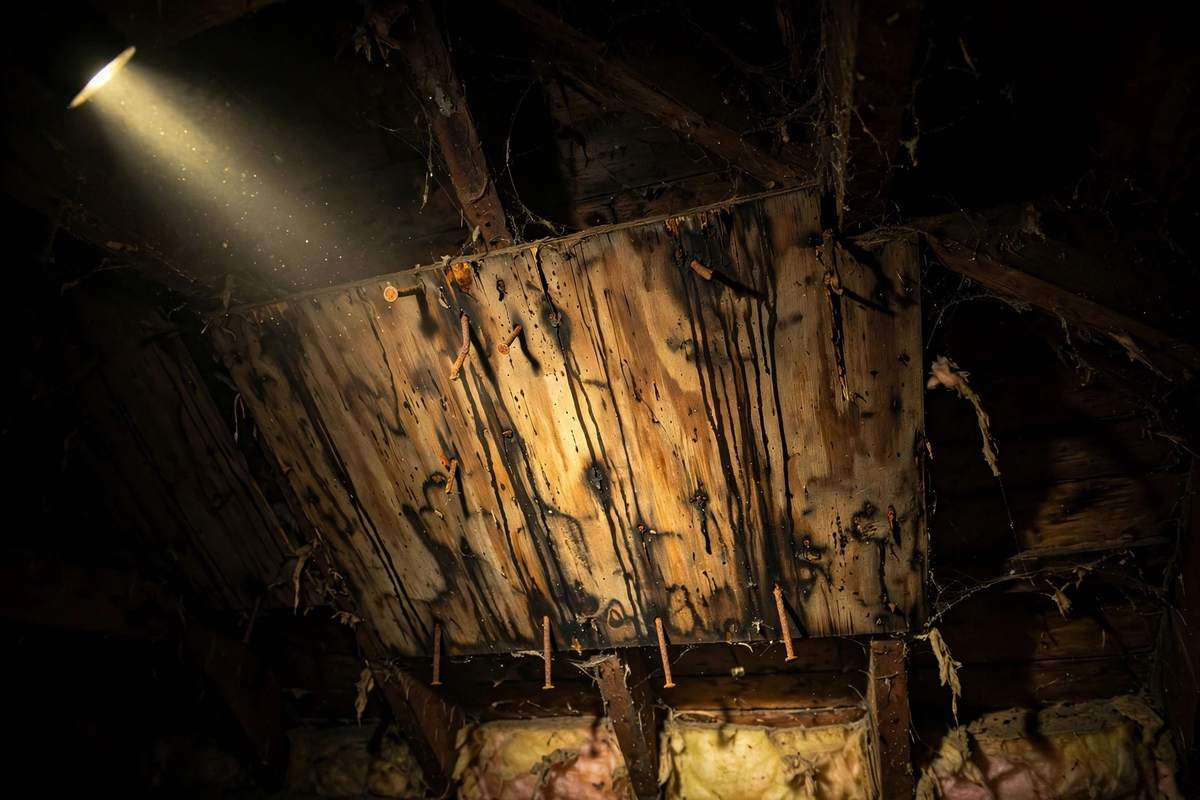
A sound deck feels firm underfoot, holds nails tight, and shows a clean, dry face from inside the attic. A failing deck tells on itself in three places. On the roof, it feels soft or spongy under a careful step, like walking on a mattress over the weak spot. In the attic, it shows dark streaks and stains running down the panels, soft black patches where rot has set in, and sometimes daylight needling through at nail holes and penetrations. Inside the house, a ceiling that sags in a shallow bowl, or a stain that keeps its shape and grows a soft spot in the plaster, is often the deck and the ceiling losing the same fight from two sides.
Deck damage has a geography. It gathers where water has been getting in the longest: under a leaking valley, below a failed pipe boot, along an eave where gutters have overflowed for seasons. That geography is why the deck cuts both ways in the decision. A soft patch the size of a door, under one old leak, on a roof that is sound everywhere else, is a repair: cut out the bad wood, panel in new deck, roof over it, done. Soft decking found in slope after slope, at eaves and valleys and around every penetration, means the roof has been letting water into its own bones for years, and at that point you are no longer choosing between a repair and a replacement. The replacement has already chosen itself, and the only real question left is how much deck comes with it.
Ask to see the deck evidence with your own eyes. Attic photos are easy to take and hard to fake: dark streaks, rust blooms on nail tips, wet insulation pressed flat under a leak path. If a crew tells you the deck is gone but shows you nothing from the attic, that verdict is missing its proof. And if a crew tells you a roof with a stained, sagging deck just needs shingles, they are selling you a raincoat for broken shoulders. The deck is the factor nobody can see from the street, which is exactly why the honest version of this call always includes the attic.
The five factors · Factor four
One leak is an event. A pattern of leaks is a diagnosis. Before anyone climbs up, sit down with your own memory of the roof and lay the leaks out in order, because the repair or replace roof call reads that history the way a doctor reads a chart. When did water first show? Where? What was done? How long did it hold? A roof tells the truth about itself over time, and the homeowner is the only witness who was there for all of it.
Read the pattern three ways. First, the same spot again. A leak that returns to the same place after a proper repair usually means the entry point was never found: the stain is rarely under the hole, water travels along the deck, sometimes up to about eight feet, and a crew that patches the stain instead of tracing the entry will be back. That is a repair done wrong, not a roof that is done. Second, new spots in new places. A leak at the boot this spring, at the valley next year, along the eave the year after: the details of the roof are failing one by one as they reach the end of their own lives, which is normal on a middle aged roof and still repairable, detail by detail, while the field stays sound. Third, leaks everywhere at once, or damp that seems to come through the field of the roof itself in hard rain, with no single detail to blame. That pattern says the surface itself has given up, and repairs start chasing water around a roof that can no longer shed it.
Timing tells a story too. Leaks that only appear in wind driven rain point at edges, laps and flashing, the places rain has to be pushed into. Leaks that arrive hours after the rain stops point at water travelling from a higher entry. A roof that leaks in ordinary rain, at ordinary spots, through shingles that have lost their granules and their seal, is a roof in its last chapter. Write your history down before the inspection if you can: dates, rooms, what the weather was doing. Hand it to the roofer. A good one will read it before climbing, and a great one will tell you what pattern they see in it and check the roof against your account. A crew that does not ask about history is skipping the cheapest evidence on the job.
The five factors · Factor five
The last factor is the roof's own repair history, and it is the one nobody puts on a poster. Roofs collect repairs the way old cars collect parts. Each one was the right call at the time, maybe. But repairs stack, and past a certain point the stack itself becomes the problem. Learning to see the stack is how you know when one more repair stops being the careful choice and becomes the expensive habit. It is the factor that quietly settles many a repair or replace roof argument, because the stack cannot be talked away. It is either there or it is not.
Start with layers. A roof can carry more than one layer of shingles, new laid over old. One extra layer is common on older Texas homes. It hides the deck from view, adds weight, and makes every later repair slower and less certain, because you cannot see what you are fastening to. Two extra layers is a roof wearing its whole past on its back. When a crew has to repair through layers, the fix is only ever as good as the oldest layer underneath, and the honest conversation at that point includes taking the stack off and starting clean, not because anyone wants the bigger job, but because the stack has used up the smaller ones.
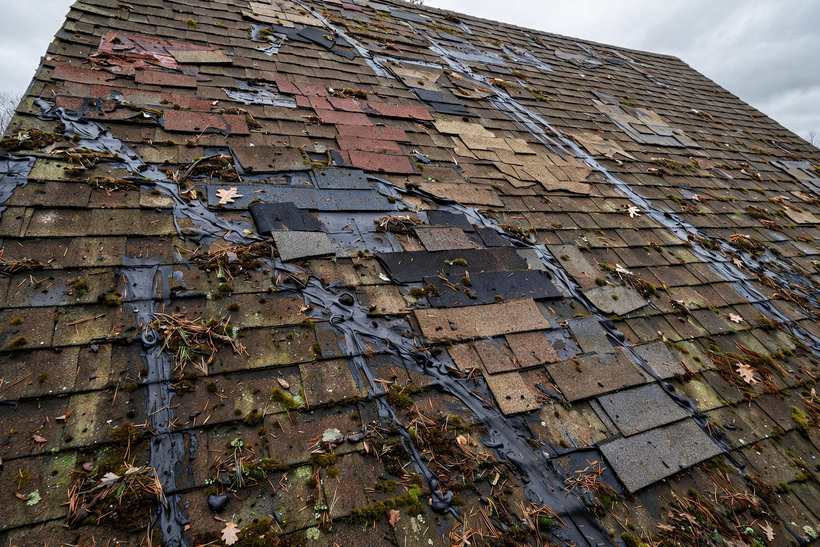
Then look at the patches themselves. A sound repair blends into the roof: matched shingles, sealed laps, flashing folded the way the water runs. A stack of tired repairs reads like a quilt: smears of sealant over cracks that needed new material, patches of mismatched shingle standing proud of the field, sealant painted along seams that should have been rebuilt. Sealant is a holding measure, not a repair, and a roof held together by smears is telling you its real condition in plain sight. Count the patches from the ground with binoculars if you like. A roof with two or three tidy repairs across twenty years is a maintained roof. A roof patched every season, in new places, with the patches themselves starting to fail, is a roof spending its last strength.
The deepest part of this factor is what repairs do to the neighbours. Every shingle repair lifts the shingles around the work. On a young, supple roof, they lift and settle back and seal again. On a dry, brittle roof, they crack. Crews call it breaking the field: the repair gets done and two shingles beside it fracture in the doing. When a roofer tells you, honestly and with photos, that they cannot repair one slope without damaging the next, that is not a sales line. On a truly brittle roof it is a physical fact, and it is one of the clearest signals in this whole decision. Stack the five factors together now: age, spread, deck, leak pattern, repair stack. The lists in the next section turn them into something you can check off.
Mixed roofs
Plenty of Texas homes are not wearing one roof. They are wearing two or three, of different ages, and the repair or replace roof call has to be made on each part separately or it will be wrong in both directions at once. The main house was re roofed nine years ago, but the garage still wears the surface from the build. An addition went up in 2016 with its own young roof tied into an old one along a valley. One slope was redone after a tree came down in 2019, and its shingles are a generation younger than the slope it meets at the ridge. Sellers forget to mention these things. Roofs never do.
This is why a single verdict for a whole house should always make you ask a follow up: which part of the roof does that verdict describe? A crew working slope by slope will happily give you the split read: the addition roof is young and repairable, the main roof is in its last years, the garage is somewhere between. That split is not indecision. It is the decision done at the resolution roofs actually age at. It also changes the order of work in a useful way. The young parts get their details renewed and are then left alone for years. The old parts get the planning. Money and worry go where the age is, instead of being spread evenly over a house that is not evenly old.
The joins between two ages deserve their own sentence, because they are where mixed roofs leak. Where a young slope meets an old one, where the addition roof ties in, the flashing and valley work carries water from both surfaces, and the older side of the join sets the lifespan of the work. When you repair or replace a roof in parts, ask specifically about the joins. A roofer who has noticed your house is two roofs will already be talking about them. A roofer who gives one age for the whole house has not looked closely enough to give any age at all.
The checklist
Everything above compresses into three lists. Read your roof against them honestly. Treat them as the repair or replace roof test you can run from your own kitchen table. Most roofs land mostly in one list. Roofs that split across all three are the grey zone, and the grey zone has its own way through, which the worked houses after these lists will show.
A repair sign is a local fact. A replace sign is a general one. That is the whole logic of the lists. Local facts get local work. General failure gets the honest conversation. If your roof shows four repair signs and no replace signs, anyone selling you a roof is selling. If it shows four replace signs, anyone selling you another patch is selling too, just a smaller thing. And if your lists split down the middle, you are in the grey zone, which is not a failure of the lists. It is where most real roofs live at least once in their lives, and it is decided by weighing which list holds the deck and the spread, because those two factors outrank the rest. A grey zone roof with a sound deck and one failing slope gets the slope. A grey zone roof with soft deck in two valleys has already answered, whatever the shingles say.
Hail or sun killed one face; the rest test clean. Replace the slope, repair the details elsewhere, and the roof goes on for years. Slope by slope is a real answer, not a half measure.
Boots, flashing and valleys are at the end of their lives while the shingles still grip. Renew the details as a set. Roofs often die at their joints years before their fields, and joints can be rebuilt.
Curling edges and granule loss but a dry attic and firm deck. This roof is on watch, not on the table. Photograph it, check it each spring, and let evidence, not looks, call the day.
Under ten years and leaking in three places is not age. It is workmanship or one hidden entry point. Trace it properly before anyone talks about replacement. Young roofs get repaired, and the repair gets done right this time.
Do it yourself first
Before any crew climbs up, you can gather a surprising amount of the evidence yourself, from the yard, with your feet on the grass. You will not make the repair or replace roof call from down there, and anyone who does is guessing. But you will walk into the inspection knowing roughly which list your roof belongs on, and that knowledge is the difference between hearing a verdict and judging one.
Start with the outline. Stand across the street and look at the roof lines. A sound roof sits flat and straight: ridges run level, slopes lie in one plane. A shallow sag along a slope, a ridge that dips like a hammock, a plane that waves as the light moves: those shapes are the deck talking through the shingles, and they belong on the replace side of the ledger until the attic says otherwise. Then the surface. Through binoculars on a bright morning you can read more than you would expect: shingles curling at the corners like old paper, tabs missing in ones and twos, patches of different coloured shingle standing out from the field, shiny lines where the granule coat has worn through and the mat shows. One curling corner is weather. A slope of curling corners is a surface in its last seasons.
Walk the gutters and the ground line next. Granules wash off a dying roof the way hair leaves a brush: check the downspout exits after rain for little piles of what looks like coarse sand. A handful after a storm on an old roof is normal wear. Cups of it, storm after storm, is the surface leaving. Look at the metal while you are there: vent caps and flashing tell the hail story honestly, and rust blooming through a flashing face means that detail is near the end of its own life whatever the shingles say. Finish at the penetrations you can see: pipe boots crack in a ring you can spot through binoculars once you know the shape, and a cracked boot on a young roof is the happiest sight in this whole decision, because it is a repair the size of a dinner plate.
Write down what you saw, with dates, even if it is three lines in a phone note. When the roofer's count lands, compare it with your read. If the crew reports a dying roof and your ground read found a straight, flat, sealed surface with one cracked boot, somebody's evidence is wrong, and the photos will show whose. If the crew reports a small repair and your own notes say sagging line, cups of granules, curling on two slopes, ask them to walk you through the difference before you agree. The repair or replace roof decision gets safer the moment two independent reads of the same roof have to agree, and yours is the cheapest second opinion there is.
Worked examples
Lists are tidy. Roofs are not. So here are three houses, each with water coming through a ceiling, each given a different answer, and each answer right. The houses are composites of the calls we take across Austin, Buda, Plano and the towns between, with the details that decided each one left in. Read yours against them.
The first house: the boot did it. A nine year old architectural shingle roof in Buda. The owners found a stain over the kitchen after a hard spring rain, the first mark in the life of the roof. In the attic, one dark path ran down from a plumbing vent, and the insulation under it was wet in a neat line. On the roof, the shingles bent in the lift test like new, the granules were thick, and the rubber boot around that vent pipe had cracked open in the Texas sun, a clean split you could see from two feet away. Every factor pointed the same way. Age: young. Spread: one detail on one slope. Deck: dry and firm apart from the one path, caught early. History: first leak ever. Stack: no repairs yet to stack. That house got a repair: new boot, the shingles around it lifted and resealed, the wet insulation lifted out and the deck checked dry. The repair or replace roof question, on that house, took about as long to answer as it takes to read this paragraph, and anyone who had sold those owners a new roof would have been stealing in daylight.
The second house: the honest middle. A seventeen year old roof in Plano, two leaks in two years: one at a chimney two springs back, repaired and holding, and now a slow drip at a valley. The lift test bent shingles on the sheltered north slope and cracked two on the baked south slope. Granules were thinning everywhere and piling lightly at the downspouts. The deck was firm across the attic, with one old stain that tested dry. The chimney repair had held, which mattered: it proved the roof could still take a repair and keep it. This is the grey zone with a sound deck, and the answer matched it. The valley got rebuilt properly, metal and underlayment, not a smear. The cracked south slope shingles got counted in chalk squares: damage real but local, a few dozen shingles, replaced as a patch with the owners warned the match would show. And the owners got the truth in writing: this roof is in its last years, plan on replacement within a few seasons, and here are the photos to budget by. No panic, no patch and pray. A repair now, sized to the evidence, and a replacement planned like adults instead of met like an emergency at midnight some future storm.
The third house: the roof had already decided. A twenty four year old roof outside Pilot Point, on its second layer of shingles. The call was a drip in the hall, but the history came out in the telling: a patch at the ridge three years ago, sealant along a valley two years ago, a repair at the eave last year that held one season. In the attic, streaks ran down panels in three places and the deck by the eave was soft enough to press with a thumb. On the roof, the lift test snapped shingles on every slope we tried, and two of the old patches had cracked open along their edges. Run the factors. Age: past the rough range, on a second layer. Spread: general, not local. Deck: soft in more than one place. History: leaks arriving in new places, closer together. Stack: patches on patches, and the patches failing. That house did not need a verdict sold to it. It needed the water stopped, the soft deck marked, and a calm conversation about replacement with the photos on the table, which is the conversation it got, decided by the owners over the following week, not that night. Same leak as the first house. Same drip through a ceiling. The roof underneath it was a different roof, so the answer was different, and any crew giving all three houses the same answer is answering a question nobody asked.
The code rule
One question shows up in Google searches about this decision more than almost any other: what is the 25% rule in roofing? It matters to your call, so here it is, stated carefully, because the honest version has a soft edge and anyone who states it as a hard universal law is overstating it.
Many cities follow a building code rule that goes roughly like this. When repairs or replacement touch more than 25 percent of a roof, or of one roof section, within a set period of time, the whole section may have to be brought up to current code instead of just patched. The thinking behind it is plain: past a certain share, the work is no longer a small repair on an old roof, it is a rebuild of that section, and a rebuilt section should meet the standards a new roof meets today. The exact shape of the rule, the share, the period it is measured over, and how it is applied, is set by each city's own permit office, and it is applied by that office, not by your roofer and not by this page.
What does that mean for a repair or replace roof decision at your kitchen table? Three practical things. First, a repair that grows can change category. If the count says a third of one slope is fractured, the job may not be allowed to stay a patch on that slope; the section may have to be redone whole, to code. That is not a roofer upselling you. That is the rule doing what it was written to do, and it can turn a planned repair into a planned slope replacement for reasons that have nothing to do with sales. Second, the rule is one more reason the count matters. A crew working from a real count can tell you roughly what share of a section the work touches, and warn you before the job starts if you are anywhere near the line. A crew guessing from the ground cannot. Third, the way to know your rule is to ask your city permit office. It is a short call or a short page on the city site, and the answer is a fact you can hold, not an opinion you have to weigh. If a roofer states your city's exact rule and its exact consequences from memory at your door, be politely doubtful, and check. Rules vary, offices vary, and the careful roofer says: here is the share of the section we are touching, here is the rule as I understand it, and here is the permit office to confirm it with before we start.
We hold one line on this: we will never use the 25% rule as a closing tool. If the work on your roof comes nowhere near a quarter of any section, the rule is not part of your conversation, and a crew that raises it to make a small repair sound impossible is borrowing the city's authority to sell you a bigger job. If the work genuinely crosses the line, you should hear about it early, in writing, with the count attached, and with time to check it yourself. The rule is real. It is also, in the wrong mouth, a very convenient fog. The count clears the fog.
The trap
There is a point in a roof's life where each new repair, however well done, buys less than the one before. Finding that point is the hardest part of the repair or replace roof call, because no single repair looks foolish. Each one is small. Each one holds, for a while. The trap is not any one patch. The trap is the rhythm.
Listen for the rhythm in your own history. Repairs that used to hold for years now hold for a season. The gap between calls shrinks: a fix in 2021, another in 2023, two in the last twelve months. The new leak is never where the last patch was; it is beside it, or one slope over, as if the water is walking across the roof looking for the next weak place. That walking is real. A roof surface ages as one piece of cloth. When the cloth starts to go, it goes in a spreading pattern, and patching one thin place simply sends the rain to the next thinnest. The roofer is not failing you. The material is finished, and it is failing in the order physics chooses, not the order anyone would pick.
The patches themselves start to testify. Sealant that was laid over a crack peels at the edges. A patch of newer shingles, sealed down five years ago, lifts because the old shingles under it have gone too dry to hold a bond. A repair crew reports that they broke three shingles getting to the one they came for. Each of those is the roof answering the repair or replace roof question in its own language: the field can no longer take work. At that point the careful money stops patching and starts planning, because every further repair is being nailed to a surface that cannot keep a promise.
One honest exception keeps this section fair. A roof can look patchy and still be sound, if the patches were few, far apart in years, and each one answered a single event: a fallen limb, one storm, one failed boot. Event patches are a maintained roof's diary. Rhythm patches, arriving closer and closer together with no single event to explain them, are a roof's farewell tour. Learn to tell your own diary from a farewell tour, and you will never be talked out of the answer your own history is giving you.
After a storm
A storm does not age a roof. It reveals the age that was already there, and it forces the repair or replace roof question on houses that had been happily not asking it. That is why the weeks after a big Texas hailstorm are when this decision gets made worst: the roof is open, the street is full of clipboards, and the honest answer needs a count that takes longer than a knock at the door.
Hold the storm version of the decision to the same five factors, with one storm specific test in front of them: is the damage functional or cosmetic? Hail dents metal and frightens owners, but a dent that did not fracture the shingle mat is cosmetic, and cosmetic damage gets photographed and left alone. A fractured mat is functional: that shingle will fail years before its neighbours, and it counts. A storm that scattered functional damage across most slopes of a young roof can honestly add up to large work, even a slope or more. The same storm on the same street, over an old roof whose mats snap in the lift test on the sheltered faces too, is not the cause of that roof's condition. It is the occasion for admitting it. The storm damage roof repair page walks the counted inspection itself: test squares, soft metal checks, the chalk. Read it with this page and you have both halves, the count and the call.
And keep the two jobs separate after a storm, the way you would after a leak. The cover goes on tonight, fitted and battened, the way the emergency roof tarping page describes. The decision gets made in daylight, from the count, over days. Storms pass in an hour. Roofs are decided for decades. Anyone who tries to merge those two clocks into one signature at your door is telling you which clock they work by.
Proof
The repair or replace roof decision runs on evidence, so here is what the evidence looks like when it is gathered properly, and what you should be holding before anyone, including us, asks you to choose. If a crew's process skips these steps, you are not being shown a roof. You are being shown a conclusion.
Photos before verdicts. The inspection starts with a camera, not a sentence. Every slope photographed wide, then close where the damage is. Test squares chalked and photographed with the count visible. The lift test photographed mid bend or mid snap. You should be able to sit at your own table and flip through your roof the way the roofer saw it, and every statement about the roof should be one tap away from the photo that backs it. Photos taken before anyone touches anything also protect the honest roofer, which is why honest roofers take them without being asked.
The count, in numbers. Fractured mats per test square, per slope. Slopes clean, slopes failed, in chalk and in writing. A verdict you can audit reads like a scorecard, not a poem. When you repair or replace a roof, this count is the document the decision stands on, and you should keep it with the house papers the way you keep the survey.
The attic, read properly. The attic is the roof's memory. Dark streaks map the old leak paths. Rust on nail tips shows where damp has been breathing through the deck for seasons. Wet insulation pressed flat marks the active path, and the highest wet mark, not the ceiling stain, points toward the entry. A decision made without the attic is a decision made with half the roof unseen, and on this page's five factors, the deck factor lives entirely in that dark space. Someone has to go up there with a torch. Make sure someone did.
The written pair of options. Here is the test that separates a roofer from a salesperson more cleanly than any other. Ask for both options in writing: the repair, scoped and described, and the replacement, scoped and described, each with what it does and does not fix. A crew confident in its count will write both down without blinking, because the evidence picks the winner and they know it. A crew that will only write one option is not advising you. It is herding you. Our own roof inspection is built to end exactly this way: a count, photos, and both roads written down, so the decision is a reading exercise, not a leap of faith.
Test any verdict
You do not need roofing knowledge to test a verdict. You need these questions, asked calmly, and an ear for the difference between an answer with evidence in it and an answer with pressure in it. Any honest crew, including ours, should welcome every one of them.
Timing
Everything on this page bends toward one habit: never make the big call in the same hour you heard the bad news. The repair or replace roof decision is worth real money and decades of weather, and it is almost never urgent in the way it is presented. The urgent part is always the same small part: stop the water. A bucket, a drained bulge, a fitted cover. That part cannot wait, and it also cannot commit you to anything. Crews who blur the two, who make the signature feel like part of the rescue, are counting on the blur.
Use the window the cover gives you. A well fitted tarp holds for roughly 30 to 90 days, and a sound temporary repair holds longer. Inside that window you can do the things good decisions are made of. Read the count again in the morning. Get a second crew to inspect and compare counts: two honest counts of the same roof should land close together, and where they differ, the photos will argue it out. Call your city permit office if the work touches a large share of one section, and hear the 25% rule in your own city's words. Talk it over with whoever shares the house and the budget. None of that is delay. That is the decision being made at the speed it deserves.
One more use for the window: let the roof be looked at in different weather. A count done in dry weather reads the surface. A look in the attic during or just after rain reads the leaks. If the first inspection happened in a dry week and something about it felt thin, a second look while the roof is wet is not fussiness. It is the other half of the evidence, and a crew with nothing to hide will welcome the invitation to come back and read the roof in the rain.
Learn to tell a real deadline from a dressed up one. Real deadlines are physical: a tarp aging in the Texas sun, a soft deck that should not see another season of leaks, a rainy stretch coming in spring. They are measured in weeks and seasons, and an honest roofer names them in those units. Dressed up deadlines are theatrical: tonight, this visit, while the crew is in the area, before the office closes. They are measured in hours, and they exist to outrun your judgement. When you hear one, you have learned something true about the crew, and the lesson was cheap. Thank them, keep their photos if they will leave them, and decide in your own time with a crew that works on roof time, not theatre time.
Keep the proof
Whichever way the call goes, start a file, and keep it with the house. A folder, a drawer, a cloud drive, the format does not matter. What matters is that the evidence outlives the conversation. Into it goes the count, the photos, your own ground notes with dates, the written pair of options, and the scope of whatever work gets done. Five years from now, when a new stain appears or a storm crosses the county, that file turns a stranger's guessing game into a reading of a known roof.
The file pays for itself in three currencies. The first is accuracy: the next crew starts from your roof's real history instead of a sales read, and the repair or replace roof question, when it comes round again, gets answered against a chart instead of a hunch. The second is protection of the plain kind: a crew that knows the last count is in your drawer counts more carefully. The third is the house itself: when the home is sold one day, a roof with a paper trail, dated photos, a counted inspection, a scoped repair, reads to a buyer the way a serviced car with a full logbook reads. It says this roof was looked after by people who kept receipts. Keep the file. It is the only part of this decision that gets more valuable every year you own it.
Bring the file out at every decision, not just the big ones. When a crew comes for a small repair five years from now, the file tells them where the old leak ran and which slope was counted clean. Small jobs get done faster and surer on a known roof, and the repair or replace roof question, when its turn finally comes, will be answered by people reading a history instead of guessing at one.
Both roads
If the answer is repair. Then the repair should be done like it matters, because on a sound roof it does: the entry point traced before anything is sealed, the failed detail rebuilt with new material rather than smeared over, the shingles around the work lifted and resealed with care so the field is not broken in the fixing. The roof repair page covers that work in full, from boots and flashing to valleys and vents. And a good repair ends with the same honesty it started with: photos of the finished work, a note of what was found nearby that bears watching, and the roof's story updated in your folder, so the next decision, years from now, starts from a fuller chart.
If the answer is replace. Then the replacement is a planned project, not an emergency purchase: the old roof stripped to the deck so the deck can be seen and repaired where it is soft, underlayment and details built to current standards, ventilation looked at with the roof open, and the new surface laid as one system rather than a patchwork. The roof replacement page walks that whole job in order. Notice what a planned replacement has that a pressured one does not: a deck inspection in the middle of it, choices made in daylight, and a start date chosen for weather, not for a salesperson's calendar.
The middle road is a real road. Repair now, properly, and plan the replacement: this is the repair or replace roof answer the second house in our worked examples took, and it suits more roofs than either extreme. It asks two things of your roofer: a repair done as if the roof will be watched, and a written, honest read on the time the repair is buying, in seasons rather than promises. It asks one thing of you: that the plan be real, written down with the photos, not a way to stop thinking about the roof. A roof on a plan gets checked each spring. A roof in denial gets met again at 2 a.m. The roof leak repair page will help you read the early warnings while the plan runs, and the guide to what is an emergency roof repair will tell you which of them cannot wait.
Local weather, local rules
Every roof decision is local, and Texas writes its own footnotes to all five factors. Heat is the first footnote: our summers age asphalt faster than the published ranges assume, crack pipe boots years early, and bake seal strips until a wind that should have done nothing lifts a whole edge. When you weigh age on a Texas roof, weigh it in Texas years. Hail is the second: the verified record counts 91 hail days since 2010 within 15 miles of Dallas, 117 around Fort Worth, 113 around Plano, 63 around San Antonio and 59 around Austin. A roof in hail country has a history written in its granules whether its owner remembers the storms or not, and the count after any big storm is not paranoia. It is maintenance. Wind driven rain is the third: Gulf weather pushes rain sideways into laps and edges that shed vertical rain for years, so a Texas roof can pass every ordinary rain and fail the one that arrives horizontally.
And the last footnote is about proof. Texas has no state licence for roofers. There is no card that settles whether the person on your roof knows a mat from a membrane. That is not a reason to fear every roofer; it is a reason this whole page runs on evidence instead of credentials. In a state where anyone can print a roofing card, the count, the photos, the attic and the written pair of options are the licence. Ask for them from everyone, us included, and the repair or replace roof call becomes what it should have been all along: a reading of your roof, in your hands, at your speed.
Service areas
Our crews work from the towns they live in, and the repair or replace roof conversation is one we have at kitchen tables across the area, with the count and the photos spread out where everyone can see them.
home base for our crews. Old roofs under live oaks, young roofs in new subdivisions, and heat that ages both faster than the label says. The lift test settles more arguments here than any other tool we carry.
fast growing, which means a street can hold a five year old roof and a twenty five year old roof side by side. Same storm, same week, two different answers, and both of them right.
lake wind and older roofs, many on their second layer. The stack factor talks loudest here, and the attic usually has the last word.
big roofs, tall trees, and the deepest hail record in our area. After a Plano storm the count matters most, because the difference between cosmetic and functional is the whole job.
Your town not listed? Call (512) 555-0147. If we cannot get to you in time, we will tell you plainly rather than leave you waiting on a promise. And if your roof only needs the small answer, you will hear the small answer, with the photos to prove it was the right size.
The whole decision
If you read nothing else, read this. The repair or replace roof call is five questions, asked in order, answered from the roof. How old is it, in Texas years, against the rough life of its material? How much of it is failing: a detail, a slope, or most slopes, counted in chalk squares? What does the deck say, firm from the attic or soft in the places water has been? What pattern do the leaks make: one event, a slow detail by detail aging, or water arriving everywhere at once? And what has already been stacked on it: tidy event repairs, or a rhythm of patches arriving closer together?
Then three closing checks. Can the crew show you the photos and the count behind their answer? Will they write both options down, the repair and the replacement, with what each one does and does not fix? And can you decide next week, with the water stopped and the roof protected meanwhile? Five questions with evidence behind them, three checks with honest answers, and the call makes itself. Anything faster than that is not a decision process. It is a sales process wearing one as a coat. Keep this card. The questions below answer the ones homeowners ask us most, and after them, the number is there whenever you want the count done on your own roof.
Questions
The questions homeowners ask us most when a roof reaches this crossroads, answered the way we answer them at the kitchen table:
Repair it when the failure is local: one detail, one slope, a sound deck, and shingles that still bend in the lift test. Replace it when failure is general: brittle shingles on most slopes, leaks in new places each season, or soft deck. Decide from the count and the photos, never from age alone or a doorstep verdict.
Many cities follow a building code rule: when work touches more than 25 percent of a roof or one roof section within a set period, the whole section may have to be brought up to current code. The exact rule is set by each city permit office, so check yours before large work starts.
Age alone should not set the date. Use the rough working lives as a guide: three tab shingles about 15 to 20 years, architectural shingles 20 to 30, tile and metal far longer. Replace when the evidence agrees with the age: brittleness, general granule loss, soft deck, leaks arriving in new places.
Not automatically. At 20 years a Texas shingle roof is entering its last chapter, so every repair deserves a harder question: will it hold without breaking the shingles around it? If the lift test still bends, the deck is firm, and the failure is local, repair it and plan ahead.
Sometimes, in gentle weather, with shade and luck. The number on the bundle is a best case rating, not a promise. Texas heat cooks the oils out of asphalt, hail bruises the mat, and south and west slopes age fastest. Many Texas roofs wearing 30 year shingles are honestly old at 20 to 25.
As long as the evidence says the roof is still doing its job: shingles sealed and bending, granules staying on the mat, deck firm, attic dry, leaks rare and local. There is no calendar deadline. There is a condition deadline, and a yearly look from the ground plus an attic check each spring will catch it coming.
The better question is which one matches the size of the failure. A local failure, repaired properly, ends the problem in one job. A generally failing roof, patched again and again, means doing the small job many times and the big job anyway. Match the work to the count and the value sorts itself out.
Yes, in effect. Repairs stack: patches on patches, sealant over cracks, layers over layers. Each new repair lifts the shingles around it, and on a dry, brittle roof those neighbours crack in the fixing. When repairs arrive closer together and hold for less time, the roof is telling you the stack is full.
Usually, yes. One spot points to one entry point: a pipe boot, flashing, a valley, a vent. But the stain is rarely under the hole, since water travels along the deck. The repair starts with tracing the entry, then fixing that detail. One local leak on a sound roof is the clearest repair case there is.
Slow down and ask for the evidence: slope by slope photos, test square counts, lift test results, attic pictures. A real verdict survives those questions. Then get a second inspection and compare counts. Ten minutes is enough time to form a sales target. It is not enough time to count a roof.
Yes, and on many roofs it is the right answer. Slopes live separate lives: the hail beaten or sun baked face can be finished while the sheltered faces test sound. A slope replacement is a full rebuild of that face, deck checked, underlayment and shingles new. It is a real job, not a patch.
Longer than anyone at your door will admit. Stop the water first: a well fitted tarp protects a home for roughly 30 to 90 days, and a sound temporary repair holds longer. Inside that window you can read the count, get a second count, and call your permit office. Decide in weeks, not in the doorway.
Get the count before you get the verdict.
One call puts a crew on your roof with a camera and chalk: photos of every slope, a count you can read, and both options in writing. Whether the count says repair or replace your roof, you will be choosing from evidence. The decision stays yours, and it stays open until you make it.
(512) 555-0147