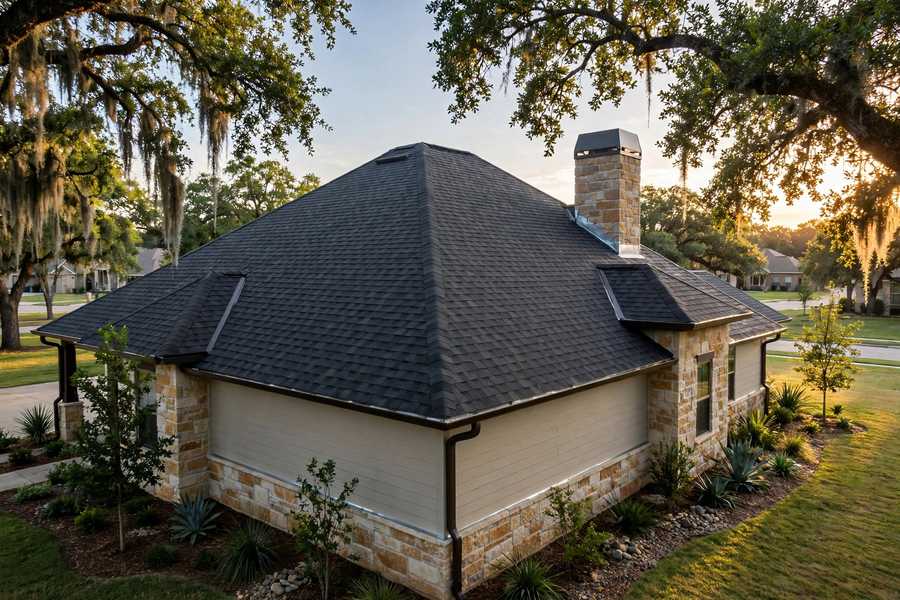
Roof Replacement · Texas
The honest version: most roofs we climb can be repaired, and we will tell you so. This page is for the ones that truly cannot.
A new roof is the biggest job a house ever books, so it should be the last resort, not the first offer. This is the roof replacement Texas page of Emergency Roof Repair Texas, a repair-first crew. We will show you the signs that a roof is honestly done, walk through the whole job step by step, and name the pressure tricks to walk away from. If your roof can be repaired, we will say that instead, and the repair page is one click away. Still deciding? Call (512) 555-0147 and talk it through with a roofer.
Crews working from the towns they live in, not a call centre three states away.
A roof replacement is the full job: the old roof stripped down to the boards, the deck checked and repaired, fresh underlayment and edging, then a whole new roof fitted over the top, with the flashing, vents and ridge renewed as part of the work. It is the right answer when a roof is worn out on every slope. It is the wrong answer for one cracked boot or one tired valley, and telling those two apart is most of this page. On this page, a roof replacement Texas job means exactly that full job, never a new surface laid over a tired one.
Repair-first, even here
Start with the thing no other roof replacement Texas page will tell you: we hope your roof does not need this page. Our whole crew is built around the repair. We stop the water, trace the leak, photograph the part that failed, and fix the smallest thing that truly holds. A replacement is what we recommend when the repair stops being honest, and only then.
That is not a sales angle. It is money logic, said out loud. A full replacement is the biggest job in this trade, so a company built on replacements starts hearing every drip as a roof at the end of its life. We built the other way. When one pipe boot has cracked in the Texas sun, a roof replacement Texas crew with a quota sees a whole new roof. We see a cracked boot. The boot gets changed, the slope gets photographed, and the roof carries on.
So read this page the way we wrote it: as the honest case for a big job, made by people who would rather not sell it to you. Every sign in the next section is a sign you can check yourself, from the ground, from the attic hatch, or from photos any roofer should be glad to take for you. If the signs are not there, the answer is a repair, and our roof repair page covers that work in full.
And if the signs are there, take your time anyway. A roof that is worn out this month will still be worn out next month, and a verdict that cannot wait two weeks was never a verdict. It was a pitch. The one exception is a roof that is actively letting water in: that needs the water stopped tonight, by tarping or a patch, while you think. Our guide to what counts as an emergency walks through that test, and the emergency line is (512) 555-0147 when you need it.
Not sure which side of the line your roof sits on? That is exactly the question our repair or replace page works through, test by test, with the same signs in the same order we use them on a real roof. Read it before you read another word here. If it points to repair, believe it, whoever does the work. If it points here, come back and read on: this is what a roof replacement Texas job should look like when it is done honestly.
The honest signs
One failed part is a repair. A roof is done when the failure is everywhere at once: every slope tired, every detail at the end of its life, the surface itself giving up. Here are the signs our crews check, in the order we check them, each one with what it looks like from where you stand. They are the same signs that decide every roof replacement Texas verdict we give.
Leaks in many places at once
One leak is a failed part. Leaks that appear in room after room, season after season, mean the whole surface is letting water through in places you have not found yet. When a roof springs a new leak every few months, each repair is honest work on a roof that is finished overall.
A single leak has a single address: this boot, that valley, those shingles above the porch. It can be found, photographed and fixed, and the rest of the roof is not implicated. That is a repair call, not a roof replacement Texas call. The picture changes when the calls stop being about one address. A stain over the kitchen in spring. A drip at the chimney by summer. A wet patch in the hall when the hard rain comes. Each one is real, each one gets fixed, and the roof keeps dealing you a new one.
That pattern is the surface itself giving up. The shingles have lost their seal and their grit across whole slopes, the felt under them is brittle, and water is finding the weak points one storm at a time. Patching that pattern is not thrift. It is paying for the same failing roof in instalments, and living with the wet ceilings in between. On a roof replacement Texas visit, this repair history is the first thing we ask about, because a roof with five honest repairs behind it is telling you its own story.
Shingles brittle or curling on every slope
Shingles should lie flat and bend a little. When they curl at the edges, crack when lifted, or snap instead of flexing on every slope, the material itself is spent. One curled patch is storm or heat damage. The same curl everywhere means the roof has aged out as a whole.
Pick the worst slope, the one that takes the afternoon sun, and look at it from the yard. Healthy shingles sit flat in straight rows, edge to edge. A tired roof waves at you: corners lifted, tabs cupped, rows that no longer line up because the material has shrunk and stiffened with age and heat. Texas sun is hard on asphalt. It cooks the oils out of a shingle year by year, and what is left is a stiff, brittle shell of the thing that was fitted.
The test a roofer runs is simple: lift a tab gently and bend it. A sound shingle flexes and settles back. A spent one cracks, or comes away in the hand. One slope failing that test after a hail storm is damage, and it belongs on the storm page. Every slope failing it, front and back, sheltered and exposed alike, is age. Age does not get repaired. There is no patch for a material that has finished its life everywhere at once, and any crew that offers to coat it, seal it or patch it slope by slope is selling you time the roof does not have.
Granules washing out everywhere
Granules are the shingle's armour against the sun. A few in the gutter after a storm is normal wear. Gutters and downspouts running heavy with grit after every rain, and bare, shiny patches showing on the slopes, mean the armour is gone and the asphalt underneath is cooking in the open.
A new shingle sheds a little grit in its first year, the loose extra from the factory, and a hard storm knocks some loose at any age. That is not the sign. The sign is volume and pattern: grit piling up at the downspout month after month, and slopes that look patchy from the street, dark and light in uneven blocks where the surface has worn thin. Run a hand over a fallen shingle from the yard and it feels smooth as paper where it should feel like coarse sandpaper.
Once the granules go, the rest follows fast, and granule loss this wide is never fixed by a patch, which is why it sits so high on the roof replacement Texas list of signs. Bare asphalt bakes, cracks and curls, and the felt under it takes the weather it was never meant to take. This is the sign homeowners most often get talked out of, because the roof still looks whole from the driveway. It is whole the way a tyre with no tread is whole. It will roll, until the first wet road. A roof replacement Texas check counts granule loss slope by slope, with photos, because this one sign alone has ended more roofs than any storm.
A deck that sags or feels soft
The deck is the board layer the roof sits on. A roofline that dips between the rafters, or boards that feel spongy under a roofer's boots, mean water has been getting in long enough to rot the structure itself. A soft patch over one leak is a repair. Soft boards across whole slopes mean the base of the roof has failed.
Look along the roofline from the street at an angle, in good light. A sound roof runs straight. A tired one sags in shallow waves between the supports, and the dips hold water after rain instead of shedding it, which rots the boards further. It is a slow spiral: water sits, boards soften, the dip deepens, more water sits. By the time the sag shows from the ground, the rot has usually been at work for years. Every roof replacement Texas crew knows this spiral, because it is the reason so many old roofs arrive at us already finished.
This is the one sign that settles arguments. Shingles can be argued about; a rotten deck cannot. Nothing new can be fastened to soft boards and expected to hold, and no surface repair reaches the problem, because the problem is under the surface. It is also the sign that cannot be judged from a photo of the shingles. It needs boots on the roof and a look from the attic, which is why our roof inspection page treats the attic as half the job. If a crew condemns your roof without ever feeling the deck or checking the attic, they have skipped the one check that matters most.
Patches on patches
Count the patches. A roof that has been patched well, a few times, over many years is a maintained roof. A roof wearing patches on every slope, sealant smeared at every joint, and repairs that keep failing at the edges of old repairs, is a roof telling you the base material can no longer hold a fix.
Every repair needs sound material around it to bite into. A new flashing seals against shingles that still flex. A patch bonds to a surface that still has grit and give. On a finished roof, the repairs start failing for a new reason: not bad work, but nothing left to work with. The sealant peels because the surface under it is crumbling. The new shingles around a patch crack because the old ones they marry into are brittle.
There is a simple way to see it. Ask for the roof's history in repairs, the way you would ask about a car's. Two or three repairs across twenty years is a healthy life. A repair every season, each one near the last, with the gaps between them shrinking, is the end of that life arriving. We keep the photos from every visit for exactly this reason: laid side by side, year by year, they show a roof winding down more honestly than any opinion. When the photos say the patches have become the roof, a roof replacement Texas conversation stops being a sales talk and becomes simple maintenance, done once, done whole.
Past the honest life of its material
Age alone is not a verdict, but it sets the stage for one. Every material has a working life, and a roof near the end of it, showing two or three of the other signs on this list, is a roof to plan around, not to keep patching. A roof of the same age with none of the signs can carry on.
The material section further down this page gives the rough working life of each roof type, the way manufacturers and roofers talk about them. Treat those numbers as guides, not deadlines. Texas heat takes years off the kind end of every range, and a sheltered roof under good ventilation can outlast the hard end. Age matters because of what it predicts: boots crack, sealant tires, felt goes brittle, and they all start arriving together.
So on a roof replacement Texas check, the honest use of age is as a tiebreaker. A twelve year old roof with a leak is a repair, nearly every time. A roof at the far end of its material's life, with leaks arriving in new places and grit in the gutters after every rain, is a roof living on borrowed time. Planning a replacement while the roof still mostly holds is a calmer job than booking one with water coming through the ceiling, and it lets you choose the crew, the material and the week, instead of having the storm choose for you.
One storm too many
Yes, when the roof was already near the end. Hail that bruises every slope, or wind that lifts and creases shingles across whole fields, can take a tired roof from coping to finished in one night. The storm did not age the roof. It revealed the age, all at once, in a way that can be photographed and dated.
This is the case that fills the weeks after a big Texas storm, and it is also the case most often abused, so it deserves plain words. A young, sound roof hit by hail usually needs repairs: a slope re-felted here, a run of shingles there, the vents and caps renewed. Our storm damage page covers that work, and our hail page covers how hail damage is honestly told from wear. Neither page reaches for a full replacement as the first answer.
The full replacement case is narrower: an older roof, already showing the signs above, where the storm damage is spread across every slope instead of gathered in one area. Then the repair map covers so much of the roof that replacing it whole is the straighter job. The proof is in the test squares and the slope by slope photos, and any crew making this call should be able to show you both, slope by slope, until the pattern is plain to you too.
Read the signs as a set, not a menu. One sign is a repair with a warning attached. Two signs mean start planning and get the roof checked properly. That check is where every honest roof replacement Texas story starts. Three or more, spread across every slope, is a finished roof, and no honest roofer will sell you another patch for it. If you want those checks run on your roof, with photos you keep, that is the inspection we describe on our roof inspection page, and the number is (512) 555-0147.
Slope by slope
Before the job itself, one more thing worth knowing: what the verdict should look like when it is honest, because a roof replacement Texas verdict is easy to fake and hard to check if you do not know the shape of a real one.
A real verdict is slow. It starts in the attic, where the deck tells its story in dark streaks, soft boards and daylight showing where it should not. It continues slope by slope on the roof itself: tabs lifted and bent, grit checked by hand, the deck felt underfoot, test areas marked and photographed where storm damage is part of the story. The failed parts get named, one by one: this boot, that valley, these slopes. Nothing about it is done from the driveway, and none of it fits inside fifteen minutes.
A real verdict is also written. You should end the visit with photos you can keep, a slope by slope account of what was found, and a clear statement of which signs from the list above your roof actually shows. If the answer is replacement, the paper should say why in words tied to those signs, not in adjectives. Old is an adjective. Brittle on every slope, grit gone on three, deck soft over the hall: that is a reason.
And a real verdict survives a second opinion. A crew that believes its own photos will tell you to show them to anyone. Take them up on it. Show the same photos to a second crew and listen for the same signs named in the same places. Honest roofers looking at honest photos mostly agree, because the roof is the roof. Where verdicts differ wildly, the photos are usually thin, and thin photos are a finding all by themselves. Ask for a verdict in that shape from any roof replacement Texas crew, us included, and walk away from one that arrives in any other shape.
The full job
A replacement is not one job. It is eight jobs in a strict order, and the order is the quality. Skip one, or run it out of turn, and the new roof starts life with a weakness built in. Here is the whole sequence, the way a roof replacement Texas crew should run it, with what to watch for at each step.
The old roof comes off, down to the boards, slope by slope.
Every board looked at and felt. Rotten boards come out, sound new boards go in.
Fresh felt or synthetic sheeting over the whole deck, the roof's second skin.
Metal edging and the starter course that seals the roof's rim.
The new surface fitted row by row, nailed to pattern, worked around every obstacle.
Every joint and penetration renewed, not reused tired.
The ridge capped, and the attic breathing checked and cleared.
Debris hauled off, and the yard swept with magnets for nails, twice.
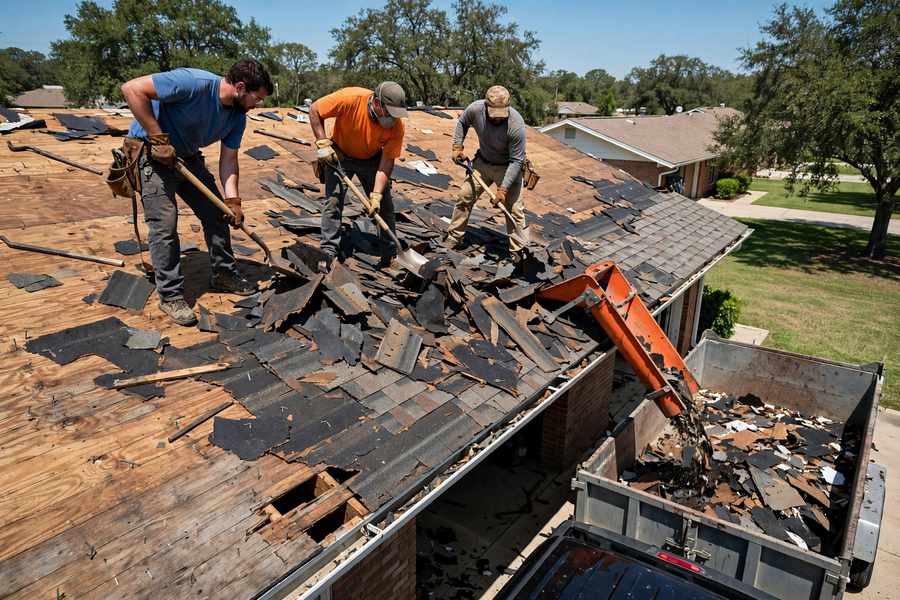
The old roof has to come off, all of it: shingles, felt, nails, the lot, down to bare boards. Crews work slope by slope, tearing off with forks and shovels made for the work, and dropping the debris into a trailer or a truck bed parked close, not onto your garden. A slope is never stripped faster than it can be dried in again, because a bare deck and a sudden Texas shower is a race nobody wins.
Watch how the tear-off is handled and you will learn the crew. Careful crews protect what is below before they start: plants covered, the air conditioner screened, patio furniture moved or sheeted. Careless crews start throwing and apologise later. The tear-off is also the loudest, messiest hour of the whole job, and the moment the roof tells the truth, because everything hidden for twenty years is suddenly in daylight.
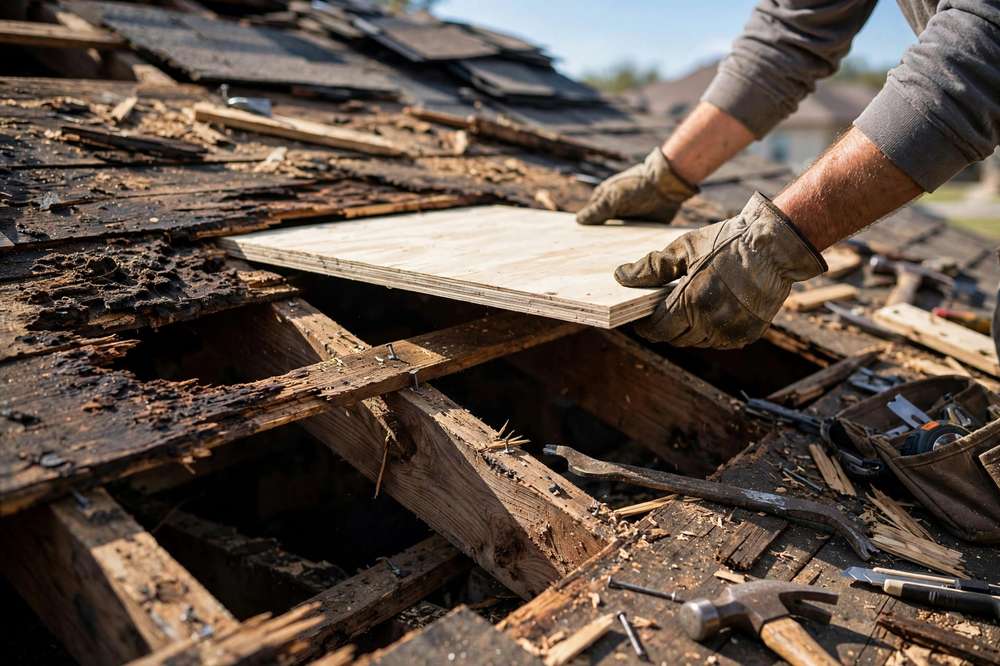
With the surface gone, the deck is naked, and this is the only moment in a roof's life when every board can be seen, walked and judged. Sound boards are firm, dry and hold a nail. Rotten ones are dark, soft and crumble at the edges. Every soft board comes out and a sound board goes in its place, cut to fit and fixed to the rafters. Skipping this step is the single worst shortcut in the trade, because a new roof fastened to rotten boards is a new roof already failing.
This is also the step where honest dealing matters most, and it is covered again in the signing section below. The short version: you should see the rot, in photos or with your own eyes from the attic, and agree the board work before it happens, not discover it as a surprise at the end. On a roof replacement Texas job run the right way, the deck check is a pause, a set of photos and a short conversation, not a blank page.
Over the sound deck goes the underlayment: the sheet layer that sits between the boards and the surface, called felt for the traditional kind and synthetic underlayment for the modern woven kind. It is the roof's second skin. Shingles shed nearly all the water, but wind drives rain upward and sideways, and the underlayment is what catches what gets past. Along the eaves and in the valleys, a stickier, self-sealing membrane does the heavy work where water gathers and lingers.
Old felt comes off with the tear-off, every scrap, because new underlayment over old, wrinkled felt telegraphs every bump through the new surface and traps damp between the layers. The new layer goes down flat, lapped so each course sheds onto the one below, and fixed smooth. From the ground this step looks like nothing, a grey or black blanket unrolled over the roof. It is quietly one of the most important hours of the job.
The rim of the roof gets its metal: drip edge, a strip of folded flashing that runs along the eaves and the rakes, guiding water off the surface and into the gutters instead of letting it curl back onto the boards and the fascia. Then the starter course, the first row of the new surface, laid along the eaves with its sealant strip set to bond the first full course down against the wind.
These edge details are where cheap jobs quietly save their money, because none of it shows from the street once the field is on. Missing drip edge does not leak this year. It rots the edge boards over five years, out of sight, until the rim of the roof is soft all the way round. When you compare scopes, this is a line to look for by name: drip edge, starter course, both written in, both fitted new.
Now the visible roof goes on: the shingles or panels, fitted course by course from the eaves to the ridge, each row lapped over the one below so water only ever runs downhill over sealed joints. Nails go in to a pattern, the right count per shingle, placed on the nail line where the next course covers them, driven flat: not angled, not overdriven through the surface, not left proud. A nail driven wrong is a leak with a date on it. Every roof replacement Texas crew works to the same nail pattern; the good ones actually follow it.
Good crews work the field around the roof's obstacles as they reach them, cutting and fitting neatly at valleys, hips and walls rather than bridging over them. The pace should look steady, almost boring. Flying pace on the field is how nail patterns get sloppy and courses wander out of line, and a wandering course is visible from the street for the whole life of the roof. This is the step your neighbours will judge, so it is worth a crew that treats straight rows as a point of pride.
Every place the roof is pierced or meets a wall is a joint, and joints are where roofs leak. Pipe boots around the plumbing vents. Flashing where the roof meets a chimney, a wall or a change of slope. Collars on the vents. On a replacement, all of it comes off with the old roof and all of it goes back new. Reusing tired flashing on a new roof is like fitting new tyres and keeping the worn brake pads: the new part will be blamed for the old part's failure.
This step matters more in Texas than most places, because the rubber in a pipe boot cooks in the sun and cracks years before a good surface wears out. Boots are the most common leak source we trace on any roof, new or old. A replacement that renews every boot, every flashing and every vent collar resets all of those clocks at once, and that reset is a large part of what you are actually getting when a roof replacement Texas job is done properly.
The top of the roof gets its cap: ridge shingles or a ridge system that sheds water over the peak and seals the joint where the two slopes meet. On many roofs the ridge is also a vent, a slotted run under the cap that lets hot attic air escape along the whole peak. While the ridge is open is the moment to check that the attic can breathe: intake at the eaves, exit at the ridge, nothing blocked by insulation stuffed where it should not be.
Ventilation sounds like a side topic. In Texas it is a lifespan topic. A cooked attic bakes the surface from below, ages the underlayment, and pushes the house's cooling load up all summer. A replacement is the one chance in decades to put the breathing right with the roof open, and a crew that talks about your attic air as part of a roof replacement Texas job is a crew thinking about the roof's whole life, not just its first season.
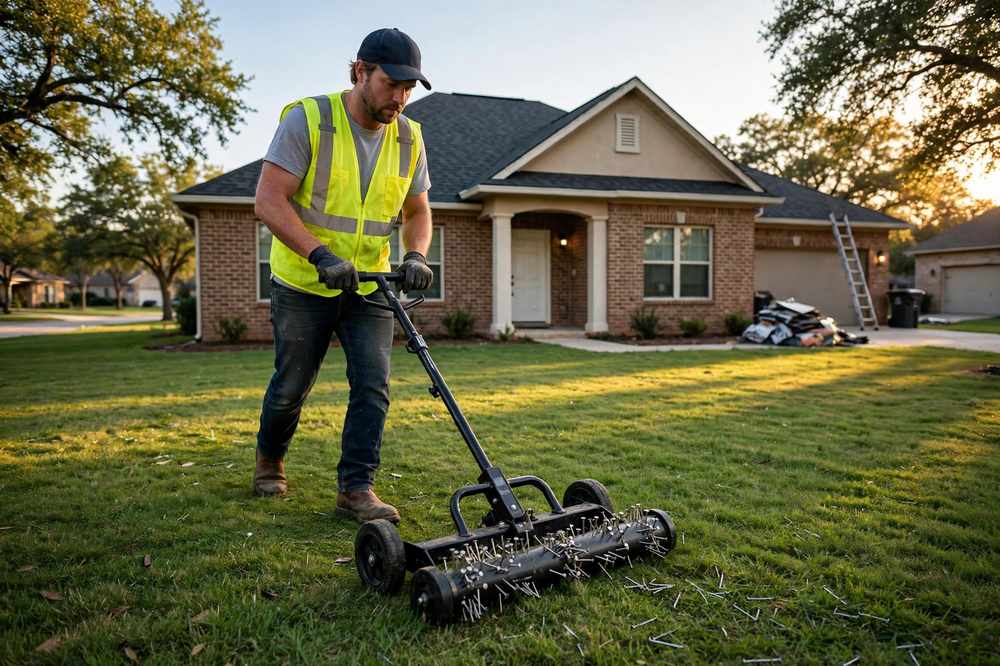
The job ends on the ground. All the old material is hauled away, the gutters are checked and cleared of the grit and scraps the work shook loose, and the yard, drive and paths are swept with a rolling magnet, a bar of strong magnets on wheels that picks up nails your eyes would miss. Then it is done again, in different light, because one pass always leaves some. Thousands of nails came off that roof. The sweep is how nearly all of them leave with the crew.
Ask about the sweep by name before you sign any roof replacement Texas paperwork, and walk the yard yourself before the crew leaves, barefoot season in mind. Kids, dogs and tyres find the nails that magnets miss. A crew that treats the sweep as a real step, listed in the scope and done twice, is telling you something about how it treated the steps you could not see from the ground.
Eight steps, in order, none of them glamorous. That is the whole secret of a roof replacement Texas homeowners can trust: there is no secret. There is a sequence, and the quality is whether every step got its full turn, especially the ones that end up hidden under the new surface.
The big shortcut
Sooner or later in every roof replacement Texas conversation, someone suggests skipping the tear-off and laying the new surface straight over the old shingles. It is quicker. It is tidier on the day. And it gives up nearly everything a replacement is for. Here is the honest version of both sides.
The layover's problem is that it hides exactly the things a replacement exists to fix. The deck never gets checked, so the rot that softened it keeps rotting under two roofs instead of one. The old surface never lies perfectly flat, so the new one wears unevenly over every bump. The flashing gets built up and bent around layers instead of being renewed, and the boots, the parts that fail first, stay buried at the bottom of the stack.
There is also a hard limit that ends most layover talk: two layers is the most a roof should ever carry, and many Texas cities will not allow a second layer at all. A roof that already wears two layers has no layover option. It gets torn off or it does not get done. That rule alone turns many a planned layover into a proper roof replacement Texas tear-off. And a roof that takes a second layer today has used up its shortcut: the next replacement, whenever it comes, starts with tearing off two roofs instead of one.
So our answer on every roof replacement Texas job is plain: we tear off. Not because the tear-off is the profitable part, but because steps two and six of the job, the deck check and the renewed flashing, cannot happen through a layer of old shingles. A replacement that skips them is a new surface on an unchecked base, and the homeowner has traded the one full inspection a roof gets in its life for a tidier Tuesday. If a crew pushes a layover hard, ask what they are avoiding looking at. The answer is usually the deck, and the deck is the one thing you most need looked at.
Choosing the surface
Every material below can make a good Texas roof, and every one fails early if it is fitted badly. The lifespans are the rough guides roofers and makers talk in, not promises: Texas heat, hail and attic ventilation move any single roof years in either direction. Every roof replacement Texas material choice is a trade between life, look and the shape of your roof. Read for the fit with your house, not for a winner.
The plain, flat shingle that roofed most of Texas for decades. Light, simple, and the shortest lived of the shingles: roughly 15 to 20 years of working life in our heat. It lies flat and looks neat, but its thin body gives up its granules sooner, and wind lifts its tabs more easily than the heavier kinds. A fair pick for a small roof or a tight plan, chosen with open eyes about its shorter clock.
The layered, thicker shingle you see on most new Texas roofs, also called dimensional. Two bonded layers give it weight, shadow lines and a longer life: roughly 20 to 30 years as a working guide. It shrugs off wind better, hides wear longer, and stands up to hail a little more kindly than three-tab. For most houses it is the sensible middle, and the surface our crews fit most often.
The heavy end of asphalt: extra thick, deep profiled shingles made to mimic slate or shake, with working lives put at around 25 to 30 years and beyond. They suit big, visible roofs where the look carries the house. The weight is real, so the frame and deck must be sound, and the honest gain over a good architectural shingle is looks and some toughness, not double the life.
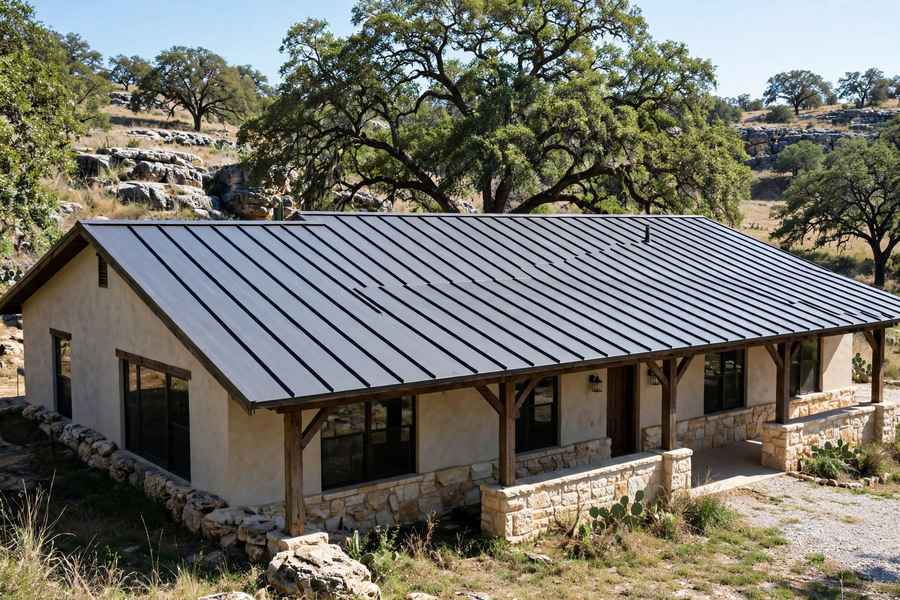
Long steel panels joined by raised seams that stand clear of the water running below them. The long-distance runner of the list: 40 years and well past it as a guide, with the paint finish usually ageing before the metal does. It sheds hail dents as cosmetic marks rather than wounds, laughs at wind, and suits the Texas sun. It asks for skilled fitting, it drums in hard rain unless the build-up under it is done right, and repairs need metal hands, not shingle habits.
The corrugated and ribbed panels you see on barns, workshops and plenty of ranch houses, fixed with screws through the face. Tough and long lived, roughly 30 to 40 years as a guide, with one known chore: the screws and their washers age, loosen and want checking and renewing over the years. Fitted with that maintenance in mind, it is honest, practical roofing. Fitted and forgotten, it leaks at the screws first.
The heavy, handsome roof of the Hill Country and the Spanish-style house. The tiles themselves can outlast the house: 50 years and more as a guide. The catch is underneath. The felt under tile does the waterproofing, and it ages in roughly 20 to 30 years, so a tile roof's real clock is its underlayment, renewed by lifting and relaying the tiles. Tile is also heavy: a frame built for shingles cannot simply be given tile. And cracked tiles from a careless boot are a slow leak of their own.
Porches, additions and flat-roofed houses need a different family: sheet membranes such as TPO, a pale welded skin that reflects the sun, or modified bitumen, a thick rolled roofing sealed at the seams. Working lives run roughly 15 to 30 years depending on the system and its seams. On flat roofs the material matters less than the detailing: seams, edges and drains decide everything, because water sits instead of running. Ponding water that is still there two days after rain is a defect to fix, not a feature to accept.
Two honest notes to finish the comparison. First, the material is the smaller half of the outcome. On any roof replacement Texas job, a mid-range shingle fitted with a sound deck, real underlayment, renewed flashing and a right nail pattern will outlive a premium surface thrown over tired boards by careless hands, every time. Second, whatever you choose, choose the version of it the crew fits every week. A roof replacement Texas crew that knows one material deeply will serve you better than one that offers all seven and masters none. Ask what is on the roofs they did last month, and let the answer steer the choice.
Different roofs, different jobs
The eight steps stay the same, but the work bends around the roof in front of the crew. Here is how a roof replacement Texas job changes shape across the roofs we actually climb.
This is the home ground: a pitched roof in three-tab or architectural shingles, one or two storeys, a valley or two, a chimney if the house is older. The replacement runs exactly as the steps describe, and the judgement calls are the deck boards, the valley build and the boots. Most of the roofs in Austin, Buda and Plano are this roof, and it is the one where a good crew's habits show most, because nothing about it is exotic. It is all in the care, and it is the roof replacement Texas crews are judged by most often.
Tall rooflines and steep pitches change the safety and the pace, not the principles. A steep roof replacement Texas job moves slower because everything is roped, staged and carried with more care, and the tear-off must be managed so debris is lowered, never dropped. Steep roofs also wear unevenly: the sheltered slopes can have years left while the sun slopes are finished, which is worth one honest conversation before the work. Usually the right answer is still the whole roof, done once, because scaffolding and staging twice gives the household two rounds of upheaval, but you should hear the slope by slope facts before you decide.
Porches, carports and additions often sit at a shallow pitch tacked onto a steeper main roof, and shallow water moves slowly and climbs. Shingles fitted to a low slope are a leak waiting for a windy rain, so a low section inside a replacement gets a membrane system on its own area, tied carefully into the shingled field above it. The joint between the two systems is the detail that decides whether that porch ceiling stays dry. On a roof replacement Texas scope, it deserves a line of its own.
A truly flat roof is a membrane job from edge to edge, and its replacement lives or dies on seams, edges and drainage. The deck check matters even more here, because flat roofs hide rot under a surface that can look sound while the boards beneath are porridge. The honest flat version of a roof replacement Texas job also fixes the drainage: if water ponded on the old roof, the new one is the chance to correct the falls so it does not pond on the new one. A crew that offers to skin over a ponding flat roof without talking about where the water goes is skipping the actual problem.
A metal roof at the end of its life usually fails at its fixings and seams first, not its panels. When the panels themselves are holed, patched in rows and rusting through at the laps, replacement means stripping to the deck or the battens, checking what the leaks have done underneath, and fitting the new system with its fixings where they belong. Homeowners are often surprised that a metal roof can hide deck rot as well as any other, since the surface still looks strong from the road. Looks are not the test. The check underneath is, and every metal roof replacement Texas crews do starts with that check.
Tile work is a relay race: the tiles come off and are stacked, the aged felt beneath is stripped and renewed, the deck is checked, and the tiles go back, with broken ones replaced from matching stock where it can be found. Many tile jobs in a roof replacement Texas season are really underlayment replacements, because the tiles have decades left in them while the felt does not. The skills are patience and handling: every tile lifted carelessly is a cracked tile, and a crew that treats tile like shingles will leave you short of tiles that cannot be matched at any hardware store in Texas.
Living through it
People ask about the work. What they mean is: what will it be like to live here while it happens? Here is the honest shape of it, for a roof replacement Texas households actually sit through.
For a typical single-family home, the loud work runs about one to two days: a day of tear-off and drying in, a day of fitting, sometimes running into a third for a big, steep or cut-up roof. Tile and metal run longer, and weather can pause any job mid-stream, because no step after the tear-off should be rushed onto a wet deck. Treat any exact promise of hours with suspicion. A crew can promise the order of the work and the care at each step. The sky keeps its own schedule.
The noise is the first thing to plan around. A tear-off sounds like a thunderstorm that has moved into the attic: scraping, banging, boots overhead from early morning. The fitting day is quieter but still a worksite, with nail guns ticking away in bursts. If you work from home, plan your calls for another room or another house on tear-off day. If a baby naps at noon, tell the crew, and a good crew will shape the loudest hour around it where the work allows. Nobody can make it silent. A straight crew will not pretend otherwise. It is the part of a roof replacement Texas week nobody warns you about, so consider yourself warned.
The house feels it indoors too. Vibration shakes dust loose from attic edges and can walk picture frames crooked on the walls, which is why the preparation section below exists. The garden takes a share: plants near the walls get covered, but a prized bed under the eaves will have a hard week, and moving pots before the crew arrives beats mourning them after. Cars want the drive clear and the garage shut, because the trailer needs the drive and debris finds windscreens.
Pets and children need a plain plan. Dogs hear a worksite as an invasion and will tell the whole street about it for two days; a friend's house or a quiet back room with a radio on is kinder than the yard. The yard itself is out of bounds while work runs, for everyone: things fall off roofs on the best-run jobs, and the magnet sweep only happens at the end. Keep the household's comings and goings to the door furthest from the work, and tell the crew which door that is on the first morning.
And then, quickly, it is done. The last afternoon goes quiet in a way that feels sudden: the trailer leaves, the sweep makes its passes, and the house has a new hat. Most people say the same two things after a roof replacement Texas job: it was louder than they expected, and shorter. Both are worth knowing before the first morning, which is why this section sits on the page at all.
Before the crew arrives
Half an hour of preparation protects most of what a replacement puts at risk. Two short lists for a roof replacement Texas week, inside and out.
None of this is your job in the sense of the contract. The crew protects the house as part of the work. But the things only you know about, the loose mirror, the dog that bolts, the sapling by the fence, are the things a crew cannot protect by guessing. Tell them on the first morning of the roof replacement Texas job, before the first shovel goes in, and the week runs smoother for everyone under and over the roof.
The paperwork
Roofing paperwork confuses people because Texas runs it town by town, and anyone who gives you one simple statewide answer is guessing. Here is what can honestly be said in general, and it is as far as this page will go: most Texas cities ask for a permit before a full roof replacement, some smaller towns do not, and the rules, forms and checks belong to the city the house stands in. That permit is part of nearly every roof replacement Texas job inside city limits, and skipping a required one is never a favour to the homeowner. The local permit office is the final word on your house, not a website, not a roofer, and not this page.
A permit, where one is required, is not red tape for its own sake. It puts the job on record, and it usually brings an inspection that the work matches what the city asks of a roof: the layer limit respected, the materials fitted as they should be, the basics done right. That inspection is a second pair of eyes working for you, and a crew that welcomes it is telling you something. A crew that urges you to skip a required permit is asking you to carry a risk that belongs to them, and the risk surfaces later: when the house is sold, when a buyer's survey asks questions, when the city notices.
Two neighbouring wrinkles belong in the same conversation. Many neighbourhoods have a homeowners association whose approval covers the look of the roof: colour, profile and material family. That approval is separate from the city permit, and it is the homeowner's to arrange, though a good crew will happily supply the material details the form asks for. And inside Austin and the bigger cities, expect the process to be more formal than in the small towns around them. Pilot Point is not Plano, and Plano is not Houston. Ask the crew, before you sign any roof replacement Texas agreement, who pulls the permit for your street and how the inspection gets booked, and be satisfied with a plain answer that names your own city's office.
The paperwork, in plain words
A roof replacement Texas agreement should be readable by the person signing it, at the kitchen table, without a dictionary or a lawyer. These are the questions to ask of any crew, us included, and the shape of a straight answer.
Notice what is not on this list: anything about money terms. That is deliberate, and it is not evasion. The questions above are the ones that decide whether the job is honest, and they can all be asked, answered and written down before figures ever enter the room. A crew that answers these seven plainly has earned the right to talk numbers with you. A crew that dodges them has told you what its numbers would be built on.
Walk-away signs
Replacement is the biggest sale in roofing, so it attracts the trade's worst habits. None of these roof replacement Texas red flags need roofing knowledge to spot. They are pressure habits, and pressure is the tell.
A verdict delivered at dusk, with a signature needed tonight because the offer, the crew or the material runs out at midnight. Roofs do not expire at midnight. A roof that is finished tonight is finished next week, and any crew can wait while you think. The deadline exists to stop you getting a second set of photos.
After a storm, a stranger knocks, offers a look, and comes down with a whole-roof verdict and a clipboard. The look was the pitch. Real damage survives being checked by a crew you called, in daylight, with no clipboard already out. Never let the person who knocked be the only person who has looked.
A full replacement recommended by someone who never climbed, never lifted a tab, never saw the attic. They may be right by luck, but they have not done the work a verdict is made of. The signs of a finished roof live on the slopes and in the attic, not at the kerb.
Paperwork that says replace roof, a material name and little else. Every hidden step of the job, the deck, the edging, the flashing, the sweep, is missing, and missing steps are where the corners get cut. Compare it with the eight steps on this page and count what is absent.
Findings described, never shown. In a trade where every phone has a camera, a crew that cannot show you your own roof is choosing not to. Photos are the cheapest honesty there is, and refusing them is a decision, not an oversight.
One drip over one room, answered with a whole new roof, no tracing, no named failed part. A leak has an address. A crew that will not look for it is not selling you a roof. It is selling you its month.
Hints that your roof is the street's eyesore and everyone can see it failing. A roof's condition is a set of facts about boards, grit and boots, not a beauty contest. The moment embarrassment enters the pitch, evidence has left it.
Hold these next to the honest verdict section above and the pattern is simple. Honest selling is slow, written, photographed and happy to be checked. Everything on this list is fast, verbal, unphotographed and allergic to a second opinion. A roof replacement Texas purchase is too big to buy in a hurry from anyone, and the crew worth hiring is the one that slows you down, not the one that speeds you up.
Mid-job honesty
It deserves its own short section, because it is the moment homeowners fear most: the old roof is off, the crew goes quiet, and somebody says the boards are worse than anyone hoped. First: on an older roof, some rot is normal. A roof that leaked for years before it was replaced has been wetting its deck for years. Finding soft boards is not a disaster and it is not, by itself, a sign you chose the wrong crew.
What matters in a roof replacement Texas job is the handling. The work at that slope pauses. The rotten boards are photographed, and where it is safe, shown to you from the attic or the ladder. The extent gets mapped honestly: how many boards, in which areas, and whether the rafters beneath are sound, because surface rot on boards and rot in the frame are different conversations. Then the renewal is agreed with you before it happens, in the plain terms the signing section describes, and only then does the job roll on.
What must never happen is the quiet version: boards swapped in silence and presented as a surprise at the end, or worse, boards left soft and roofed over because stopping felt awkward. A new roof is only as sound as what it is fastened to. The pause, the photos and the conversation are not delays to the job. On a roof replacement Texas job done honestly, they are the job, arriving exactly where twenty years of weather said they would.
The first year
A new roof mostly looks after itself, but its first year is worth a little attention, because small things caught early stay small. Most of this takes minutes, none of it involves climbing, and all of it protects the roof replacement Texas job you just had done.
Check after the first storms. Walk the yard and the ceilings after the first two or three hard rains. Outside, look for anything out of place: a lifted edge, debris where it should not be. Inside, look up. A new roof should be a non-event in a storm, and the first storms are its exam.
The attic smell test. Give the work a week or two, pick a dry day, and poke your head through the hatch for one long breath. A sound attic smells of warm wood and dust. A sweet, musty edge to the air means moisture has settled somewhere out of sight, so call while the job photos are still recent enough to check against.
Keep the gutter line clear. New roofs shed their loose factory grit in the first months, so gutters run sandy for a while. That is normal. What matters is that they keep running: a blocked gutter pours water back at the new edging and the fascia, the very parts the job just renewed.
Keep the paper. The scope, the deck photos, the finished photos and the material paperwork, in one folder. That folder is the roof's birth certificate. It serves you at the next repair, it serves a buyer years from now, and it serves any crew asked to judge the roof honestly.
After the first year, the rhythm settles into something light: a look from the ground each spring, a glance at the ceilings after any storm with a name, and the attic smell test whenever you are up there for the decorations. The parts that age first on any roof are the small ones: the rubber boots around the vents, the sealant at the joints, the flashing edges. They age on a new roof too, just from a standing start, and a small renewal visit years from now, boots changed before they crack, is how a roof reaches the long end of its material's life instead of the short end.
And if anything on this page ever looks wrong on your roof, call (512) 555-0147. A crew that stands behind a replacement wants the first call about it, not the last. The photos from the job are on file, the scope is on paper, and a straight answer about our own work is the least a roof replacement Texas homeowner should expect from the people who fitted it.
Service areas
Our crews work from the towns they live in, and a replacement is planned work, booked ahead, with the same local crews who handle our emergency calls:
home base for our crews. Hard sun, hard storms and a lot of roofs from the building booms now reaching the end of their first surface. Roof replacement Texas work here is steady, planned in the calmer months where the household allows.
young subdivisions growing older together. Roofs fitted in the same few years reach their signs in the same few years, so one street can hold a whole season of honest verdicts, some repair, some replacement.
older roofs and lake wind. Long weather exposure means decks here earn a particularly careful check at tear-off, and tile and metal roofs are a bigger share of the work than down south.
big roofs, tall rooflines and a long hail history. Wide slopes mean the full eight steps at full scale, and storm history checked slope by slope before any verdict is given.
Your town not listed? Call (512) 555-0147. A roof replacement Texas booking is made ahead, not raced to, so the honest answer about distance is easy to give: if we cannot serve your roof properly, we will tell you plainly and early.
Questions
The questions every homeowner asks before the biggest job on the house, answered the way we answer them on the phone:
One leak or one failed part is a repair. Replacement is the answer when the failure is everywhere: shingles brittle on all slopes, granules gone, leaks arriving in new rooms, or boards soft underfoot. Ask for the signs in photos, slope by slope, and count them yourself before you believe any verdict.
Yes, gladly, and it happens often. Our crew is built on repairs, so if a patch and a renewed flashing will hold, that is what we recommend, with photos so you can judge. A replacement we talked you out of is a repair we earned, and a customer who trusts the next call.
Sometimes it is allowed, and we still will not do it. Laying over hides the deck, so rot keeps rotting unseen, the new surface lies uneven, and tired flashing stays buried. Two layers is also the most a roof should carry. A replacement that skips the deck check gives up its main benefit.
For a typical family home, the loud work takes about one to two days: tear-off and drying in first, fitting second, longer for big, steep, tile or metal roofs. Weather can pause a job, because no step should be rushed onto a wet deck. Any crew promising exact hours is guessing at the sky.
The work pauses at that slope and you get photos of the boards before anything is covered. Sound boards go in where the rotten ones came out, agreed with you first, in plain words. Rot found mid-job is normal on an older roof. Rot hidden under a new roof without a word is not.
Standing seam metal and clay or concrete tile run the longest, forty years and well beyond as rough guides, while architectural shingles give roughly twenty to thirty. Treat every figure as a guide, not a promise: Texas heat, hail and attic ventilation move any one roof years either way.
A proper replacement renews every common leak source at once: surface, underlayment, flashing, boots and vents, so the old leaks end with the old roof. It cannot promise a roof that never needs care. Boots and sealant still age in the sun, and the first-year checks on this page keep small things small.
In most Texas cities, yes, a full replacement needs a permit, and some smaller towns do not ask for one. The rules belong to the city your house stands in, so the local permit office is the final word. Ask any crew, before signing, who pulls the permit for your street.
It should name the work in plain words: full tear-off, deck boards checked and renewed as agreed, underlayment type, drip edge and starter course, the surface and its pattern, all flashing, boots and vents renewed, ridge and ventilation, haul-off and the magnet sweep. If a step is not written, it is not promised.
Honestly noisy, especially tear-off day, which sounds like a storm in the attic, and messy while the old roof comes off. A careful crew covers plants, parks the trailer close, hauls everything away and sweeps the yard with magnets twice. The mess should be loud, brief and gone, never left behind.
Yes, nearly every household does. The house stays liveable throughout: water and power stay on, and life moves to the quieter rooms on tear-off day. Plan pets somewhere calm, keep children out of the yard while work runs, and use the door furthest from the crew. It is a worksite, not an evacuation.
Walk the yard after the first storms and look for anything out of place, check the ceilings for any new mark, and put your head in the attic now and then: a healthy attic smells like warm wood and dust. Keep the job photos and the written scope in a folder. Small checks, early, keep a new roof new.
Not sure your roof is really done?
Get the signs checked, slope by slope, with photos you keep. If a repair honestly holds, that is the answer you will get from us.
(512) 555-0147