24/7 emergency response · A roofer answers, day or night Serving Austin & nearby Texas towns
Emergency Roof Repair TexasEmergency Roof Repair · Texas

Storm Damage Roof Repair · Texas

Storm Damage Roof Repair in Texas

The storm has passed. The roof still has to be checked, slope by slope, before the next rain finds what the storm broke.

If the storm came through last night, this is the storm damage roof repair page to read first. It tells you what to check from the ground, what to do in the first hours, and how a real inspection proves what is broken and what is fine. People search it in different words after the same storm, roof storm damage repair, roofing storm damage repair, roof repair storm damage, and storm damage roof repair near me. They all mean the same job, and this page is that job. Call (512) 555-0147 and we will start with photos, not promises.

Crews working from the towns they live in, not a call centre three states away.

  • Every slope photographed
  • Repair first, a new roof only when the photos say so
  • Written scope before any work starts
Tell us what the storm didWe call back fast, day or night.
91Dallas hail days since 2010
59Austin hail days since 2010
15 miHow the hail record is counted
24/7Emergency line, day or night

Storm damage roof repair is the work that makes a storm hit roof watertight again. Torn and cracked shingles come off, lifted tabs get resealed or replaced, and the deck gets fixed where wind or a limb broke through. It starts with a full inspection, because the damage you cannot see is the damage that leaks later.

Read the roof first

What storm damage looks like, the obvious and the hidden

Some storm damage shouts. Shingles in the yard, a limb on the roof, a bare patch where shingles used to be. Some of it whispers, and the whispering kind hurts more, because it leaks quietly for months before a ceiling stain gives it away. Walk your yard, look up from the ground, and never climb up there in wet weather. Check for both kinds. Every storm damage roof repair call we take starts with this same split: what the storm left where anyone can see it, and what it left where only a close look finds it.

What you can see from the ground:

  • Shingles lying in the yard, or bare patches where shingles used to be
  • Shingles standing crooked, curled back, or creased along a line after high wind
  • Dents in metal roof vents, flashing, and gutters. Soft metal shows the size of the hail that hit the roof
  • Granules piled where your downspouts drain. That grit is the shingle weather surface, washing off
  • Branches on the roof, or anything heavy leaning against it
  • A fresh stain spreading across a ceiling or down an inside wall

Read the signs the way a crew reads them:

  • Shingles in the yard mean the wind got under a seal, and the neighbours of a lost tab were lifted too
  • A vent cap dented deep means the hail was big enough to hurt shingles, not just mark them
  • Granules at the downspout mean the surface of the roof took a beating
  • Together, the signs tell you whether the roof needs a patch, a counted inspection, or a crew tonight

Inside the house, the storm writes its own list. A stain that was not there last week. A drip that starts an hour after the rain does, because the water had to travel. Paint bubbling along one wall. A musty smell in a closet that shares a wall with the roof's low edge. Check the ceilings under valleys and under any spot where the roof changes shape first, because those are the places storm water collects and pushes in. Then check the attic if you can do it safely from the hatch: dark streaks running down the boards, nail tips gone rusty, insulation lying flat and dark where it has been wet more than once. Inside signs do not name the repair either, but they tell a storm damage roof repair crew where to start counting, and they tell you whether tonight is a bucket night or a booking morning.

The damage you cannot see from the ground. A hailstone does not have to punch a hole to break a shingle. Under the gritty surface of every shingle sits a fiberglass mat. That is the layer that actually keeps water out and gives the shingle its strength. A hard hit can bruise or fracture that mat while the surface still looks almost fine from the driveway. The spot then wears fast. It sheds granules, softens, and starts letting water through weeks or months after the storm, when nobody is connecting the leak to the weather any more.

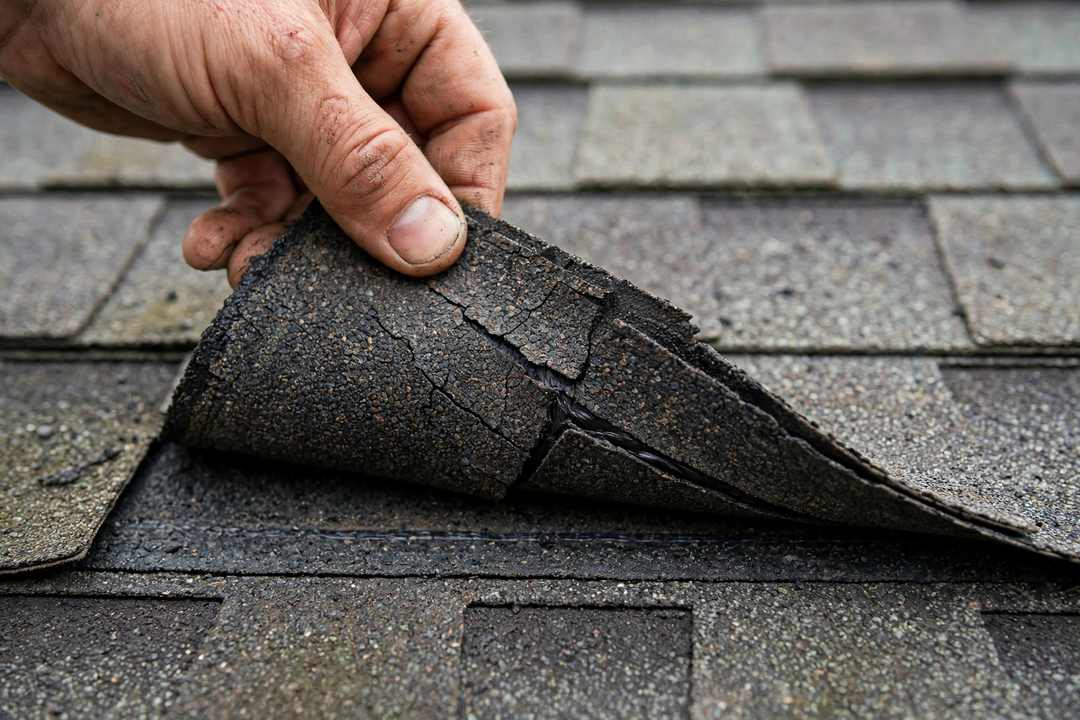
Wind hides its damage the same way. A lifted tab folds back down and looks seated, but the seal under it is broken and the fold left a crease in the mat. From the street the slope looks whole. From six inches away, with a hand under the tab, it is a row of open seams waiting for the next driving rain. This is why storm damage roof repair is an inspection job before it is a repair job. The roof has to be read up close, slope by slope, before anyone can honestly say what the storm did.

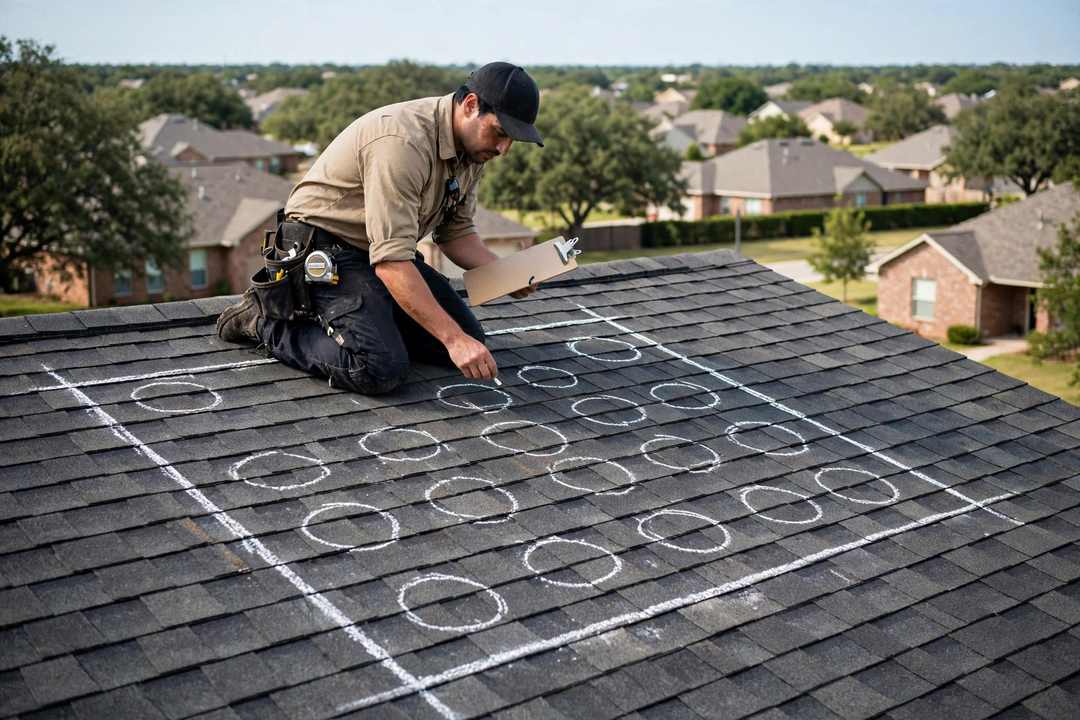
This is the honest answer to the argument we hear after every big storm. The homeowner counts two or three cracked shingles, the roofer says the roof is in bad shape, so who is lying? Sometimes nobody is. A ground level count and a slope by slope inspection are two different measurements. Hits cluster. One slope facing the storm can carry real damage while the slope you see from the street looks untouched. The count is what settles it. Chalk marks, test squares, and photos, not adjectives.
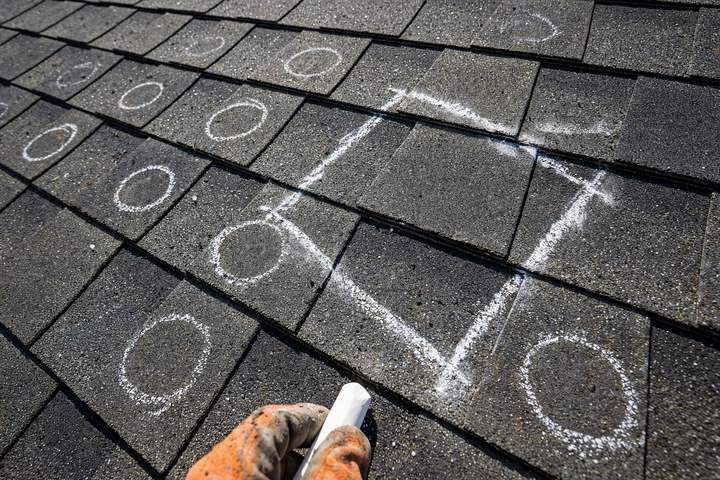
Hail damage on a Texas roof, hits circled in chalk inside a test square
Illustration: hail hits circled in chalk and counted inside a test square. The count, in photos, is the whole argument.

Know your storm

The five ways a Texas storm breaks a roof

Texas storms do not all hit a roof the same way, and storm damage roof repair is not one job. It is five different jobs wearing the same name. Hail breaks from above. Wind breaks from the edge. Trees break by weight. Driven rain breaks by finding seams. Loose debris breaks whatever it lands on. Knowing which one hit your house changes what gets checked, what gets fixed, and what can honestly wait. The sections below take each one in turn, in the order Texas homeowners meet them.

Hail: the hit that hides

Hail is the most common storm damage in Texas and the hardest to judge from the ground. A hailstone strikes straight down. It knocks granules loose, dents the surface, and on a hard hit it cracks the fiberglass mat inside the shingle. The shingle does not split open like a plate. It bruises, the way a knock bruises fruit under unbroken skin. The bruise is soft when pressed. It sheds its granules over the following weeks. Then the sun works on the bare spot, the mat dries and cracks further, and a shingle that should have lasted years starts letting water through.

Size matters, and the roof keeps the record. Small hail, pea size and under, mostly scuffs a healthy roof and knocks loose grit that was already letting go. Hail around an inch across starts bruising mats, especially on older shingles that have gone brittle in the Texas sun. Bigger stones, the kind that dent car hoods and crack vent caps, can fracture mats across a whole slope in minutes. Soft metals tell the story first: ridge caps, vent covers, flashing and gutters dent at sizes that also hurt shingles, which is why a storm damage roof repair inspection always reads the metal before it judges the shingle field.

Hail also picks its slope. A storm moving through drops its hardest stones on the faces turned toward it, so one or two slopes can be beaten while the rest of the roof looks clean. A crew that checks only the street side can miss the damaged slope entirely, and a crew that condemns the whole roof from one beaten slope is guessing in the other direction. The count, per slope, in chalk, is the only honest middle.

Wind: the lift that lets go later

Wind does not need to tear a roof apart to damage it. It works at the edges, the ridges, the corners, and any tab whose seal has weakened with age and heat. A gust gets under a loose edge, lifts the tab, and either tears it away or folds it back. The torn ones are easy: they land in the yard or the street. The folded ones are the trap. The tab settles back into place and the roof looks whole, but the fold cracked the mat along the crease and the seal strip that held the tab shut is broken. That shingle is now a flap. The next storm lifts it again, rain gets under it, and the leak starts months after the wind that caused it.

Wind damage clusters in patterns a trained eye reads fast. Corners and rakes take the worst of it, because wind speeds up as it turns a corner. Ridges lose caps. Old roofs lose more tabs than young ones, because their seals have baked through more summers. After a wind storm, storm damage roof repair means walking the edges and testing seals by hand, tab after tab, replacing the creased and torn shingles and resealing the ones that lifted without cracking. A shingle that lifted and laid back flat is not undamaged. It is unsealed, and unsealed is a leak with a delay on it.

Fallen trees and limbs: the weight problem

A limb on a roof is not just debris. Think of it as weight resting on boards that may already be cracked, shifting a little with every gust. A big limb can punch straight through the deck and open the attic to the sky. A smaller one can crack rafters and deck boards without breaking the surface, so the roof looks bruised rather than broken, right up until the next rain finds the split. Live oaks are the usual source around Austin: heavy limbs, wide canopies, and wood that comes down in storms even from trees that looked healthy.

The order of work after a tree hits matters more than the speed of it. Power lines come first, before anyone touches anything: a downed line in a wet yard is the most dangerous thing a storm leaves behind. The limbs holding the tree up do not get cut, because a trunk resting on a roof is balanced on those limbs, and cutting the wrong one lets the whole weight shift and roll. Clear only enough to see the damage. Then cover the opening. Our storm damage roof repair crews treat a tree hit as two jobs in one visit: make the structure safe, then make the roof watertight. Cutting and hauling can wait for daylight and the right crew.

Driven rain: the leak that climbs

Rain on its own rarely beats a sound roof. Rain pushed sideways by storm wind is a different force. It climbs. It runs uphill under laps, into joints, and through gaps that falling rain never tests, which is why a roof can sit through a dozen soft rains and leak badly in one named storm. Valleys, chimneys, vent pipes, and the joints where a roof meets a wall take the worst of driven rain, because those are the places where water is channelled and pushed at once.

Driven rain damage often looks like no damage at all. Nothing is torn and nothing is missing. The water simply went somewhere it should not, soaked the underlayment and deck edge, and left. The signs show inside: a stain that appears only in hard weather, a drip that starts when the wind picks up and stops when it drops. Storm damage roof repair after driven rain is mostly tracing work, following the water back to the joint it climbed through, then sealing and refastening that joint so the next storm finds it shut.

Debris and everything the wind carries

A Texas storm throws things: dead branches, fence panels, trampolines, loose patio gear, and shingles torn from the house across the street. Debris damage is impact damage. It cracks shingles, dents metal, punctures the surface, and sometimes drives a branch end through the deck like a spear. It also scatters. One heavy strike in the middle of a slope can crack a ring of shingles around the point of impact, and the grit knocked loose by the blow washes off for weeks.

After a debris storm, the check has to cover the whole roof, not just the spot under the branch you can see. Look for punctures, cracked and displaced shingles, and anything still resting on the surface. A branch left lying on a roof keeps grinding its spot in every gust and holds moisture against the shingles under it. Moving debris off a roof is roof work, not yard work, when the roof is steep, wet, or damaged underfoot. That is a line storm damage roof repair crews do not bend: the ground work is yours, the roof work is ours.

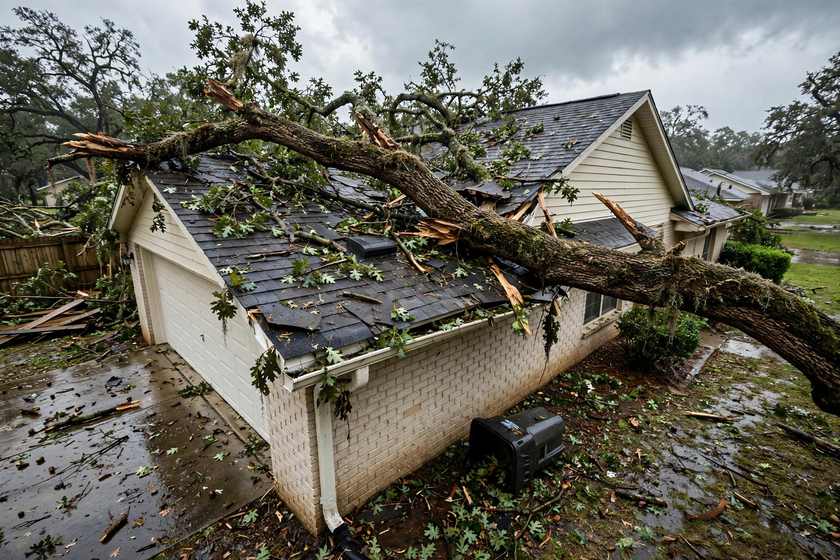
A fallen oak limb resting on a storm damaged roof in Texas
Illustration: a limb down on the roof. Weight first, watertight second, cutting last.

Hail sizes

How big does hail have to be to hurt a roof?

This is the question every Texas homeowner asks the morning after, usually holding a handful of melted stones. The honest answer is a ladder, not a line, because the same stone does different work on a young roof and an old one.

Pea size hail, under a quarter inch, mostly scuffs. It knocks loose grit that was already letting go and rattles the gutters. A healthy roof shrugs it off. Marble size, around half an inch, starts to matter on older shingles whose mats have gone brittle in the sun. Quarter size, about an inch across, is where bruising becomes common: stones at this size dent soft metals, and a mat that dents under a stone is a mat that can fracture. Golf ball size and up, an inch and three quarters and beyond, breaks things in the open: fractured mats across whole slopes, cracked tiles, split vent caps, and punctures where a stone landed on an edge or a seam.

Age moves every one of those lines. A five year old roof can take quarter size hail that would bruise a fifteen year old roof, because the young mat still bends where the old mat snaps. Slope direction moves them too: the face turned into the storm takes the stones at full speed, while the sheltered face may only catch them spent. This is why storm damage roof repair never judges hail by the stones in the yard alone. The stones set the suspicion. The test square, the pressed thumb, and the dented metal settle it. And it is why the freezer bag matters: the size of the hail that fell on your street is evidence, and evidence is what the whole count stands on.

Your own first read

Reading your own roof from the ground: the five minute walk

You cannot inspect a roof from the yard, but you can read it, and a good read tells you whether to call tonight, book a check, or relax. Do it in daylight, after the ground dries, in this order.

Start across the street, where the whole street facing slope fits in one look. Sight along the lines of the shingles. A sound slope reads flat and even. Storm damage breaks the pattern: a tab standing at an odd angle, a dark patch where shingles are gone, a ridge line that dips or lifts, caps missing at the peak. Photograph the whole slope before you move. Then walk the near side slowly and look at the edges, because edges are where wind starts its work: corners lifted, the first course along the eaves uneven, flashing at the wall joints peeled back a finger's width. Move to the sides and the back the same way, one slope at a time, photographing each. The back slope is the one nobody photographs and the one storms often choose.

Finish at the evidence on the ground. The gutters and the downspout mouths hold the grit count: a handful of granules after a storm is wear talking; a pile is hail talking. The yard holds the rest: tabs, cap pieces, a vent cover, branches, and anything that used to be on the roof and is not any more. Count what is down. Every piece in the yard is a gap somewhere above. Then step inside and match the walk to the ceilings, room by room, under each slope you just read.

What does a good read earn you? The right call, at the right size. Bare deck, a hole, water inside: that is tonight, and it is storm damage roof repair at emergency speed. Damage you can see but a dry house: that is a booked inspection this week, while the evidence is fresh. A clean read, flat slopes, quiet gutters, dry ceilings: that is a roof that rode the storm out, and you hold the dated photos that prove it, which is its own kind of win. The walk never replaces the count on the roof. It decides how fast the count needs to happen, and it stops a small problem spending a season becoming a big one.

More weather coming

When the next storm is already on the radar

Texas storms rarely travel alone. They arrive in lines and clusters, three wet days in a row, a second front behind the first. So the morning after a storm, the forecast is part of the repair plan. If more weather is coming before the permanent fix can happen, the order of work changes: openings get covered first, even roughly, because a rough cover tonight beats a perfect repair scheduled after the next rain. Loose debris comes off the roof so the wind cannot throw it twice. Lifted tabs near edges get secured where they can be reached safely, because the second storm starts its lifting where the first one loosened.

This is also where a calm head saves a roof. A forecast is not a deadline to sign anything under. It is a reason to cover, photograph, and book in that order. Storm damage roof repair crews who work Texas springs plan around the radar as a matter of routine: cover in the dry hours, count in the clear ones, repair when the roof can dry and bond. If a crew uses the next storm as pressure to sign tonight, they have told you the forecast is a sales tool to them. To us it is a work schedule, nothing more.

First hours

What to do in the first hours after a storm

The first hours of storm damage roof repair decide two things, how much water gets in, and how good your record of the damage is. The order matters. None of it involves a ladder while the ground is still wet. Our guide to the first 24 hours goes deeper on each step.

1Wait until it is safe to move around.

Downed power lines, leaning trees, and sagging ceilings are the real dangers after a storm, not the roof. If a line is down or a ceiling is bowing, keep everyone out of that room until it is checked. A wet yard hides live wires under branches, so treat every fallen line as live until the power company says otherwise.

2Photograph everything before anyone touches it.

The roof from the ground, debris in the yard, hailstones next to a coin for size, stains and drips inside. Timestamps on phone photos make them a dated record. Once a repair starts, the before is gone for good. Shoot wide first, then close, then the room under the damage.

3Check the attic and ceilings, and catch the water.

Buckets under drips, towels at the baseboards. If the ceiling bulges, it is holding trapped water. Bucket underneath, one small hole at the lowest point with a screwdriver, and let it drain on your terms. Move what water ruins: electronics, papers, anything fabric, up high and away from the wet patch.

4Get the opening covered.

A tarp stops more damage while the permanent repair is arranged. A limb through the deck, a torn off section, any hole you can see sky through: that opening is tonight's job, not next week's. Our emergency tarping page is built for this moment.

5Do not climb up there.

Stay on the ground. A wet roof gives your boots nothing to hold, storm-loosened decking can drop you without warning, and loose grit and branches cover holes your sole will never feel. The useful work tonight is indoors and at ground level anyway. Morning will find the roof waiting, and you unhurt.

6Do not sign anything at the door tonight.

Big storms pull in out of town crews who knock, promise, and pressure. A real emergency gets handled without a signature under time pressure. Our emergency roof repair page lists the storm chaser warning signs in full.

One more thing about the first hours: keep the hailstones. If hail did the damage, put a few stones in a bag in the freezer next to a coin in the same photo. Stone size fades from memory within a day, and the size of the hail is half the argument about what the storm could and could not have done to the mat inside your shingles. It takes one minute, and it is the kind of record no storm damage roof repair inspection can recreate later.

And talk to your neighbours, briefly, before the week scatters everyone. Storms are strangely local: one street takes the hail core, the next street over gets rain and a story. Knowing which streets around you took damage, and roughly when the worst of it passed, sharpens your own record. If three houses on your block lost tabs and yours lost none that you can see, that is a reason to book the count anyway, because your roof stood in the same wind. Neighbours are also the first to know which crews knocked, what they said, and who actually lives in town. After a storm, the street itself is a reference list, if you ask it while it still remembers.

The counted check

The storm check, step by step

Here is exactly what one of our storm inspections produces, because "trust us, it is bad" is not evidence. A storm damage roof repair check is a method, not a walk around. It runs the same way on every roof, so the result can be compared, questioned, and checked by anyone who wants a second look.

1Walk every slope.

We walk every slope, not just the one facing the street. Storm damage picks its faces, and the slope you cannot see from the road is often the one that took the storm. Every slope gets the same time, the same tests, and its own count.

2Chalk and count.

Every hit gets circled in chalk and photographed close up. On hail calls we mark a test square on each slope and count the hits inside it, the same counted method every slope gets, so the numbers can be checked. Hits per square, per slope, in writing.

3Lift and test.

We lift tabs to check for creases and test whether old shingles snap instead of bend. A crease you can feel is damage a photo from the ground will never show. Brittle shingles change the repair plan, because a patch that cracks its neighbours is not a repair.

4Check the attic.

The roof tells half the story. The attic tells the other half: water trails on the deck boards, daylight at a puncture, wet insulation under the damaged slope. We read the attic against the slope counts, so an inside stain and an outside hit get matched or ruled out honestly.

5Hand over the count.

Then you get the count, slope by slope, with the photos attached. What is broken, what is bruised, what is fine, each in its own list. The photos are yours. Show them to anyone. A count that cannot survive a second pair of eyes is not a count worth having.

And the promise that goes with it: if the honest count is three damaged shingles, we say three damaged shingles, and we repair three damaged shingles. If the count says a slope is done, the photos will show you why before we ever use the word replacement. That is the standard on every storm damage roof repair job we take. Evidence first, adjectives never, and the decision stays yours.

Roofer counting chalked hail hits inside a marked test square in Texas
Illustration: the counted check. Chalk, a test square, and a number per slope.

The quiet damage

The damage that shows up six months later

The most expensive storm damage is usually the kind that passed inspection day looking fine. A fractured mat does not leak the week of the storm. It leaks after months of Texas heat have worked the crack open, or in the first driving rain of the next season, and by then the ceiling stain gets blamed on anything but the storm that caused it.

Granule loss runs the same quiet clock. Every handful of grit in the gutter is roof life gone, and a hail thinned roof ages faster from that summer on. The granules are not decoration. They are the shield that keeps sun off the asphalt and the mat. Strip them early and the shingle underneath ages in dog years: it dries, curls at the edges, and cracks along the lines where the hits landed. A slope can lose years of life in one storm without losing a single shingle.

Lifted seals run the third clock. A tab lifted by wind and settled back looks repaired. It is not. The seal strip is broken, and every hot afternoon works the tab a little looser, because the shingle expands and shifts against a bond that no longer holds. The next strong wind does not have to lift it from a sealed start. It starts from a loose one. That is how a roof that survived the spring storm loses shingles in the autumn one, and why storm damage roof repair includes resealing and replacing lifted tabs now, while the fix is small.

So give a storm roof a checking rhythm, not a single look. At one month, walk the ceilings again and look at the downspout mouths: fresh grit a month on means a bruised slope is still shedding, and a stain that has grown since the storm means water found a road in. At three months, after a few hard rains have had their turn, check the attic smell and the same ceilings once more. Most delayed storm leaks declare themselves inside that window, while the trail back to the storm is still warm and the fix is still small. A roof that stays dry and quiet through both checks has most likely told you the truth back on inspection day. A roof that has not, has told you something better: where to look, early, while storm damage roof repair is still a patch and not a project.

That is why a post storm inspection is worth having even when nothing is dripping today. It is the simplest end of storm damage roof repair: a count, a set of photos, and a dated record of what the storm actually did. If the count comes back clean, you hold proof of that too, and proof of a clean roof is worth having the next time a storm rolls through and the knocks start at your door.

Two different jobs

Wind damage and hail damage are different jobs

They often arrive in the same storm, but they break a roof in different ways, and they get repaired differently. Knowing which one hit your roof changes the repair plan.

Wind damage. Wind gets under the edge of a shingle and lifts it. Sometimes the tab tears off and lands in the yard. More often it folds back, cracks along the crease, and lays down again looking normal, but the seal that held it shut is broken and the crease is a crack waiting for the next storm. Wind repair means checking the seal on every lifted tab, replacing the creased and torn ones, and resealing what can honestly be saved. Wind damage turns on that seal. A shingle that lifted and laid back flat is not undamaged, it is unsealed.

Hail damage. Hail hits from above. It dents soft metals, knocks granules loose, and, the part that matters, bruises or fractures the fiberglass mat inside the shingle. Hail repair means replacing the shingles whose mats are broken, slope by slope, based on a counted inspection, not on how the roof looks from the street. Hail turns on the count and the date. Hits per test square, matched against the storm that passed over your address. No date, no record, which is one more reason the photos cannot wait.

A creased shingle lifted by hand after wind damage in Texas
Illustration: a creased shingle, lifted by hand. The fold is cracked and the seal is gone, even though the tab lays flat again afterward.

Read the two side by side and the repair logic sorts itself out. Wind damage is repaired at the level of the tab: reseal this one, replace that one, check the whole edge. Hail damage is repaired at the level of the slope: count the hits, judge the mat, replace what the count condemns. A crew that treats hail like wind will reseal bruised shingles and call it done. A crew that treats wind like hail will condemn slopes over a handful of lifted tabs. Storm damage roof repair done right starts by naming which storm force did the work, then repairs at the level that force demands.

Know your roof

Storm damage by roof type

The storm does not ask what your roof is made of, but the damage it leaves depends on the answer. Four roof kinds cover most Texas homes, and each one fails in its own way, gets checked in its own way, and gets repaired in its own way.

Shingle roofs

They take the full list: bruised mats from hail, lifted and creased tabs from wind, punctures from debris. They are also the easiest roofs to read honestly, because the chalk and test square method was built for them. Storm damage roof repair on shingles is a counting job: hits per square, creases per edge, then repairs sized to the count. One slope can be beaten while the rest of the roof is sound, and the repair can be just as local.

Metal roofs

They shrug off hail that would bruise shingles, but they dent, and their storms work the seams and fasteners. Wind worries a metal roof at its edges and joints: panels lift at the seams, screws back out a fraction with every heat cycle, and a storm can open a seam that then drinks driven rain for months. The check on metal is seams, fasteners, and dent depth over the deck. A dent that did not bend the panel over a seam is cosmetic. A lifted seam is a leak with good manners, quiet until it is not.

Tile roofs

They hide their storm damage best of all. The tile is a shield; the felt under it is the waterproof layer. Hail and debris crack tiles, wind slides them, and a limb can break a run of them, but the leak starts when the felt underneath is torn or has aged out where a tile moved. From the street the roof looks perfect while water runs under it. Storm damage roof repair on tile means lifting tiles carefully, reading the felt, and replacing both where the storm broke through. It is slow work, and broken neighbours are the risk in every step.

Flat and low slope roofs

They fail by ponding. A storm drops debris into drains, wind pushes water under laps, and hail can split a surface that then drinks rain for hours. The water sits, so a small opening feeds a large wet area, and the drip inside can land rooms away from the hole. The check on a flat roof starts at the drains and the low spots: standing water a day after the storm is the roof confessing. Covers work differently here too, because a loose sheet over a pond is just a lid on the pond.

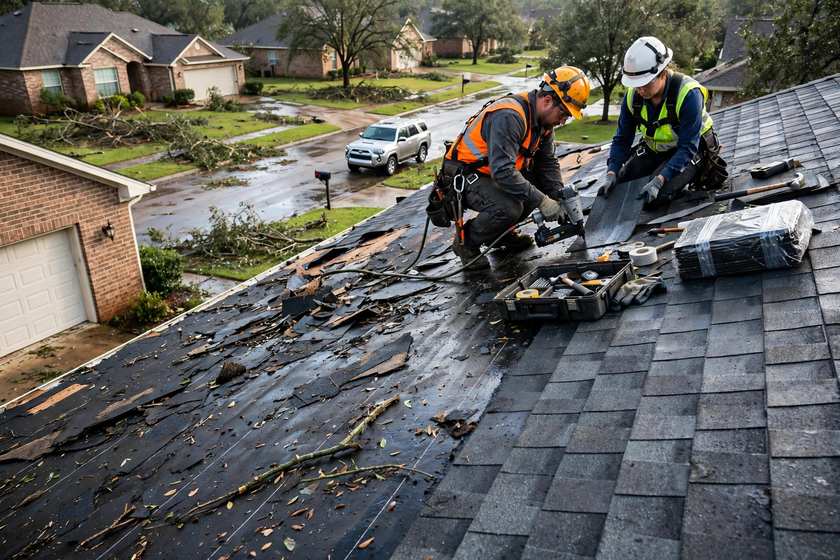
Crew repairing one slope of a storm damaged Texas roof
Illustration: one slope at a time. Damaged shingles off, deck checked, new shingles on. Repair at the scale the damage calls for.

Whatever the roof is made of, the order of storm damage roof repair stays the same: make it safe, cover the opening, count the damage, then repair at the scale the count calls for. The material changes the details. It never changes the order.

Part by part

The parts of the roof a storm tests

A roof is not one surface. It is parts, each with its own job, and a storm tests every part at its weakest point. Reading a storm damaged roof means reading the parts in turn.

Ridge caps sit on the peak, bent over the joint between two slopes, and wind worries them first because the peak catches the full force of a gust. A storm that takes caps opens the very top of the roof, and rain that gets in at the ridge travels far before it shows. Valleys carry the water of two slopes at once, so they collect debris, and a valley dammed with branches and leaves pushes water sideways under the shingles beside it. Flashing, the metal work around chimneys, walls, and vents, fails by lifting: wind peels an edge, driven rain enters the gap, and the leak appears below the chimney like the chimney itself is crying. Pipe boots, the rubber collars around vent pipes, crack with heat and age, and a storm often finishes what the sun started, so a post storm leak at a boot is half storm, half birthday. Vents and turbines dent under hail and spin loose in wind, and their dents are the measuring tape for hail size on the whole roof. Gutters bend, fill with grit and leaves, and overflow against the fascia boards, soaking the edge of the deck from below. The deck itself, the boards under everything, only fails when something heavy lands or water sits for months, but when it softens, every layer above it loses its footing.

A storm damage roof repair inspection that only reads the open shingle field misses most of this list. The field is the toughest part of the roof. The parts are where storms win, so the parts are where the count starts.

Shops and offices

Storm damage on shops, offices, and flat commercial roofs

Most of this page is written for houses, but the same storms cross the same streets and land on shops, offices, warehouses, and church halls, and callers ask how to repair storm damage on a commercial roof often enough that it earns its own lines. The forces are identical. The roof is not. A commercial roof is usually flat or nearly flat, covered in a membrane or built up layers rather than shingles, and crowded with things a house roof never carries: air conditioning units, vents, exhaust fans, sign mounts, and drains set into the surface itself.

Storm damage there shows differently. Hail splits and dents the membrane and crushes the insulation board under it, leaving soft spots that hold water. Wind gets under seams and at the perimeter edge, and a peeled seam on a flat roof can open yards of covering in one gust. Debris blocks the internal drains, and a flat roof with blocked drains becomes a pond, and a pond is heavy: water weighs on the structure hour after hour until it finds or makes a way down. The check follows the same order as a house, safety, cover, count, but the counting is done in seams, splits, soft spots, and drain lines rather than test squares. Storm damage roof repair on a commercial building also has one extra clock: the business inside it. A covered opening and a dry interior matter by morning, not by next week, and the written scope has to say plainly what is temporary and what is permanent, so nobody mistakes the bridge for the fix. The names change, the order does not: that is storm damage roof repair wherever the storm lands.

Age changes the answer

An old roof and a young roof do not take the same storm

Ask two neighbours what the storm did and you will hear two different storms, because the age of the roof rewrites the damage. A young roof, under ten years, has mats that still bend, seals that still grip, and granules still thick on the surface. Hail that would fracture an old mat dents a young one and stops. Wind that would strip an old edge lifts a young tab and lets it reseal. Storm damage on a young roof tends to be honest and local: the puncture, the torn section, the one slope that faced the weather.

An old roof, past fifteen years in Texas sun, is a different material wearing the same shape. The mats have gone brittle. The seals have baked through so many summers that some tabs are held by habit more than bond. The granule coat has thinned, so every hit lands closer to the mat. On an old roof, a middling storm does widespread work: bruises everywhere the stones landed, seals broken along every edge the wind worried, and shingles that snap in the lift test whether the storm touched them or not. That is not the storm being worse. That is the roof being older.

Why does this belong on a repair page? Because it changes what a fair count looks like, and it protects you in both directions. On a young roof, a crew reporting damage on every slope after a modest storm should have to show you extraordinary proof. On an old roof, a crew reporting that one small patch fixes everything should have to explain the brittle lift tests and the broken seals they walked past. Age is the context the count gets read in, and any storm damage roof repair conversation that skips the age of the roof is skipping the fact that decides half the argument.

The honest call

Repair it or replace it? How that call should be made

After a storm, this is the decision everything else hangs on, and it should be made from the roof, not from a sales script. No competitor page we have read lays this call out plainly, so here is the framework our storm damage roof repair crews actually use, in the open, where you can hold us to it.

The first question is whether the damage is functional or cosmetic. A dent that did not break the shingle mat is cosmetic. It looks rough and shortens nothing. A fractured mat is functional damage. That shingle will fail years before its neighbors, whether it leaks today or not. Cosmetic damage gets photographed and left alone. Functional damage gets repaired or counted toward replacement. Any crew that mixes the two piles together is inflating one of them.

Then it is about spread and age. Damage scattered across most slopes, or an old roof whose shingles snap when lifted for a repair, points toward replacement. Patching brittle shingles can do more harm than the storm did. Damage on one or two slopes of a sound roof points toward repair, full stop. One more thing homeowners rarely get told: shingles get discontinued. If yours are, a repair may not match the rest of the roof. That is worth knowing before work starts, because a patch that stands out is still a patch.

Age cuts both ways, and an honest crew says so. A young roof with one beaten slope is a repair, plainly. A roof in its last years, with seals failing on every slope before the storm ever arrived, may not be worth scattering repairs across, because each repair disturbs brittle neighbours and buys months, not years. The storm did not make that roof old. It just gave the owner a decision to make with the roof open. The evidence for that decision is the lift test and the count, and both should be in your hands, in photos, before the word replacement is spoken.

And one boundary we hold on every storm damage roof repair call: the size of the job follows the size of the damage, never the other way round. A repair measured in shingles gets a repair. A slope measured in test squares full of fractured mats gets a slope. A roof whose count fails on every face gets an honest conversation about replacement, with the photos on the table. If a crew's answer is the whole roof before they have counted a single square, you are not hearing an inspection result. You are hearing a sales target.

Two houses on the same street show how the framework lands. The same hailstorm crossed both. On the first house, nine years old, the count found one beaten slope: test squares full of fractured mats on the storm face, clean squares on the sheltered faces, seals sound elsewhere. That house got a slope. One slope of new shingles, matched as closely as the line still allows, and the rest of the roof left alone with years of life in it. On the second house, twenty one years old, the squares failed on three faces, and the lift test snapped shingles on the fourth. Repairing that roof would have meant disturbing brittle shingles on every slope to fix damage on every slope. That house got the honest conversation, photos on the table, counts in writing, and a decision the owners made over a week, not a night. Same storm, same street, two different answers, both of them storm damage roof repair done at the size the evidence called for.

The honesty check

After the storm, the knock: how storm chasers work

Problem map research puts this fear first for a reason: after every big Texas storm, the knock comes. A friendly stranger, working just down the street, who would love a look at your roof. Some are honest roofers drumming up work. Some are storm chasers who follow hail maps the way other crews follow weather, and they find damage whether the storm left any or not. You do not have to guess which kind is at your door. Their methods give them away.

  1. The doorstep inspection pitch. The visit starts with an inspection offered at the door, on the spot, with nothing in writing. The inspection itself is not the problem. The problem is what it is for: getting a signature before you have seen a single photo. An honest crew will book the check, do the count, and hand you the evidence first. Ask: will I get photos and a written count before I sign anything? The answer sorts most doors in ten seconds.
  2. Marks that were never hail. Fabricated damage is real after big storms: chalk circles drawn where no hit landed, normal wear and blistering pointed at as storm hits, and in the worst cases, shingles worked by hand until they crack, so the crack can be photographed as hail. Real hail leaves a pattern: random hits, matched on soft metals, counted in squares. Ask to see the dents in the vent caps and flashing. Hail that fractured shingles also marked the metal. Clean metal and a ruined roof do not travel together.
  3. The whole roof, every time. A chaser's inspection has one destination. The count is never three shingles. It is never one slope. Whatever the storm did, the answer is a full replacement, announced fast, often before the ladder is down. Real storm damage roof repair comes in sizes, and most of it is small. A crew that cannot describe a repair smaller than a roof is not describing your roof. They are describing their target.
  4. Pressure with a clock on it. Sign tonight. The offer dies at midnight. The crew is only in the area this week. Every version of the hurry has the same job: stop you comparing, checking, or sleeping on it. Real damage keeps until morning, and a real roofer will still be in town next month. Ask for the local address and three recent jobs nearby. A chaser's address is a motel or a mailbox. A local crew's address is a street you can drive to.
  5. The vanishing act. Storm season ends, the trucks leave, and the patch that lifts in October has nobody to call. This is the quiet part of the chaser problem: not the signature, the absence after it. Before any storm damage roof repair work starts, know who stands behind it in six months. Local address, local jobs, a name that answers its own phone. Those three checks take five minutes and they outlast every pitch.

Our crews pass the same tests we just handed you, and we will answer every one of those questions before we climb. Texas has no state licence for roofers, so a card and a truck prove nothing after a storm. Proof is a count, photos, a written scope, and an address that stays put. That is the standard for storm damage roof repair in Texas, for us and for anyone you let on your roof.

The bridge

Tarping after a storm: the bridge, not the fix

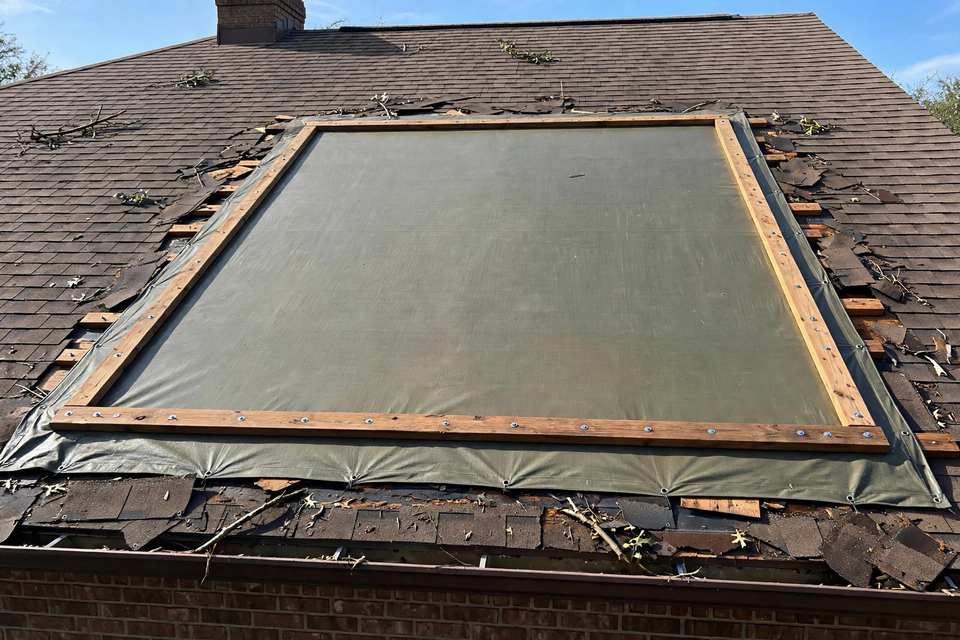
Between the storm and the permanent repair sits the tarp, and storm damage roof repair leans on it hard. A tarp fitted well, flat, tight, running about four feet past the damage on every side and held with battens screwed down, not just nails, keeps a broken roof dry for about 30 to 90 days. That window is the breathing room in which the count happens, materials arrive, and the real repair gets booked in dry weather.

A tarp fitted badly is worse than none, because it promises dry and delivers a sail. Wrinkles channel water instead of shedding it. Loose edges lift in the next gust, and a lifting tarp can tear shingles off with it as it goes. Size matters too, in both directions: a tarp that stops at the damage lets wind driven rain under its edge, and a tarp that swallows half the roof for one torn shingle is a decision worth questioning out loud, with photos of the damage under it. Right sized, flat, battened, checked from the ground after every hard wind: that is the whole craft. Our emergency tarping page covers the method in full, the sizes, the fixings, and how long a cover can honestly stay up.

A word on the other covers you will see after a storm, because callers ask. Felt paper, the roofer's underlayment, is a real emergency cover for a small, clean hole: nailed down over the opening, it sheds water well and holds for a few months before it starts to tear, roughly three to four in working roofers' experience. It is not a slope sized answer and it is not a season long one, but for one puncture it can be the right first skin. Plastic sheeting is the weakest of the three: fine for a night over a small hole, tucked under a lifted shingle at its top edge so water runs over it and not under it, and ready to shred the first time the wind worries it. The tarp is the only cover built for weeks of weather. Knowing which cover a storm damage roof repair crew reaches for, and why, tells you a lot about whether they are bridging to a repair or just covering the conversation.

A battened tarp covering storm damage on a Texas roof
Illustration: the bridge between the storm and the repair. Flat, battened, and checked from the ground after every hard wind.

Leak tracing

When the storm leaves a leak behind

Some storm damage announces itself as a leak days later: a stain after the next rain, a drip that starts when the wind drives water under a lifted tab. That leak is storm damage with a delay on it, and it gets traced, not guessed at. Water enters high, at a lifted seam, a cracked boot, an opened valley, then travels along the boards before it drops, sometimes eight feet from where it got in. The stain is where the water gave up, not where it entered.

So a post storm leak starts in the attic, following the trail up to the highest wet mark, then matches that mark against the slope counts from the storm check. When the entry point is a storm opened seam, the repair belongs to this page. When the trail leads to a tired boot or a joint that was failing before the storm, that is a leak repair with its own full method, and our roof leak repair page walks it end to end. Either way, storm damage roof repair does not seal the stain and hope. It finds the door the water used, and it shuts that.

The Texas calendar

Storm seasons in Texas: the year in four acts

Texas storm damage has a calendar, and knowing it helps a homeowner read their own roof's year. Spring is hail season in the north and centre of the state: March through June, the months when cold air still meets Gulf moisture over Dallas, Fort Worth, Plano, and down through Austin and San Antonio. Most of the hail days in the records below were earned in those months, and most storm damage roof repair calls in Texas trace back to a spring night. Summer belongs to the coast and the Gulf storms: hurricanes and their remnants push inland with rain measured in inches per hour and wind that works the edges of every roof it crosses, and a Gulf storm can drop a season of driven rain in a weekend. Autumn brings a second, quieter storm season as the fronts return, and it is the season that finds the spring's lifted seals and bruised mats, because autumn rain is patient and driven. Winter is the short act: the odd ice event and freeze in the north, brittle shingles, and pipes that burst in attics and soak ceilings from inside, a leak that wears a roof problem's clothes but starts in the plumbing.

The calendar matters because damage and discovery rarely share a season. The storm does its work in spring. The heat opens the cracks in summer. The leak announces itself in autumn. A homeowner who knows the acts stops blaming the nearest rain and starts asking the better question: which storm, in which season, started this. That question is the first step of every honest storm damage roof repair inspection we run.

Counted records

Texas hail, in real numbers

Texas does not get one hailstorm a year. It gets hail season, year after year, and some cities take far more of it than others. These are counted records, days with hail reports within 15 miles of each city centre, since 2010. Dallas has had 91 hail days. Fort Worth has had 117. San Antonio has had 63. Austin has had 59. Plano, up in the same northern corridor, has had 113. The Dallas Fort Worth area is known as Hail Alley for a reason.

That history is why storm damage roof repair in Texas starts with a counted inspection after a storm, not a glance from the street. A roof that has lived through ten hail seasons can carry old hits next to new ones, and only the count, matched to the storm date, tells them apart. An old bruise and a fresh fracture can look alike in a photo. They do not feel alike under a thumb, and they do not date alike in a record. The dated photos from the first hours, the frozen hailstones next to a coin, the test squares per slope: together they pin this storm's damage to this storm, and that pinning is what makes the repair plan honest.

Hail season also explains the rhythm of Texas roofing. Spring storms beat the roofs, summer heat works the cracks open, and the leaks arrive in autumn rain, months after the cause. A homeowner who connects those three seasons stops asking why the roof leaked in October from a storm in April. The roof did not suddenly fail. It failed on schedule, the storm's schedule, and storm damage roof repair is how that schedule gets interrupted.

Home base

Austin storm notes: the home base picture

Our crews work out of Austin, so this is the storm picture we know street by street. Austin has recorded 59 hail days since 2010, fewer than the northern corridor, but Austin storms arrive with a local twist: the live oaks. Wide, heavy canopies over most older neighbourhoods mean limb damage is a standing part of Austin storm work, and leaf blocked valleys hold water against shingles long after the rain stops. A valley packed with oak leaves is a dam, and the water behind it finds the seams.

Austin heat writes the second half of the story. The same summers that crack vent pipe collars also bake shingle seals, so an Austin roof that took wind five years ago may be one hard gust from lifted tabs today. After an Austin storm, our storm damage roof repair check reads the boots and seals as carefully as the hail count, because here the storm often finishes a weakness the heat started. Austin homes with a storm problem, a leak, or a roof that simply needs honest eyes on it can start on our Austin page.

Service areas

Areas we serve

We handle storm damage roof repair across Texas, with dedicated local pages for the cities below:

Austin

home base for our crews. Hail, live oaks, and heat baked seals.

Buda

fast growing and storm prone, twenty minutes from our tools. Young roofs, and young roofs fail at the details first.

Pilot Point

lake wind and older roofs up north, where lifted edges and hidden leaks are the local pattern.

Plano

113 hail days since 2010 and big roofs under tall trees, in the heart of the northern hail corridor.

Somewhere else in Texas? Call (512) 555-0147. If your town just took a storm, say so. The plan starts with photos either way.

Aftercare

After the repair: the next 30 days

Most pages end at the repair. A storm roof has a month after that matters, because the storm tested everything, not just the spot that got fixed.

Watch the repaired slope in the next rain

The first hard rain after a repair is its real test. Stand in the attic or check the ceiling under the repaired slope while it rains, not after. A dry ceiling in a driving rain is the repair proven. A fresh mark, however small, is a call back, and it is far easier to trace while the weather that caused it is still overhead.

Check the cover, if one is still up

While a tarp holds the roof until the second stage of work, check it from the yard after each hard wind. Edges peeling back, corners snapping loose, or rainwater sitting in a belly all mean the cover has shifted. A shifted tarp wants attention ahead of the next rain, because every fault up there shows from down here.

Walk the yard again at one week

Storms keep dropping their evidence late: a tab that was hanging lets go, grit keeps washing out of the downspouts, a cracked branch finally falls. A slow lap of the yard a week on catches what the first shocked lap missed, and anything new belongs in the same dated photo record as the storm itself.

Keep the paper

The photos, the count, the written scope, the repair record: one folder. It is the history of what this storm did and what was done about it. The next storm, the next crew, the next decision all get easier with that folder on the table, and a roof with a paper trail is a roof nobody can invent damage on.

If a repair on this list fails later, ring the same number again: (512) 555-0147. Work that does not last is ours to return to and put right. A storm damage roof repair crew that stays away from its own repairs has already given you the measure of those repairs.

Questions

Straight answers

No sales talk. The questions every caller asks, answered the way we answer them on the phone:

How soon should storm damage be repaired?

The temporary cover, tarping or a dry in, should happen within a day or two, before the next rain. The permanent repair can usually wait days to a few weeks for dry weather and materials. What should not wait is the inspection. Fractured shingles and lifted seals only get worse, and photos taken late prove less.

What does a storm damage roof inspection include?

We walk every slope, chalk circle each hit, and count damage inside marked test squares, the same method used across the trade, so the numbers can be checked. We lift tabs to test seals and creases, check the attic for leaks, and hand you the photos and the count, slope by slope.

How do I know if hail damaged my roof?

Look for dents in soft metal, vents, flashing and gutters, granules piled at the downspouts, and shingles that feel soft or bruised when pressed. The sure test is a counted inspection. A hail hit can fracture the mat inside a shingle while the surface still looks fine, so a ground level look alone cannot rule it out.

Can I fix storm damage myself?

You can bucket drips, move furniture, and photograph everything. That first hour work genuinely helps. The roof work itself is where do it yourself goes wrong. Wet shingles are slick, damaged decking can give way underfoot, and a patch laid over a fractured shingle hides the damage instead of fixing it.

How long does storm damage roof repair take?

Emergency tarping takes a few hours. A localized repair, one damaged section or a partial slope, is usually a day of work once materials are on site. A full slope runs one to two days, and a whole roof replacement typically two to three. Weather calls the schedule. Permanent work needs a dry roof to bond.

Can storm damage be repaired, or does the whole roof need replacing?

Most storm damage can be repaired. A torn off section, a damaged slope, cracked shingles in one area, those are repairs, not new roofs. Replacement makes sense when damage is spread across most slopes, when the shingles are too brittle to lift and reseal, or when the roof was near the end of its life before the storm hit.

What happens if I ignore storm damage?

Mostly, it waits, quietly. A fractured shingle mat lets a little more water through each season until the ceiling stains. Lifted seals catch the next storm and turn missing tabs into bare decking. Granule loss ages the whole roof faster. Damage that was a small repair this spring is a deck and drywall job by next year.

What should I do right after a storm damages my roof?

Stay clear of downed lines and leaning trees first. Photograph everything before anyone touches it, roof from the ground, debris, hailstones by a coin, stains inside. Catch drips, drain a bulging ceiling into a bucket, and get any opening covered. Do not climb up, and do not sign anything at the door that night.

When should a roof be replaced instead of repaired after a storm?

When the count, not the pitch, says so: fractured mats across most slopes, shingles too brittle to lift without snapping, or a roof already near the end of its life before the storm. One or two damaged slopes on a sound roof is a repair. Ask for the test square counts and judge from those.

How do I spot a storm chaser at my door?

The signs travel together: an inspection pushed at the door with nothing in writing, a whole new roof announced before any count, pressure to sign the same night, and no local address you can drive to. A real crew shows photos, counts in chalk, writes the scope, and is still in town next season.

Storm came through last night?

One call starts the whole chain: photos before anything moves, a roof made watertight, and a written scope for the repair itself, repair sized if that is the honest size.

(512) 555-0147
Call (512) 555-0147