The first 24 hours guide
A plain guide to the worst day a roof can have: what counts, what to do in the first hour, and what can safely wait for daylight.
If water is coming through your ceiling right now, you do not need a lecture. You need the first steps, in the right order, and they are a few lines down this page. If you have ten calmer minutes, read the whole guide. It answers one question from every side: what is an emergency roof repair, how do you know you have one, and what do you do before, during and after the crew arrives. It is written by the Emergency Roof Repair Texas crews who take these calls across Texas, in the same plain words we use on the phone at 2 a.m. The number, if you need it before you read another line, is (512) 555-0147.
Read it tonight, or keep it for the night you need it.
Start here
What is an emergency roof repair? It is the same-day work that stops water getting into a house through a damaged roof: the open spot covered, the leak traced and sealed, the roof made weather-tight until the full repair can be done properly in daylight and dry weather.
That short answer hides two separate tests, and it helps to pull them apart. The first test is water. If rain is getting in right now, through a hole, a torn section or a failed joint, and it is landing inside your home, you are not looking at a maintenance job. You are looking at an emergency, because every hour of rain adds damage that has nothing to do with the roof itself: soaked plaster, wet insulation, ruined floors, mould starting in places you cannot see. The second test is exposure. If the roof is open, decking showing, felt torn, a section gone, then the next rain will get in even if the sky is clear at this moment. An open roof with a dry house is still an emergency roof repair waiting for weather. It just gives you a few more hours to act in. Keep both tests in mind, because what is an emergency roof repair is decided by either one of them, not only by the drip you can already see.
What it is not matters just as much. A ceiling stain that has been there since spring, dry to the touch, with no drip and no rain due, is a repair job, and a real one, but it is not tonight's emergency. A tired old roof with no leak is a planning job. A few curled shingles on a sound roof are a maintenance job. Calling those things emergencies does nobody any good. It panics the homeowner and it clogs the night line for the family whose ceiling is actually coming down. Part of knowing what is an emergency roof repair is knowing what is not, and this guide will keep drawing that line, case by case, because the line is the most useful thing on the page.
One more piece of the definition, the piece the first day teaches you: an emergency repair is a two-part job. Part one happens fast, in whatever weather the storm left behind, and its whole job is to stop the water and make the roof safe. Part two happens later, in daylight, on a dry roof, and its job is to fix the damage properly so the problem does not come back with the next storm. People who expect one visit to do both parts perfectly end up disappointed with honest crews and delighted with careless ones. The tarp is not the repair. The seal in the rain is not the repair. They are the bridge to the repair, and a good crew will say so out loud.
So when you ask what is an emergency roof repair, the honest answer has a shape: water stopped first, house made safe second, damage proved with photos third, and the lasting fix done properly once the roof is dry and checked. Everything in the next 24 hours follows that shape. The rest of this guide walks through it hour by hour.
The signs
Most people do not need the definition. They need their own ceiling translated. Here are the signs our crews hear described on the phone every week, and what each one means. If you are working out what is an emergency roof repair in your own house tonight, match your ceiling to this list before you match it to anyone's opinion.
This is the clearest sign there is. Water that has crossed the roof, the attic and the ceiling has already done a tour of your house, and it is still coming. A slow drip is a small emergency and a fast drip is a big one, but both are the same kind: the roof has an entry point, the entry point is open, and rain will use it for as long as the rain lasts. Bucket first, then the phone. This is what is an emergency roof repair in its most common form, the form that fills most of our nights.
If you can see the sky from inside the attic, or light coming through a ceiling seam that should be dark, the roof is open in the plainest sense. Shingles, felt and decking have all been breached. There is no version of this that waits for a convenient weekday. Even on a clear night, an open roof is an emergency, because Texas weather does not send warnings and the next cell can be over your street before the radar apps agree it exists.
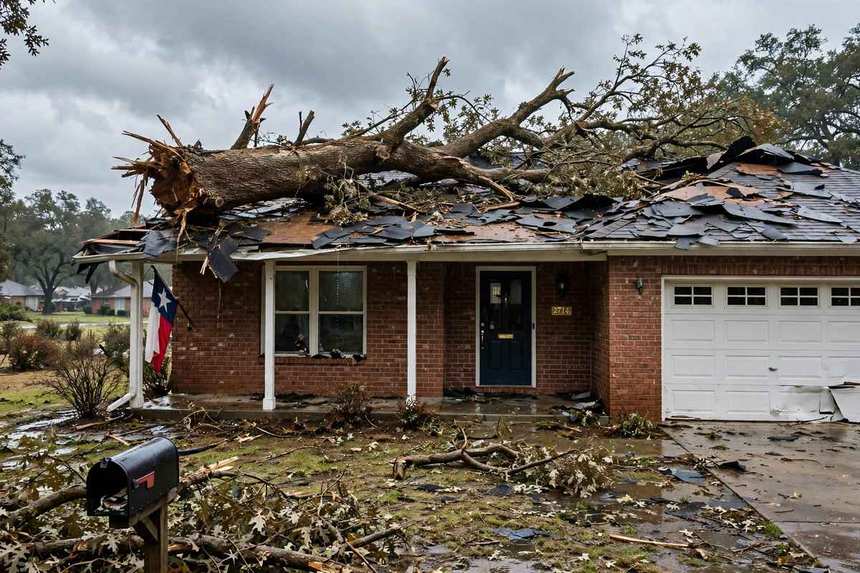
A limb that has punched through is two problems at once: a hole, and a load. The tree is resting weight on boards that are already broken, and wind can shift it. The room under it should be emptied and left empty until the tree is dealt with. This sign has its own full section later in the guide, because the order of work matters and the first step is not the roof at all. It is the power lines.
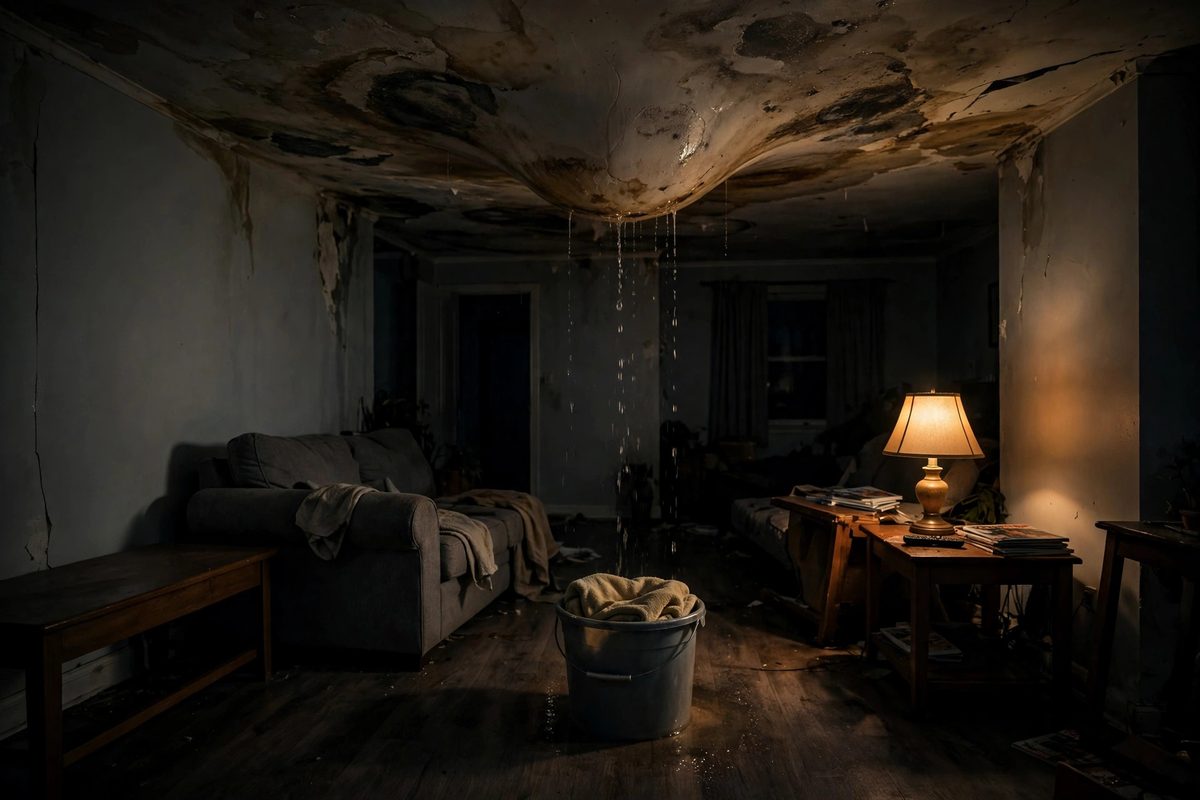
A bulge means water is pooling on top of the ceiling, held up by paint and plaster that were never built to be a dam. A sagging ceiling is holding even more. This is the one sign that can turn from a leak into a collapse, and it has its own decision rule in the first-hour steps below. Read that rule before you touch anything. Small bulge and wide sag are handled in opposite ways, and mixing them up is how ceilings end up on floors.
Water and wiring change the problem from damage to danger. A drip through a light fitting, a wet patch spreading toward a socket, a leak over the breaker box: these are emergencies even when the drip itself is small, because the risk is shock and fire, not just a ruined ceiling. The first step is at the breaker box, not at the bucket, and it is covered as step one of the first hour.
Wind that takes shingles often takes the felt under them, and felt is the roof's second skin. A bare patch of decking or torn felt with rain still falling, or rain due before morning, is an emergency even if nothing has dripped yet. The water is not in the house because it has not arrived, not because the roof can stop it. One gust-driven shower is all it takes.
Flat roofs do not leak the way pitched roofs do. Water sits on them, so a split or an open seam can drink rain for hours and let it out far from the hole, through a ceiling rooms away. If a puddle is still standing on the roof a day after the rain stopped, the roof is telling you its slope or its drain has failed. Ponding plus an indoor drip is an emergency. Ponding alone is a soon job, days not weeks.
A stain with a moving edge is active water, caught in the act. Mark the edge with a pencil and the time. If it moves again in twenty minutes, you have a live leak, and live leaks do not wait for office hours. A stain that has not moved in a month of rain is a different animal, and it is covered in the grey cases below.
Grey cases
Real houses rarely match the clean lists. Most calls sit in the grey area between call now and wait until morning, so here are the cases we hear most, and how our crews call them on the phone. If you are asking yourself what is an emergency roof repair in a house that looks a bit like each of these, start here.
This can wait. Hail bruises shingles from the inside: the stone mat cracks, the grit loosens, and the damage shows up over the following months as early wear, not as a drip tonight. Book a proper check in daylight, get the slopes photographed, and write down the date of the storm while you remember it. What you should not do is sign anything on the doorstep tonight, while the storm is still the loudest voice in the room.
Call now, before the limb moves. It is sitting on deck boards that may already be split under its weight, and one more gust can push it the rest of the way through. Nobody should be in the room below it, and nobody should go up and haul it down either. A bent limb stores force like a spring. Cut it in the wrong place and it whips back, and that whip is what injures people. This is one of the cases where what is an emergency roof repair stretches to harm that has not landed yet but plainly will.
Plenty of homeowners talk themselves out of this one, and they show up again and again in the stories we read. When a drip only appears in a downpour, the cause is usually rain pushed sideways by the wind, slipping under a lifted shingle edge, past flashing worn thin, or through a joint that holds fine until water piles up and runs sideways. None of that makes it harmless. Catch the drip in a bucket, check the ceiling is holding, and it can wait until morning. Do book the tracing soon: every hard rain sends the same water into the same boards, rotting them a little more each time.
The water does not care which room it is in. It is rotting the same boards and feeding the same mould. The only thing that changes is how much furniture you have to move. Treat the leak exactly the same, and use the extra calm to take good photos. Callers sometimes ask if a porch drip really counts when they ask what is an emergency roof repair. It counts. The roof does not know which room it is over.
This one can sit until a dry morning. Under every shingle lies a layer of felt, and felt alone will turn rain for a stretch. That buys time, nothing more. Felt was never made to face the weather, and Texas sun cooks it brittle fast. Leave the bare spot through a season and the felt cracks, and then rain has a straight path in. The questions at the end of this guide take the single missing shingle further.
Call straight away, and before anything else, switch off the power to that circuit at the breaker box. Of every case on this page, this is the one where the roof itself can sit and wait while the wiring cannot. Water running through a live fitting can give you a shock, and it can start a fire. No ceiling in the house is worth either of those.
Book it for the morning rather than calling tonight, but do book it, because this one still earns a proper look. When the light is good, do the daylight round. Walk the yard and look for shingles and loose grit. Stand in the street and read the slopes from there. Then open the attic hatch and breathe. A clean yard, slopes sitting flat and a dry smell in the attic mean the roof most likely came through fine. Grit sitting in the gutters, an edge lifted, or a musty smell up there means book the check now, while the storm is still recent enough to date.
Do not cancel the call. A leak that stops in dry weather is still a hole in your roof, and the next rain will find it again, usually at a worse hour. A stopped drip is good news for your ceiling tonight. It is not a repaired roof. Keep the booking, and use the dry hours to take the photos you could not take in the rain.
This happens more than any other case on this list. Water travelled, dried, travelled again, and the stain only showed when it finally soaked through. It is a tracing job, not a panic job, unless it is moving now. Book it, photograph it, and read the leak page linked near the end of this guide, because the stain is almost never under the hole.
The decision
Here is the same test our crews use on the phone, in its full form. Ask it the way they do: walk the house once, slowly, and look up, not at the floor. Water shows itself on ceilings and high on walls first. Check the rooms under the roof's low edges and under any spot where the roof changes shape, because valleys and joints leak before open fields do. Then run the two lists.
Still not sure? Call (512) 555-0147 and describe what you see. Talking it through settles it faster than staring at the ceiling does, and an honest crew will tell you when your job is a morning job. That honesty is part of the answer to what is an emergency roof repair: the emergency line is for emergencies, and a crew that treats every call as one is selling, not sorting.
If the answer is morning, do the overnight version of the first hour anyway: bucket under anything that might drip, furniture moved, photos taken, and a note of when you first saw the stain. Then sleep. A watched stain and a bucket in place turn a borderline case into a safe one, and the crew that arrives at daylight starts with your photos instead of a cold trail.
The quick version
If you read nothing else before you decide, run this. It takes a minute, standing in the room, looking up.
Ask first about the water: what is an emergency roof repair in this house, tonight, if water is moving through the ceiling right now? It is an emergency, full stop, whatever the size of the drip.
Ask second about the roof itself: what is an emergency roof repair if nothing is dripping yet, but the deck is open, the felt is torn, or a limb is resting on broken boards? Also an emergency. The water simply has not arrived yet, and Texas weather will deliver it.
Ask third about tomorrow: what is an emergency roof repair if the stain is old, dry to the touch, and has not moved through the last two rains? It is not one. It is a booking, made calmly, in daylight, with time to vet the crew properly before anyone climbs.
Three questions, one minute, and you have sorted almost every case this guide covers. The rest of the page exists for the cases that do not sort cleanly, and for the hours after you have made the call.
First-hour manual
The crew is on its way. This hour is yours, and it matters more than most people think. The worst damage in most of these jobs happens indoors, in this hour, not up on the roof. Seven things, in this order. If you take nothing else from this guide, take this hour: it is the practical core of what is an emergency roof repair, the part you control yourself.
Water and wiring do not mix. If drips are falling through a light fitting, running toward a socket, or spreading anywhere near the breaker box, switch that circuit off at the box before you touch anything else. Do not stand in water to reach the box. If the floor is wet and the box is across it, leave the power alone, keep everyone out of the room, and tell the crew the moment they arrive. A dark room is easy to live with for one night. A live one is not.
Get a bucket under the drip and towels down around it, and drag furniture and rugs out of the wet zone. Drop a folded towel into the bottom of the bucket. It kills the dripping noise, and that noise is the thing that keeps the whole house awake at 3 a.m. Small trick, long night. If the bucket fills faster than you like, swap in the biggest container you own and keep an eye on how quickly it fills. That speed matters. It tells the crew how much water is coming through, and it tells you whether your night is holding steady or sliding the wrong way.
If the ceiling starts to bulge, it is holding a pool of water above the plaster. Here is the decision rule, the whole rule, because the two halves of it point in opposite directions and both halves are right. A small bulge that is still growing can be drained on purpose: bucket under the lowest point, one small hole with a screwdriver, nobody standing under it, and let the water run out in a thin stream you control. A controlled drain saves the ceiling. But if the bulge is wide, the ceiling is sagging across a span, or you can see cracks spreading out from it, do not touch it at all. Keep people and pets out of that room and close the door. A ceiling that is letting go needs an empty room under it, not a hero with a screwdriver. Small bulge, drain it. Wide sag, empty the room. That one call is the difference between a drained ceiling and a collapsed one, and it is the single most useful fact in this guide.
Stay on the ground. A wet shingle roof has almost no grip, boards weakened by the damage can break under your weight, and even a bone dry tarp slides under boots. Nothing you could do up there this hour is worth the climb, because the work that protects the house tonight all happens indoors. The roof will keep until daylight, and the point is that you do too. Being sure-footed on a ladder in normal weather does not change this. A storm-damaged roof in the dark is a different surface from the one you stood on to clear the gutters, and it catches experienced people out.
The stain, the drip, the bulge before you drain it, the bucket where it stood, the fallen limb, the shingles in the yard, from the ground and from indoors. Photos taken tonight are proof tomorrow, whatever you decide to do with them. They also help the crew directly: a photo of the drip's true spot, and of the ceiling it falls through, saves real time in the attic, because the crew starts from your picture instead of from a guess. After hail, add one more: a few hailstones in your hand or next to a coin, so the size is on record.
Electronics, papers, books, anything fabric: up high and away from the wet patch. A cardboard box sitting on a wet floor is already lost at the bottom; get what is inside it out. Lift curtains clear of a wet wall. Open the doors of a soaked cupboard so air can move. Work outward from the drip in a widening circle, because water spreads further than it looks like it does, especially under flooring.
(512) 555-0147. A roof letting water in needs roofing hands: tarping gear, proper ladders, harness sense, and an eye trained to find where the water is really getting in. A general handyman is a fine call for a sticking door. For an open roof in the rain, you want the crew that does this every week of the storm season.
One last word on this hour: the attic does not need a hero either. If there are solid boards to stand on and you have a decent torch, one quick look from the hatch can show you which side of the roof the water is entering from, and that is genuinely useful. If the space up there is tight, pitch black or already wet, leave it shut. No detail about a leak is worth putting a foot through the ceiling for, and you will not be telling the crew anything they cannot read for themselves when they get there. Reading the attic is part of every visit we run.
While you wait
Once the buckets are out and the power is safe, the emergency changes character. The first hour is action. The next few hours are watching, and watching done well is real work.
Keep the buckets emptied before they overflow; an overflowed bucket at 4 a.m. restarts the whole problem on the floor below. Take a photo every time the stain grows or a new drip starts, with the time noted, so the crew can see how fast things are moving and in which direction. Water that moves toward a wall is heading somewhere different from water that spreads in a circle, and the photos will show it better than your memory will at daylight.
If the rain stops and it is light out, take photos of the roof from the ground: missing shingles, a lifted ridge, a limb, a tarp edge if one is already up. Do not climb up to look closer. The ground photos are for the record and for the crew's planning, and they are enough.
If the crew is coming tonight, clear the driveway and unlock the gate so they can get ladders to the roof without waiting on you. Move cars out from under the damaged slope if you can do it safely from the ground. Put pets in a closed room. Crews work faster in a house that is ready, and in an emergency, faster is drier.
And if the leak stops when the rain stops, do not cancel the call. A leak that stops in dry weather is still a hole in your roof, and the next rain finds it again, often at a worse hour and in worse wind. This is a point worth pressing, because it is where good nights turn into bad months: the dry spell after a leak is the best time to fix it, not a reason to forget it. Knowing what is an emergency roof repair includes knowing that a quiet roof can still be an open one.
If you are waiting until morning by choice, because your case landed on the wait list, set one alarm in the night to check the buckets and the bulge. Ceilings change slowly and then suddenly. One look at 3 a.m. is a small effort against a collapse at 5.
How we work
Every emergency call we take runs the same four steps, whether it is one torn shingle or half the roof in the yard. Knowing the order helps you judge any crew, ours included, because a crew that runs these steps out of order is telling you something.
Before any repair work starts, the rain has to be shut out. We cover the open area, seal it down and leave the roof weather-tight, so the house stops taking water. On a night call that can be a tarp measured, fitted and battened in the dark, or a patch sealed over the one open spot. We judge it by one simple test: when we step back and look, nothing is getting in any more.
Anything loose comes down before it can fall. Anything dangerous gets dealt with first, and no one works underneath a damaged part of the roof. A limb hanging over the house is either made safe on the spot or left completely alone until it can be taken down properly. Boards that are broken get marked so nobody puts a foot on them. From the ground this part can look slow. It is the reason everything after it can move fast without anyone getting hurt.
Everything that failed gets photographed, and so does everything we do about it, and we walk you through the pictures in plain language before we leave. The split boot. The flashing that lifted. The hole where the limb came through, and the cover now sitting over it. Anything too awkward to photograph, we carry down the ladder and put in your hands. In this trade, proof is not a favour we do you. It is the work itself.
The lasting repair comes last, once the roof has dried out and been checked over properly in daylight. It is written down as a scope before anyone starts, so you can read exactly what will be done. The scope names the parts, the work itself and the order the work runs in. And if that daylight check turns up damage the night visit could not see, it goes in the scope too, with photos, before a single extra thing is done.
That order never changes: stop the water, make it safe, show the proof, then repair. Crews that start with the repair and skip the proof leave you with a dry house and no idea what was done. Crews that start with a sales talk leave you wet. When people ask us what is an emergency roof repair as a service, rather than as a definition, this is the answer: it is those four steps, in that order, every time.
The 2 a.m. version
This is the question the night itself asks, so here is the whole thing as one walk-through, the way it actually happens in a real house.
It is 2 a.m. and something wakes you: a drip, steady, somewhere it should not be. First, do not rush. More people get hurt hurrying in the dark than leaks do damage in the next ten minutes. Torch or phone light on. Walk toward the sound slowly and look up as you go.
You find it: a drip through the ceiling, or a stain spreading, or, worst version, a bulge. Run the first hour in its order, but at night speed. Power first if the water is anywhere near a fitting. Bucket under the drip, towel in the bottom so the house can sleep. Bulge check: small and growing means drain it into the bucket with one small hole; wide or sagging or cracking means everyone out of that room and the door closed. Photos, even bleary ones. Furniture moved. Then the call.
On the phone, say four things: where the drip is, when it started, whether the ceiling is bulging, and whether water is near any lights. Those four facts tell the crew what to load and how fast to roll. If the crew tells you your case can wait for morning, believe them, and do the overnight version: buckets checked once in the night, door closed on any room with a sagging ceiling, alarm set.
What not to do at 2 a.m. is a short list and it matters. Do not climb. Not the roof, not the attic ladder with an armful of towels, not a step stool under a bulging ceiling. Do not move a heavy limb. Do not go outside to look at the roof in the dark and the wet; there is nothing out there you can act on, and there may be a downed line you cannot see. The night version of what is an emergency roof repair is mostly indoor work, done calmly, in the right order. The roof part belongs to the crew, and it will still belong to them at dawn.
It is the hour when the question what is an emergency roof repair stops being something you search and becomes a sound in your own house. By morning, a night leak handled this way looks like a small story: a bucket, a drained bulge, a set of photos, a covered roof. A night leak handled the other way is how ceilings come down and ankles break. The difference is not luck. It is the order of the steps.
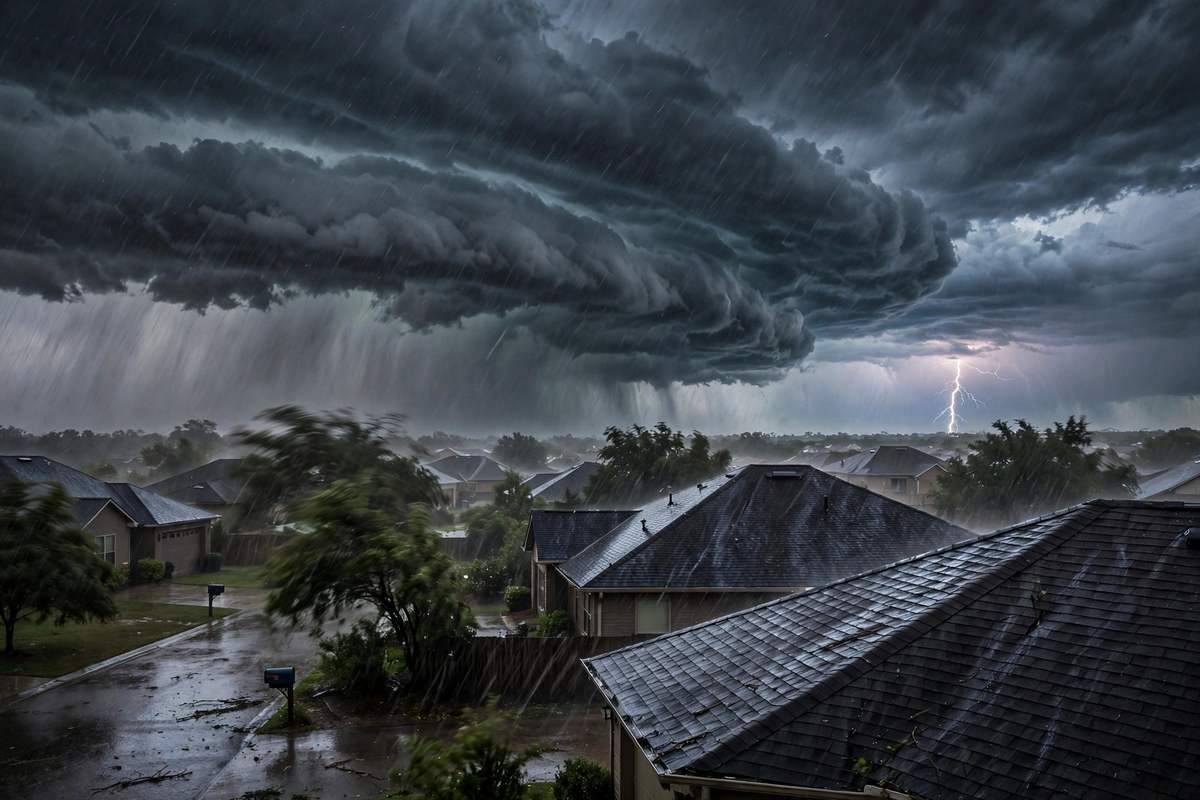
Texas weather
A reader in Austin once asked, on a public question board, what to do if a roof starts leaking during an Austin thunderstorm. The answers there were thin, so here is the full one, because a Texas thunderstorm is its own kind of emergency, with its own rules.
A Texas cell does not arrive like ordinary rain. It arrives sideways. Wind pushes water under laps, up under flashing, and into joints that falling rain never tests, which is why a roof can be sound through a dozen soft rains and leak hard in one named storm. Add hail: Austin has recorded 59 hail days since 2010, within fifteen miles of the city centre, and Dallas has recorded 91, San Antonio 63 and Plano 113. This is Hail Alley. The storm is not an accident here. It is a season.
During the storm itself, the rules tighten. Nobody goes on the roof while lightning is anywhere in the county, ours included. Nobody goes on the roof in the hard wind at the front of the cell. If your leak starts mid-storm, your whole job is the indoor first hour: power, buckets, the bulge rule, photos, and the call. Crews stage during the storm and roll when the cell passes, and a crew that promises to climb during lightning is a crew to avoid, not to hire. So if you are asking what is an emergency roof repair while the cell is still overhead, the honest answer is: only the indoor half of it, until the sky clears.
Watch for the thunderstorm-specific signs. Water coming in at a wall top or a window head during sideways rain points at edges and joints, not the open field. A drip that starts exactly when the wind peaks and stops when it drops is wind-driven water, and it tells the tracing crew where to look. Shingles in the yard mid-storm mean the field is opening; note which side of the house they came from if you can see it from a window, and stay inside while you note it.
When the cell passes, the clock that matters starts. The first dry hour after a Texas thunderstorm is when tarps go on across the whole street, and the houses that called during the storm are the houses at the front of the line. This is the practical reason to call from the bucket stage instead of waiting for a dry roof and a calm mind: in storm season, the order of calls is the order of visits.
And one Texas habit to unlearn: after the storm, the knock comes. Strangers working the street, offering to look at your roof. Some are fine. The vetting section below gives you the questions that sort them, and the storm does not change the questions. If anything, storm week is when they matter most.
Holding measures
Between the first hour and the permanent repair, something has to hold the roof. Here are the holding measures, ranked the way we rank them on real jobs, with what each one can and cannot do. Every measure below answers the same practical question that sits behind what is an emergency roof repair: what keeps the water out tonight without making the real repair harder later? None of them is the repair. All of them are bridges, and a bridge is judged by how honestly its limits are stated.
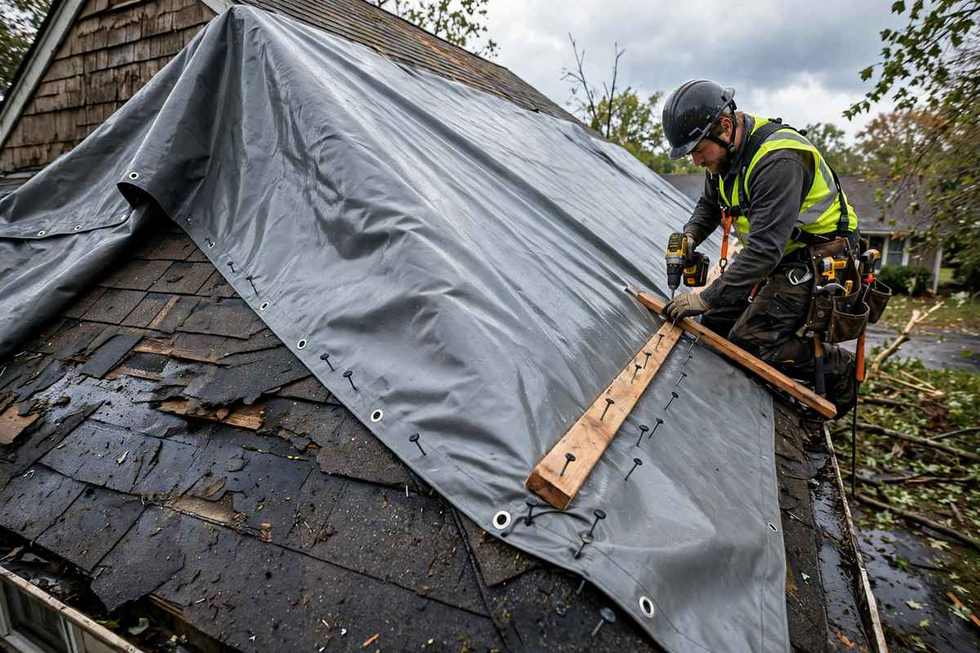
The full method lives on our tarping page, but the short version belongs here, because most emergency covers are tarps. Size it to the damage plus about four feet past it on every side, not to the whole slope. If the damage is near the ridge, carry the tarp over the peak so rain cannot run under the top edge. If the damage sits mid-slope, the better trick is to lift two courses of shingles above the damage and tuck the tarp's top edge underneath, so water runs over the sheet instead of under it. Keep it flat, with no wrinkles that can pond water. Fix the edges with boards, battens screwed down over the sheet, with cap nails where boards cannot go. Set the middle battens at a shallow angle, in a loose V, so they shed water instead of damming it. Trim the excess; loose sheeting is a trip hazard for the next person on the roof and a sail in the next wind.
A tarp fitted this way protects for about 30 to 90 days. A thin sheet, loose edges or wrinkles that hold ponds will fail in the first hard wind, and a tarp that fails at 3 a.m. is worse than a leak you were watching, because it fails all at once. If you are told a whole slope needs covering for one small hole, ask why, and ask for the photos. There are honest reasons for a big tarp, torn felt across a slope, damage scattered by wind, a seal broken across a whole field. A good crew will show you which one it is.
For a small hole, a torn patch, or the first cover over a tree hole once the limb is made safe, a sheet of roofing felt, nailed down with cap nails, is a tidy holding cover. Working roofers give felt about 3 to 4 months before it starts to tear, less in hard Texas sun. It sits flatter than a tarp, it does not flap, and for a hole of a foot or two it is often the better bridge. It is not waterproof the way a finished roof is. It is a strong pause.
For a hole of about 2 to 3 feet, a sheet of heavy plastic with its top edge tucked under a lifted shingle course, and its bottom edge weighted or nailed, sheds water surprisingly well for a few days. It is the waiting-for-the-roofer fix: quick, light, and honest about being temporary. It will not survive a wind event, and it should be replaced by felt or a fitted tarp as soon as a crew can do it.
For a small, clean hole in a shingle field, there is a neater trick the crews use: lift the shingle above the hole, slide a rigid piece of flashing or sheet metal under it so the water runs over the patch and off the roof, and fix through the patch into the deck, never through the shingle above. Done right, this is nearly a repair in its own right for a pinhole or a single puncture. Done from the ground with sealant instead, it is not. This one belongs to someone already safely on the roof, which at night means the crew.
Everything you can do from inside the house is water management, not repair: buckets, the controlled drain of a small bulge, towels, drying. Sealant pushed up from the attic, patches stuck to the ceiling, foam sprayed at the deck from below: these slow water down at best, and at worst they trap it in the decking where it rots the wood quietly and sends the drip somewhere harder to trace. Inside work is a holding step. The real fix is always on the roof, at the entry point, and any product that promises otherwise is selling the promise, not the fix.
The question boards are full of tape and spray questions, so here are the honest lifespans, the ones working roofers give when nobody is selling anything. Silicone sealant on a small gap lasts weeks before the Texas sun and movement work it loose. Butyl sealant lasts about a month in full ultraviolet before it gives up. The famous tapes and spray-on rubber coatings can hold for some months on a clean, dry, still surface, which a working roof in a storm is not, and they make the real repair harder when they fail, because the crew has to clean them off before anything proper will stick. None of this makes these products useless. It makes them what they are: days-to-weeks holding measures for small, dry, reachable spots, bought with open eyes. The myth is not that they never work. The myth is that they are repairs.
Special cases
Two parts of a roof do not take the standard tarp well, and both turn up in emergency calls often enough to earn their own section.
Water ponds on them instead of running off, so a tarp laid flat can pool, sag and hold a growing pond of its own, a pond with a lid. The temporary answer is usually a patch, not a sheet: roofing cement worked into the split, or a peel-and-stick patch pressed flat over it, edges weighted, and only in dry weather, reached from a ladder or a safe standing spot, never by walking a wet flat roof that may be soft underneath. A ponding roof also hides its hole: the drip indoors can be rooms away from the split, because the water travels under the surface before it finds a way down. Mark where the indoor drip is, and tell the crew. On a flat roof, that mark is half the search.
Where two slopes meet, water runs hard and fast, faster than anywhere else on the roof, which makes a valley leak in a storm the worst moment to attempt a fix. The temporary answer is a tarp run up the valley and over the ridge, fastened high and dry on the slopes above, never nailed into the valley itself, where every nail is a new hole in the fastest water on the roof. A valley that has opened at its seam is a daylight repair with the shingles around it lifted and reset. Anything done to it in the rain is a holding measure, and should be named as one.
Both are reminders that what is an emergency roof repair on one roof shape is the wrong fix on another. Both cases teach the same lesson the whole guide teaches: the temporary fix has to match the shape of the roof, not just the size of the hole. A crew that reaches for the same sheet for every roof is fitting its habits, not your house.
Be ready
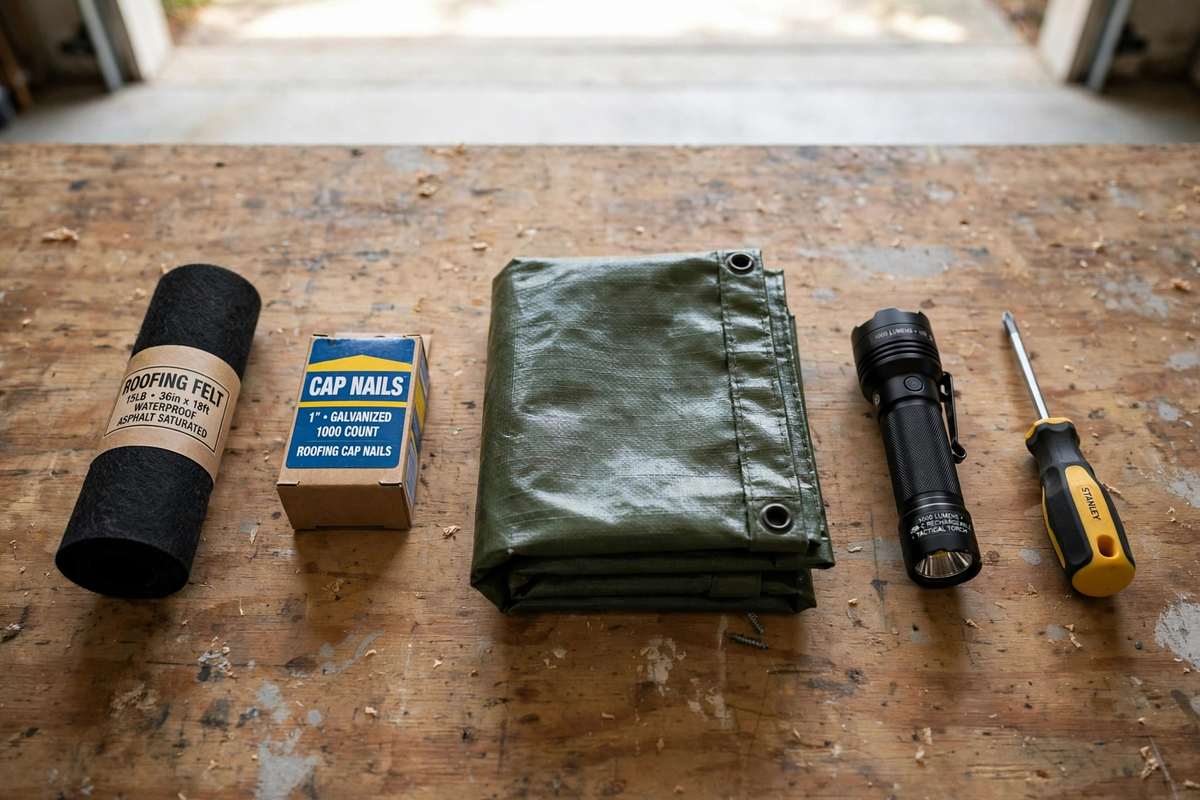
If you have trees near the house, and in most Texas towns you do, there is a small kit worth keeping in the garage. It comes from working roofers' own advice, and it turns a bad night into a handled one.
The first cover for a small hole, lighter and flatter than a tarp, and the sheet a crew will reach for first on a clean break.
Cap nails, the ones with the wide plastic or metal caps, hold felt and sheeting without tearing through it the way a bare nail head does in wind.
Not for you to fit in a storm. For the crew to fit, if theirs is the third roof of the night, or for a ground cover under a limb. A dry tarp in the garage beats a shredded one in the yard.
The whole indoor defence, ready instead of hunted for at 2 a.m.
Attics and breaker boxes are both dark at the exact moment you need them lit.
For the one small hole in a bulging ceiling, if your bulge passes the small-and-growing test.
(512) 555-0147. Phones die, get wet and lose signal in storms. Paper does none of those things.
The kit is not about doing the crew's job. It is about owning the first hour, which is the part of what is an emergency roof repair that belongs to the house, not the roof. Everything on this list together takes one shelf in the garage. The first time it earns the shelf is usually the same night you learn why it is there.
Tree down
A fallen tree is the emergency that most changes the order of work, so here is the sequence, in order, the way the crews run it.
First: look for power lines, before anything else. A tree that comes down on a house often comes down across lines on its way. If a line is down, touching the tree, the roof or the ground anywhere near them, nobody goes near the tree at all, and the first call is to the power company and, if there is sparking or fire risk, to emergency services. A roof can wait a night. A live line cannot be part of anyone's evening. Check from a doorway or a window. Do not walk the yard in the dark looking for it.
Second: empty the room under the tree. The tree is a load on a broken structure. Until someone qualified has judged it, the room below is closed, door shut, people and pets out. Ceilings under a resting tree can hold for hours and then give. Treat the space the way you would treat the wide-sag ceiling: as a room that is politely warning you.
Third: do not cut the limbs that are holding the tree up. This is the mistake that hurts people. A fallen tree is a structure under tension: some limbs are props, some are springs, and cutting the wrong one rolls the trunk or fires a limb back at the saw. Homeowners with chainsaws do real damage here every storm season. Clear only what is loose and on the ground, if anything, and leave every cut on the roof itself to people who read load for a living.
Fourth: clear only enough to see the damage. Once the tree crew has made the trunk safe, the roofing work starts with seeing: what is broken, what is only bent, where the deck is open. Photos from the ground and from a ladder, then the first cover.
Fifth: felt is the first cover. Over a tree hole, a sheet of felt paper, cap-nailed down, is usually the first weather-tight layer, because it sits flat over splintered edges where a tarp would bridge and tear. The fuller cover and the repair follow in daylight, once the deck can be judged properly.
The sequence is the lesson: power, people, load, look, cover. A tree on the roof is the clearest case of what is an emergency roof repair not being a race. It is a queue, and the roof is fourth in it.
The honesty check
After every big Texas storm comes the knock: someone who is working just down the street and would love a look at your roof. Some of them are fine. Some find damage that was never there. You do not have to guess which kind is standing at your door, or which kind answered your call. Vetting gets easier once you know what is an emergency roof repair actually involves, because you can hear whether the person at the door is describing that job or a different one. Ask these questions before anyone climbs.
Then the red flags, the short list that working roofers themselves publish: not local and gone by winter; pressure to sign within minutes; a special that expires at midnight; a pitch that leads with giveaways in the first minute; no written scope, just a handshake and a start date. And the proof that answers all of it: a physical local address, a few jobs finished in the last six months that you can ask about, and a written scope tied to one specific failure, given before any work starts.
Texas makes this check more important, not less. Texas has no state licence for roofers, so there is no licence number to look up, no badge that settles the question. A card and a truck prove nothing after a storm. What proves a roofer here is local, checkable and calm: an address, recent work, photos, plain answers.
One more question belongs on the list, and homeowners ask it on the question boards more than roofers expect: who is responsible for safety on my roof? Falls are the standing risk of this trade, and a proper crew treats them that way: harnesses and anchors on steep slopes, ladders tied off, nobody up in lightning or on a wet surface that cannot be read. Ask how the crew works, and listen for gear and rules, not bravado. A crew that is careful with its own people on your roof is a crew that will be careful with your roof. That, too, is part of judging what is an emergency roof repair service worth having: the safe crew and the honest crew are usually the same crew.
The decision window
There is a saying in this trade that the first 24 to 72 hours after a storm decide whether a roof needs a simple repair or something much bigger. It is not quite magic, and it is worth understanding what it really means, because it tells you when to make decisions and when to refuse to. It also settles a common confusion about what is an emergency roof repair means by urgent: the response is urgent. The verdict is not.
In the first hours, everything is wet, dark and partly hidden. A crew can stop water and read the obvious damage, but wet shingles hide bruising, swollen boards hide cracks, and a roof in the rain cannot be judged fairly by anyone. By the second or third day, the roof is dry, the light is honest, and the full check can happen: slopes walked, seals tested by hand, boots and flashing inspected one by one, the attic read for the water's whole path. That dry check is where the truth of the roof lives.
So the repair or replacement question belongs to the window, not to the doorstep in the rain. The things that decide it are plain once the roof is dry. The age of the roof and the state of its surface: brittle shingles that crack when lifted cannot be patched neatly, and a young roof with one failed part is a repair all day long. The spread of the damage: one slope torn by wind is a repair; three slopes bruised by hail with seals gone across the field is a different conversation. And the history: a roof that has leaked in four places in two years is telling you something a roof with its first leak is not.
A crew that pushes the big decision into the first hour, in the rain, with a deadline attached, is using the window backwards. The emergency is urgent. The decision is not, and the 24 to 72 hours exist precisely so the decision can be made dry, in daylight, with photos. That is what is an emergency roof repair done properly: fast hands, slow verdicts.
What you should have by the end of the window: a roof that is not letting water in, photos of everything that was found, and a written scope for the permanent work, tied to the specific parts that failed. If any of those three is missing, ask for it before anything else is booked.
After the water stops
Once the water is stopped, the clock that matters moves indoors. Wet carpet, insulation and plaster should start drying within 24 to 48 hours, or mould takes hold where you cannot see it. This is the step homeowners skip because the drama feels over, and it is the step that decides whether the emergency stays a roof story or becomes a health story. Drying is the part of what is an emergency roof repair that nobody photographs, and it decides more than most of the parts that do get photographed.
The method is plain. Open windows when the weather allows. Run fans toward the wet patch, not away from it. Lift anything that traps damp against a wall: boxes, rugs, the backs of cupboards pushed tight to wet plaster. In the attic, if you can look safely from the hatch, wet insulation that is flat and dark needs air and time; insulation that stays soaked needs to come out, and that is a daylight job to raise with the crew.
Last, leave the ceiling stain alone and keep an eye on it. As a fixed leak dries, the mark holds its size and the edges turn pale and powdery. Trouble looks different: the mark spreads, goes darker, or shows up again after the next rain. Any of those means water is still getting in, and the answer is a call back to the crew, not a coat of paint. Paint seals the evidence away while the leak keeps working above it. Let three solid storms pass with the mark dry and unchanged, and then it is safe to paint.
About a week later, once the roof has had a day or two of dry weather, open the attic hatch, put your head in and just breathe. An attic that is drying out smells of warm wood and dust. One holding trapped damp smells sweet and musty, and that smell is water still sitting somewhere it has no business being. You do not have to climb in or touch a thing. The smell on its own is reason enough to call. Damp caught in the first week is a drying job. Damp found in month three can mean opening the ceiling.
Go deeper
This guide is the map of the first day. Three parts of it have their own full pages, written for the moment you are standing in. Each of the three pages below takes one part of what is an emergency roof repair and goes all the way down into it.
The storm did more than start a leak: wind, hail or a fallen limb, and a whole roof to check slope by slope. The storm page runs the full check and the Texas hail numbers.
The cover itself, in full: sizing, the over-the-peak and tuck-under methods, battens, lifespan, and how to tell a right-sized tarp from a padded one.
The stain is not under the hole. The leak page teaches the full tracing method, the attic signs, the timing patterns and the two-person hose test.
And if you are reading this with water coming in, the guide can wait. Call (512) 555-0147. A roofer answers day and night, and the first thing we will do is run the same test this page teaches: is this an emergency, and what happens first.
Questions
No sales talk. The questions this guide exists to answer, in the order people ask them at 2 a.m.:
It is the same-day work that stops water getting into a house through a damaged roof: the open spot covered, the leak traced and sealed, the house made safe. The lasting fix follows once the roof is dry and checked. A dry old stain, with no drip, is a repair job, not an emergency.
Stay calm and work indoors. Kill the power if water is near lights or sockets. Put a bucket under the drip, drain a small bulging ceiling into it, and empty the room under a wide sagging one. Take photos, move what water ruins, then call a roofer. Never climb at night.
Catch the water and make the room safe before anything else. Bucket under the drip, towels down, furniture and electronics moved clear. If the ceiling bulges, drain a small one with one hole and a bucket, or empty the room under a wide one. Then photos, then the phone call.
Phone a roofer from your area, one who handles emergency callouts and traces leaks to their source, rather than a handyman. Before you agree to anything, ask two things: will you find where the water gets in before sealing anything, and will you photograph the damage? Texas does not licence roofers statewide, so local proof counts for a lot.
Treat it as one whenever water is on the move: dripping steadily, creeping across the ceiling, or gathering above it. Water anywhere near light fittings or wiring makes it more serious still. An old, dry stain that has not changed in months matters, but it can normally wait for a daytime visit. Movement is what makes the difference.
From inside, you cannot fix it, only manage it: bucket, drain the bulge, dry the room. On the roof, the holding fixes are a fitted tarp, a felt sheet over a small break, or plastic tucked under a shingle, each with honest limits. All of them are bridges to the real repair.
No. Anything you smear on from the attic side, or patch over on the ceiling, buys time at best. Worse, it can hold water in the decking, rotting timber out of sight. Indoor work only limits the harm: catch the drips, drain any bulge, dry everything out. The lasting fix is made on the roof, where the water gets in.
Only if the bulge is small and still growing: bucket under the lowest point, one small hole, let it drain in a stream you control. If the bulge is wide, the ceiling is sagging, or cracks are spreading, do not touch it. Empty the room and close the door instead.
Plan on 30 to 90 days for a well fitted tarp, less for a thin sheet in Texas sun. Sun breaks the material down, wind works the edges loose, and wrinkles start holding water instead of shedding it. If the permanent repair will take longer, have the tarp checked and refitted first.
The emergency part, yes: stopping the water, covering the damage and making the roof safe is usually one visit. The permanent repair depends on what the dry check finds. A small leak fix is often finished the same day. Bigger damage is made weather-tight first, then repaired once everything is dry.
Check what is under it. If the felt below is whole and no water is getting in, it can usually wait for a dry morning booking. If the boards show, the felt is torn, or rain is due, treat it as urgent and call. Photograph the spot and the shingle itself.
Start within 24 to 48 hours of the water stopping. Fans on the wet patch, windows open when the weather allows, anything trapping damp lifted away from walls. Wet insulation and plaster left alone grow mould where you cannot see it. Drying early is the easiest step in the whole emergency.
The first hour protects the inside of the house. The first visit stops the water and proves the damage with photos. Then, on a dry roof in daylight, the real check happens and the permanent repair is scoped in writing. That window, not the first panicked hour, is when repair or replacement gets decided.
Water does not wait, and neither should you.
You now know what is an emergency roof repair, what to do in the first hour, and how to judge the crew that answers. If your roof is in trouble tonight, make the call and let the steps start.
(512) 555-0147